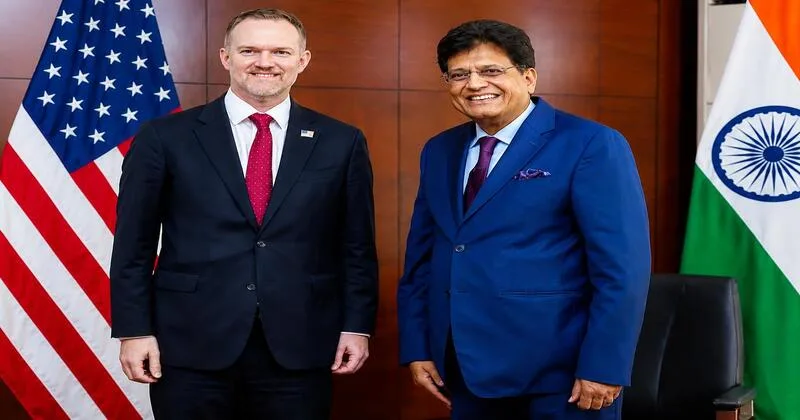
New Delhi: The first phase of the proposed India–United States bilateral trade agreement (BTA) has moved into its final stage, with United States Trade Representative (USTR) Jamieson Greer scheduled to visit New Delhi on June 23-24 for high-level talks with Commerce and Industry Minister Piyush Goyal. The two-day engagement is expected to focus on giving final shape to the framework of an interim trade deal while advancing negotiations on the broader bilateral trade agreement between the two countries.
Commerce Secretary Rajesh Agarwal said on 22 June that Ambassador Greer’s visit would be centred on finalising the framework agreement that was discussed during the visit of a US trade delegation to India in the first week of June. “USTR, as of now, is scheduled to visit India. On 23-24th, he will be engaging with Commerce Minister Piyush Goyal. Our expectation is that the discussion will be centred around giving final touches to the framework deal, which was discussed during the US team’s visit during the first week of June, and also on the larger bilateral trade agreement (BTA) being discussed between the two countries,” Agarwal said.
Commerce Minister Piyush Goyal also confirmed the visit while speaking to reporters in Mumbai. “For the US trade deal talks, tomorrow my counterpart is coming to Delhi,” Goyal said. The visit comes amid growing optimism in both capitals that an interim trade agreement can be concluded soon, paving the way for a comprehensive bilateral trade pact.
High-level engagements push negotiations forward
The upcoming discussions follow a series of intensive engagements between officials of the two countries. Assistant USTR Brendan Lynch visited New Delhi from June 1 to 4 to advance negotiations on the proposed trade arrangement. On June 5, Goyal had stated that India and the United States were moving towards closing all open issues in the interim trade agreement and indicated that both sides were likely to execute the “very, very vibrant” first phase of the BTA by the middle of next month.
The trade agreement was also a key topic during the meeting between Prime Minister Narendra Modi and US President Donald Trump on the sidelines of the G7 Summit in Evian, France.
According to Foreign Secretary Vikram Misri, the proposed trade pact figured prominently in the discussions between the two leaders, who instructed officials from both countries to complete the agreement at the earliest possible date.
Speaking at a media briefing after the summit on June 18, Misri said India and the United States had already achieved significant progress in negotiations. “With the United States, we have made significant progress already on the conclusion of an interim free trade bilateral trade agreement”, Misri said. “We are in the final stages of concluding that agreement”.
This week, Ambassador Greer will travel to India to meet with Union Minister Piyush Goyal and other senior Indian officials to discuss the historic U.S.–India Joint Statement and the Interim Agreement as part of the broader U.S.-India Bilateral Trade Agreement negotiations:… pic.twitter.com/s0HzXybbgO
— ANI (@ANI) June 22, 2026
He added that Ambassador Greer’s visit would help carry the negotiations forward. “Next week in fact the United States trade representative Mr Jamieson Greer will be visiting India to take forward these discussions. In the bilateral meeting between Prime Minister and President Donald Trump yesterday in Evian, this was a major subject of discussion. Both leaders once again gave instructions for this agreement to be concluded at the earliest possible”.
Misri reiterated that substantial progress had already been achieved and that the negotiations were now approaching their final phase.
President Trump also struck an optimistic note after meeting Prime Minister Modi. “We had, in particular, some very good conversations with Prime Minister Modi, India. And we’re doing trade deals, we’re doing a lot of things, a lot of things are happening between the United States and India,” Trump said. He further remarked that the two countries were “very close” to finalising the trade agreement.
Tariff issues and pending concerns
Despite the positive momentum, some issues remain under discussion. On June 20, Goyal indicated that recent investigations and fresh tariff announcements by the United States had contributed to delays in concluding the agreement. “We cannot implement the FTA until we secure a competitive advantage”, Goyal said. “The issue currently pending is that our duties need to be lower compared to those of competing nations; once this is settled, the trade agreement will be implemented”.
In March, the Office of the United States Trade Representative launched two unilateral Section 301 investigations under the Trade Act of 1974 involving several countries, including India. The investigations relate to allegation over excess industrial capacity and alleged failures to eradicate forced labour in global supply chains. Subsequently, on June 2, the USTR proposed imposing tariffs of 12.5 per cent on imports from 54 countries, including India, citing allegation regarding the prohibition of goods allegedly produced through forced labour.
This week, Ambassador Greer will travel to India to meet with Minister @PiyushGoyal and other senior Indian officials to discuss the historic U.S.–India Joint Statement and the Interim Agreement as part of the broader U.S.-India Bilateral Trade Agreement negotiations.
Following…
— United States Trade Representative (@USTradeRep) June 21, 2026
Indian negotiators have continued discussions with their American counterparts while seeking terms that would provide competitive market access and ensure parity with other trading partners. Commerce Secretary Rajesh Agarwal recently stated that the ministerial discussions during Greer’s visit are expected to focus on providing final touches to the framework agreement and addressing outstanding issues.
The broader objective remains the conclusion of a mutually beneficial bilateral trade arrangement that expands trade opportunities and strengthens economic cooperation between the world’s largest and fifth-largest economies.
US signals confidence ahead of New Delhi talks
Ahead of the visit, US Ambassador to India Sergio Gor expressed confidence regarding the progress of negotiations.
In a post on X on June 22, Gor said he was looking forward to welcoming Ambassador Greer to New Delhi for multiple rounds of discussions with Minister Piyush Goyal and other senior Indian officials. “Looking forward to welcoming Ambassador Greer @USTradeRep to New Delhi! Multiple sessions scheduled with Minister @Piyush Goyal to advance the U.S.-India trade deal!,” he wrote.
According to a USTR release, the meetings in New Delhi will focus on the United States–India Joint Statement and an Interim Agreement, both of which form part of the wider bilateral trade negotiations launched by President Donald J. Trump and Prime Minister Narendra Modi on February 13, 2025.
The release stated that Greer’s discussions in India will be aimed at advancing efforts toward fair, balanced and reciprocal trade between the two countries.
Looking forward to welcoming Ambassador Greer @USTradeRep to New Delhi! Multiple sessions scheduled with Minister @PiyushGoyal to advance the U.S.-India trade deal!
— Ambassador Sergio Gor (@USAmbIndia) June 22, 2026
Following his engagements in New Delhi, Ambassador Greer is scheduled to travel to Tashkent, Uzbekistan, where he will meet President Shavkat Mirziyoyev, Head of the Presidential Administration Saida Mirziyoyeva, and Deputy Prime Minister Jamshid Khodjaev. The USTR said Ambassador Greer would use these international engagements to discuss trade relations and opportunities for achieving balanced and reciprocal economic partnerships with the United States.
With senior leadership in both New Delhi and Washington pushing for an early conclusion, the June 23-24 meetings are expected to play a decisive role in finalising the framework of the interim agreement and setting the stage for the broader India–US Bilateral Trade Agreement. The latest round of negotiations reflects the growing strategic and economic partnership between the two democracies, with both governments seeking to deepen trade ties and unlock new avenues of cooperation through an ambitious and comprehensive trade framework.