Highlighting the nation’s defense achievements on the social media platform ‘X’, Prime Minister Narendra Modi stated that India has made remarkable progress in air, land and maritime security over the past 12 years. Indigenous fighter jets, missile systems, warships, submarines and record defense production levels stand as proof that India is rapidly advancing towards self-reliance in the defense sector. This journey is also laying a strong foundation to transform the country into a global defense manufacturing hub.
Over the last decade, India’s defense policy has shifted rapidly from mere weapon procurement to prioritizing indigenous manufacturing and technological self-reliance. Initiatives like ‘Make in India’ and ‘Atmanirbhar Bharat’ have been effectively implemented in the defense sector. Consequently, despite remaining one of the world’s major defense importers, India has achieved significant success in strengthening its domestic defense industry.
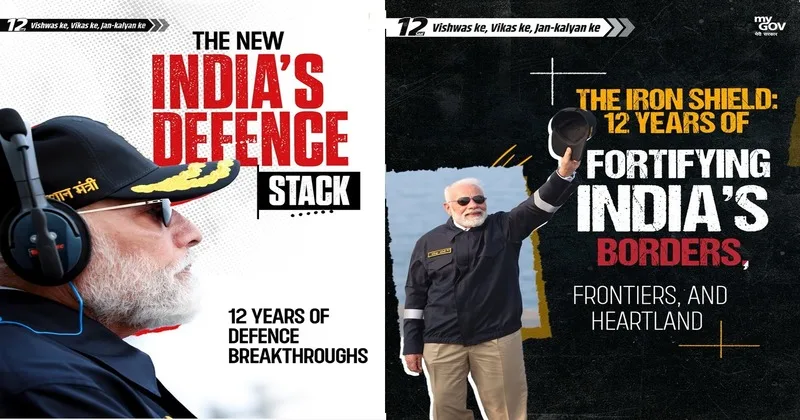
According to information shared by “MyGov India,” India has consistently invested in building defense capabilities, technological development and military modernization. This is why the country is today scaling new heights in the production of indigenous fighter jets, missile systems, warships and submarines.
India’s defence capabilities have witnessed significant transformation over the last decade, guided by the vision of self-reliance and powered by innovation, technology and indigenous manufacturing. This thread gives a glimpse of the strides India has made in the defence sector… https://t.co/FPCjacoX34
— Narendra Modi (@narendramodi) June 17, 2026
Tejas: The New Identity of Indian Skies
The indigenous fighter jet ‘Tejas’ stands out as a key element of the Indian Air Force’s strength. Developed by Hindustan Aeronautics Limited (HAL), this aircraft has become a symbol of India’s aerospace prowess and technological self-reliance. Tejas has proven that India is capable of not only designing modern fighter jets but also successfully manufacturing them. With the induction of the Tejas Mk-1A and rapid progress on the Mk-2 project, the country is developing a robust indigenous combat aviation ecosystem. Alongside this, the C-295 transport aircraft program is also opening doors to new opportunities in India’s aerospace sector.
Self-Reliant India in Missile Power
Indigenous missile technology forms a major pillar of India’s strategic strength. Missile systems such as BrahMos, Astra, Rudram and Akash have become the backbone of the Indian defense apparatus today. The Akash missile system is a vital component of India’s air defense network; its advanced variant, ‘Akash-NG’, is equipped with faster response capabilities, superior tracking, and modern technology to neutralize hostile aerial threats. Meanwhile, the air-to-air Astra missile and the anti-radiation Rudram missile have established India’s indigenous technological prowess on the global stage.
Pinaka and Agni-V: Expanding Strategic Might
The Pinaka multi-barrel rocket launcher system has played a pivotal role in the modernization of the Indian Army’s artillery. Its mobility, precision, and indigenous design have significantly enhanced the Army’s strike capabilities on the battlefield. On the other hand, the Agni-V missile has bolstered India’s strategic deterrence. Capable of striking over long ranges, this missile holds a crucial place in India’s security policy and elevates the nation’s strategic standing globally.
This thread explains how India has strengthened its defence capabilities across air, land and sea, advanced indigenous technologies and built a stronger foundation for self-reliance and national security.#12YearsOfSurakshitBharat https://t.co/vbISH1cTc1
— Narendra Modi (@narendramodi) June 17, 2026
Growing Strength in Maritime Security
Amidst rising strategic challenges in the Indian Ocean region, the Indian Navy has undergone rapid modernization. The indigenous aircraft carrier INS Vikrant and the nuclear-powered submarine INS Arihant represent historic milestones in this journey. INS Vikrant stands as a symbol of India’s shipbuilding capabilities and technical expertise, while INS Arihant has equipped the nation with a vital pillar of nuclear deterrence.
Furthermore, the Project-17A stealth frigates, Project-15B destroyers and Kalvari-class submarines are providing the Indian Navy with modern combat capabilities. These projects have made India significantly more self-reliant and capable in the realm of maritime security. Record Growth in Defence Production
The most significant evidence of military modernization is reflected in defence production figures. In the 2025-26 financial year, India’s total defence production reached a record level of Rs 1.78 lakh crore. This represents a 15.6 percent increase compared to the Rs 1.54 lakh crore recorded in the previous financial year (2024-25). This achievement appears even more remarkable when viewed against data from earlier years; defence production stood at Rs 84,643 crore in 2020-21, whereas it was merely Rs 43,746 crore in 2013-14. In other words, indigenous defence production has quadrupled over the span of approximately a decade.
Private Sector Emerges as a New Partner in Transformation
Private sector participation in the defence industry is steadily rising. In the 2025-26 financial year, the private sector’s share of total defence production rose to 24 percent, up from 22 percent the previous year. In terms of value, the private sector’s contribution reached approximately ₹42,000 crore, an all-time high. This indicates that the Indian private industry has begun to play a pivotal role in defence manufacturing. Although Defence Public Sector Undertakings (DPSUs) and other government institutions still account for approximately 76 percent of total production, the growing involvement of the private sector is viewed as a positive sign for the future.
Defence Exports Open Up Global Markets
The impact of India’s defense capabilities is now becoming evident in global markets. In the 2025-26 fiscal year, defense exports surged to a record ₹38,424 crore. Indian defense products are now regarded as competitive and reliable on the international stage. From missile systems like BrahMos to various other defense equipment, the demand for Indian products is steadily rising.
Defense Minister Rajnath Singh has attributed this achievement to the expanded defense industrial base developed under the leadership of Prime Minister Narendra Modi. He believes that the sector will grow even faster in the coming years, driven by the government’s policy support, increasing private sector participation and the expansion of export capabilities.
Under the inspiring leadership of PM Shri @narendramodi, India’s defence production is reaching new heights every year. I am delighted to inform everyone that India’s annual defence production has surged to an all-time high of Rs 1.78 lakh crore in the Financial Year (FY)…
— Rajnath Singh (@rajnathsingh) June 17, 2026
Reflecting on the defense sector’s success, it is evident that over the past 12 years, India’s defense narrative has evolved beyond mere achievements in weaponry and military platforms; it has become a symbol of confidence, self-reliance and national resolve. From Tejas to Vikrant, Agni-V to BrahMos, and from record production to soaring exports, every milestone conveys a clear message: India is emerging not merely as a consumer in the defense sector, but as a manufacturer and exporter. This transformation could well prove to be a solid foundation for establishing India as a global defense power in the years ahead.