For decades, Purvanchal, the eastern part of Uttar Pradesh, covering Gorakhpur, Varanasi, Azamgarh, Mau, Ghazipur and their neighbouring districts, sat at the bottom of every development index the state produced. A state planning department analysis drawn from census data suggests that western UP recorded the highest number of registered factories at 12.74 per lakh population, followed by central UP at 7.17, while the east trailed far behind. The story of the last eight years shows how a double-engine government, the same party in power at the Centre and in Lucknow, set about closing that gap with capital, policy and follow-through.
The Samajwadi inheritance: Summits that evaporated
To understand the degree of progress, one must measure the baseline w.r.t previous government. The Akhilesh Yadav government, in office from 15 March 2012 to 19 March 2017, with the Chief Minister himself holding the Industrial Development portfolio, made its pitch to investors through summits and memoranda. The problem was not the announcements; it was what happened after them.
Independent scrutiny of that period tells the tale. Of the investment pledges announced under the SP government, follow-up reports, including CAG assessments and independent analysis, found that actual investment and implementation were a fraction of what had been promised. The economic landscape inherited in 2017 was defined by stalled industrial estates, investor summits where pledges evaporated into the air, rural power cuts running up to 18 hours and a GDP that limped along without structural acceleration.
The institutional environment compounded the failure. Under the SP government, UP was consistently ranked in the bottom quartile of Indian states on business environment parameters, investors spoke privately of being asked for bribes at every stage of clearance, and the administration was structurally hostile to capital. The power sector, the lifeblood of any factory, was crippled, with state distribution companies carrying debt exceeding Rs 70,000 crore, making fresh investment in generation and supply politically difficult.
For Purvanchal, the region furthest from the western industrial heartland, these failures landed hardest. There was no signature export programme such as the One District One Product concept, which would later transform UP artisanal and manufacturing clusters.
Nowhere was the gap between intent and execution clearer than on the Purvanchal Expressway, the project meant to unlock the region. The record shows that a tender for the expressway was issued when less than 25 % of the required land had been acquired, against the standard expectation that at least 90 % be secured before tendering such a large engineering procurement and construction contract. A road tendered without land is a road that does not get built, and its incomplete state through 2017 left Purvanchal’s industrial ambitions without their most basic enabler.
The double-engine pivot: Law, land and logistics
The double-engine government’s first contribution to Purvanchal was not a factory; it was an environment in which factories could exist. The region’s reputation had long deterred capital. According to one account, Purvanchal was once perceived as a region plagued by crime and mafia dominance, but it has improved law and order under the Yogi Adityanath government, which opened the door to new industrial opportunities. For investors weighing where to commit hundreds of crores, the security of plant, personnel and supply chain is not a soft factor; it is the precondition the previous regime never met.
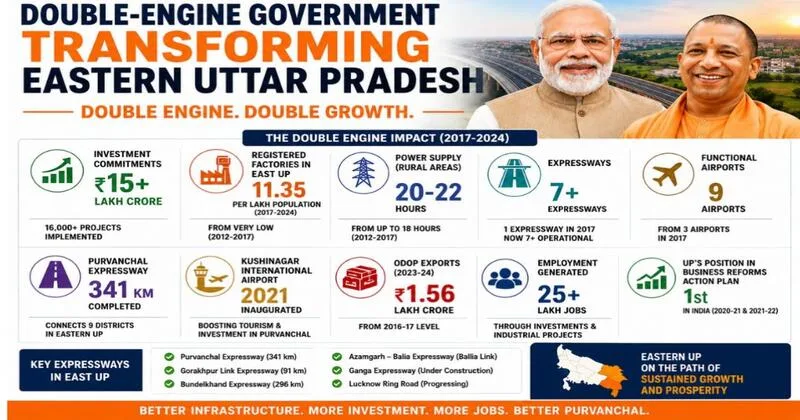
On that foundation came infrastructure at a scale the earlier era never approached. UP, which had one expressway in 2017, now has more expressway kilometres than any other Indian state, with the 341-km Purvanchal Expressway and the Gorakhpur Link Expressway among the corridors completed or substantially advanced.
The completed Purvanchal Expressway now connects nine districts of eastern UP— Lucknow, Barabanki, Amethi, Sultanpur, Ayodhya, Ambedkarnagar, Azamgarh, Mau and Ghazipur. Air connectivity expanded in parallel. UP moved from three functional airports in 2017 to nine by 2024, with the Kushinagar International Airport in Purvanchal inaugurated in 2021 to link the Buddhist pilgrimage circuit to the world. Where the SP era left one expressway tendered on un-acquired land, the double-engine era delivered a completed corridor and a working airport in the same region.
This matters for the industry because logistics cost is the silent tax on eastern UP manufacturing. An expressway cutting the Lucknow-to-Ghazipur journey, an airport moving high-value goods and an industrial belt planned along the new corridors together change the unit economics of locating a plant in Purvanchal rather than in the long-favoured west.
The number comparison that distinguish the two eras
The measure of the double-engine difference is the conversion of intent into operational capacity. Across the state, four Ground Breaking Ceremonies have implemented more than 16,000 projects involving investment of over Rs 15 lakh crore, and of these, more than 8,300 projects have already begun commercial operations, generating employment for lakhs of youth. The contrast with the previous era’s evaporated pledges is the entire argument; these projects are running on the ground, and more than half have already crossed into commercial production.
The structural rebalancing toward the east is deliberate and quantified. At GBC 4.0 alone, an estimated Rs 10 lakh crore in projects, 29 per cent of investment was directed towards Purvanchal, second only to the western region, against 14 per cent for Madhyachal and 5 per cent for Bundelkhand. For a region that historically captured a marginal share of state industrial investment, a near-third allocation represents a structural correction rather than a token gesture. As the government’s own framing puts it, the establishment of industrial parks in Bundelkhand, Purvanchal and the Terai proves the development model is not limited to western UP and industrialisation with regional balance, for the first time since 2017, has become a reality.
Where earlier policy concentrated on a handful of favoured industries, the current approach has given equal encouragement to diverse sectors of semiconductors, textiles, leather, food processing, plastics, perfume, pharma and electronics, connecting small and medium investors to the mainstream through PM Mitra textile parks, mega leather clusters, food parks and the flatted-factory model.
ODOP: The export engine the SP years lacked
If one programme captures the policy gap between the two eras, it is One District One Product. Launched on 24 January 2018, the scheme assigned each of UP’s 75 districts a signature product for focused promotion, later being extended nationwide by the Centre. Its impact on exports is measurable, with the total value of ODOP product exports from the state rising from Rs 58,000 crore in 2017-18, on the eve of the scheme launch, to Rs 96,000 crore in 2021-22, an increase of Rs 38,000 crore in four years.
In Purvanchal, the regional signature crafts of Varanasi silk and brassware precisely form the GI clusters that the earlier policy left unbranded and disconnected from formal markets. ODOP linked artisans to formal supply chains, e-commerce platforms and export markets, identifying signature products such as Varanasi silk and Agra leather and quietly changing the livelihoods of millions. The MSME base that this rests on, over 1.3 crore units, is the backbone of UP employment, and has received little coherent policy support under the SP government.
Gorakhpur and Varanasi: The Purvanchal case study
If one institution captures the regional shift, it is the Gorakhpur Industrial Development Authority. Over the past eight years, GIDA has transformed into one of Purvanchal’s most dynamic centres of manufacturing, investment and employment generation, its industrial footprint steadily expanding as new enterprises take shape. The hard figures from its 36th Foundation Day make the concrete base with GIDA allotted 116 industrial plots across 8,71,841 square metres, corresponding to a proposed investment of approximately Rs 6,139 crore and the creation of 11,072 new jobs. In the same cycle, 38 new units carrying Rs 134.15 crore in investment had their foundation stones laid, while 33 units developed with Rs 123.82 crore were inaugurated, together generating more than 2,700 employment opportunities.
Varanasi tells a complementary story of readiness rather than rhetoric. For the upcoming Ground Breaking Ceremony, the government set a Rs 6,000 crore investment target for the district, of which Rs 3,944 crore, over 60 per cent, was already ready for implementation, with the proposed projects expected to employ more than 2,400 people. A 60 per cent implementation-readiness figure before the ceremony even begins is the precise inversion of the SP model, where announcements ran far ahead of any execution.
Mirzapur and Sonbhadra: The most striking reversal
If any districts measure the distance travelled, they are Mirzapur and Sonbhadra, long synonymous with backwardness and in the Sonbhadra case, insurgency was a key issue. Today, the Mirzapur division leads the entire state. Across its three districts, Mirzapur, Sonbhadra and Bhadohi, a total investment of Rs 86,000 crore has been made, placing the division first among all 75 districts and 18 divisions of Uttar Pradesh. Ahead of Meerut, Jhansi, Lucknow and Moradabad.
Sonbhadra, once affected by Naxal activities and bordering Bihar, Jharkhand, Chhattisgarh and Madhya Pradesh, this mineral-rich district has, under improved law and order, connectivity, electricity and roads, surpassed even economically robust districts like Ghaziabad and Gautam Buddha Nagar (Noida) in investment terms. The district’s heaviest commitments are in power and minerals; its top five investor companies have each committed no less than Rs 13,000 crore, concentrated in thermal power and pumped-storage plants, while Mirzapur has drawn investment in the cement, ethanol and minerals sectors.
The pipeline figures sharpen the picture further. Of the Rs 1,24,389 crore investment announced for Purvanchal, the share went to three former Naxalite-affected districts: 30 projects worth Rs 54,042 crore in Sonbhadra, 46 projects worth Rs 16,161 crore in Chandauli, and 46 projects worth Rs 5,957 crore in Mirzapur. These districts are not merely receiving allocations; they are beating their earlier government records. Among the 19 UP districts that exceeded their investment targets by more than 100 per cent, Sonbhadra surpassed its target by 121 per cent, with Chandauli and Mirzapur also significantly exceeding theirs. For a belt, the SP era could neither secure nor develop; an over-fulfilled investment target is the most concrete rebuttal available.
The comparison reflects that the Samajwadi government did only a bunch of work, and the double-engine government did everything from conversion to providing direction in GDP contribution. The previous era generated pledges that independent audits found largely unrealised, tendered its flagship Purvanchal corridor without the land to build it, ran a power network buried under Rs 70,000 crore of distribution debt and left the east with the lowest factory density in the state and no export programme to speak of.
The double-engine government record is defined by the opposite metrics, where thousands of projects moved from memorandum to commercial operation, a near-third of fresh state investment deliberately routed to Purvanchal, ODOP exports up Rs 38,000 crore, GIDA delivering plots and jobs by the thousand, and a former Naxal district in Sonbhadra now outranking Noida on investment.
For a region that spent decades as the byword for UP’s developmental lag. The shift from one expressway and evaporated summits to operating industrial parks, a completed nine-district corridor, an over-fulfilled district investment pipeline and a quantified employment record is the substance of the transformation.