
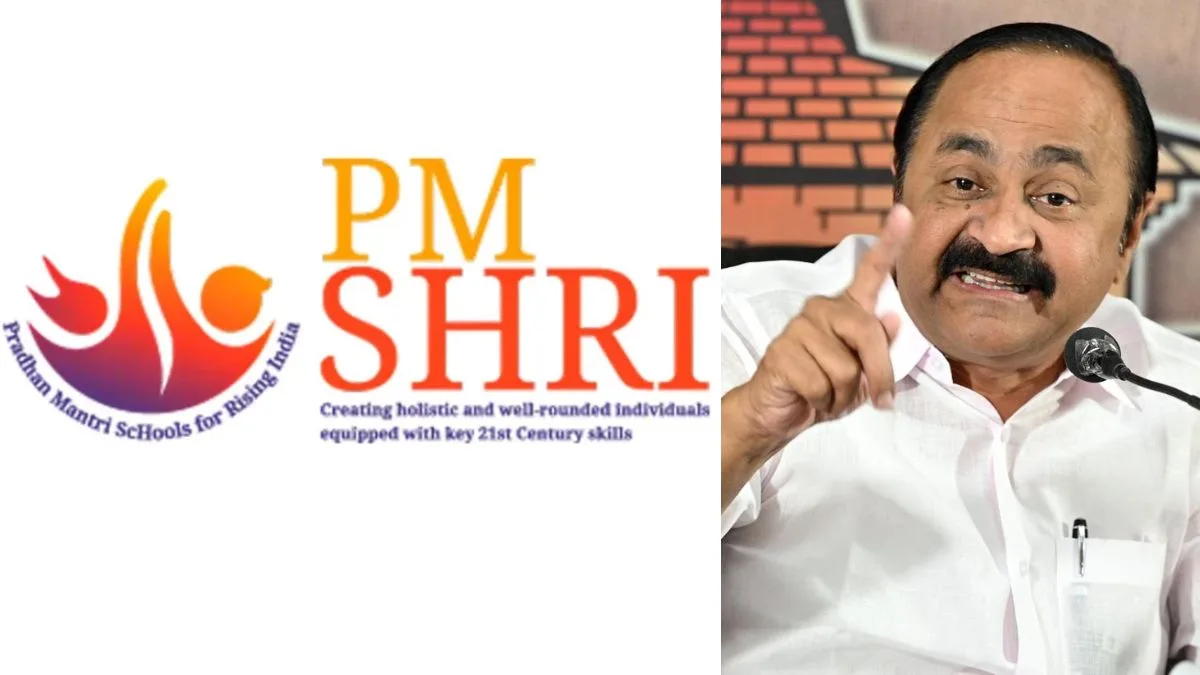
The Congress-led United Democratic Front (UDF) government of Keralam has decided to go ahead with the PM SHRI (Pradhan Mantri Schools for Rising India) scheme. Addressing a press conference on June 17, Chief Minister V.D. Satheeshan disclosed this while briefing the media on the Cabinet’s decision.
A four-member committee has been formed to conduct a detailed study of the scheme. An action plan will be decided after the committee submits its report. Ministers N. Shamsudheen, Roji M. John, P.C. Vishnunath, and M. Liju are members of the committee.
The Chief Minister said that the government would request the Union government for certain relaxations. The education minister has already submitted a status report to the Chief Minister. The report makes it clear that the freezing of the PM SHRI-related agreements by the previous Left Democratic Front (LDF) government has no legal validity. It is in this context that the government has formed a committee to study the project.
The formation of the committee is an interim relief for the government because the UDF had opposed the project tooth and nail while in the Opposition. That is why it has constituted a committee before implementing the scheme.
The Memorandum of Understanding (MoU) for the PM SHRI scheme was signed by K. Vasuki, Secretary of the General Education Department, on October 16, 2025, on behalf of the LDF government to secure Central education funds.
However, the CPI, the second-largest constituent of the LDF, later protested against the signing of the MoU without discussing it in the Cabinet or informing coalition partners. This resulted in considerable turmoil within the LDF. Subsequently, the CPM’s Education Minister stated that the government would keep the MoU on hold.
Later, Sivankutty came out with the argument that the previous Left government’s decision to sign the initial MoU was a “tactical” step taken only because the Union government had withheld educational funds, including Samagra Shiksha grants, as leverage.
The PM SHRI (Pradhan Mantri Schools for Rising India) scheme provides upgraded infrastructure, modern smart classrooms, and holistic learning environments to more than 14,500 beneficiary schools across the country. Participating institutions receive targeted grants to promote skill-based education, digital literacy, and environmentally sustainable and inclusive campuses aligned with the National Education Policy (NEP).
Schools selected under the PM SHRI programme receive several key enhancements and resources:
• Financial grants: Annual composite, library, and sports grants to upgrade and maintain facilities, procure computers, and install interactive smart panels.
• Modern infrastructure: Sustainable campus upgrades, including solar panels, LED lighting, rainwater harvesting systems, and nutrition gardens.
• Digital and smart education: Digital libraries, smart classrooms, and IT infrastructure to foster future-ready learning.
• Inclusive learning environments: Special provisions for children with special needs (CWSN), including assistive devices, ramps, and accessible facilities.
• Experiential learning: A shift from rote learning to competency-based education through coding, robotics, vocational training, hands-on workshops, and field visits.
• Safety and wellness: Self-defence training for girls, health check-ups, and psychometric assessments to support student development and career guidance.
• Mentorship and leadership: PM SHRI schools serve as mentor institutions, guiding neighbouring schools by demonstrating high-quality and inclusive educational practices.