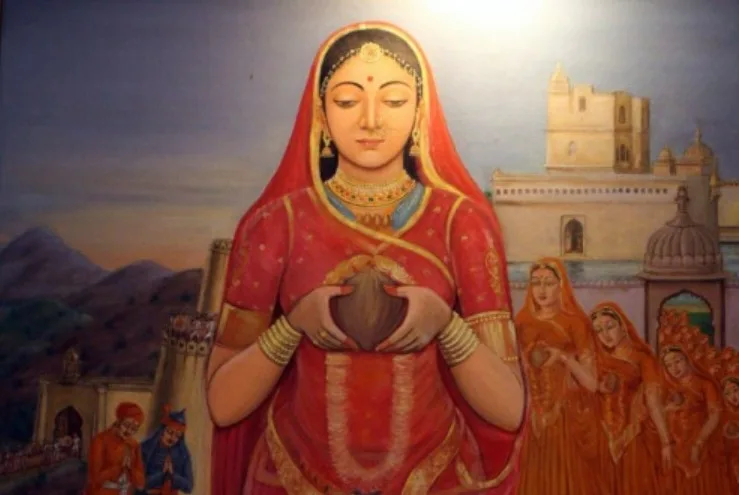
Rawal Ratan Singh was the son of Rawal Samar Singh, a direct descendant of Bappa Rawal, the founder of the Mewar kingdom in Chittor. Rawal Ratan Singh had a wife of unparalleled beauty named Maharani Padmini. Countless stories have been written regarding the beauty of Mewar’s Maharani Padmini and the lustful desires of Alauddin Khilji.
According to several historical narratives, Alauddin Khilji’s obsession with Maharani Padmini became one of the central factors associated with the siege of Chittor. And this led to subsequent first Saka (heroic resistance) and Jauhar (ritual self-immolation). Many myths were perpetuated by placing credence in the poetic rendition of Malik Muhammad Jayasi—the author of Padmavat—a fictional narrative woven around Rawal Ratan Singh and Maharani Padmini.
The popular name ‘Padmavati’ gained widespread recognition through Malik Muhammad Jayasi’s 16th-century epic Padmavat, which blended history, folklore and poetic imagination. One cannot grant a Muslim individual the liberty, through the exercise of his imagination, to alter the very name of Mewar’s Maharani, thereby obscuring the memory of her unimaginable sacrifice and her deeds undertaken for the preservation of Dharma (righteousness). While world history has often portrayed warfare as a masculine pursuit—a concept extensively documented in Western literature and established as a global standard—Indian philosophy takes a different approach. In the Indian tradition, Goddess Durga is worshipped before embarking on military campaigns, signifying that feminine power (*Nari Shakti*) is regarded as the ultimate source of strength.
There are numerous tales of such valor, and Maharani Padmini stands as a prominent example. To protect her honor and that of her clan, she initiated the practice of self-sacrifice by consigning herself to the flames (*Jauhar*); inspired by her, countless women throughout history have sacrificed their lives for the sake of the nation and their faith (*Dharma*). It was Maharani Padmini’s exemplary leadership that inspired thousands of women to join her in this act of *Jauhar*, ensuring that no unworthy person could defile their mortal remains, even after death. Indian history is replete with various forms of struggle, yet Maharani Padmini’s struggle remains unique—an act of self-immolation where self-respect was held paramount. Psychologically, death by fire is considered the most agonizing; yet, Indian women willingly embraced this path to safeguard their faith, lineage, and nation, setting an example for future generations to remain vigilant in the defense of *Dharma*.
Secondly, Jayasi composed the epic Padmavat some 250 years after the actual siege of Chittor; therefore, his work cannot serve as a basis for a historically accurate reconstruction of the events of that era. (Book:Maharana, Author: Omendra Ratanu, Page: 59)
The History of Alauddin Khilji
Alauddin Khilji was born between 1287 and 1288 CE. He was raised by his uncle, Jalaluddin Khilji, who governed the regions surrounding Delhi. Jalaluddin had served as a junior officer under the Slave Dynasty; however, in the course of time—following the death of Muizuddin Qaiqabad, the last monarch of the Slave Dynasty—he married the late king’s daughter and thereby established his dominion over the kingdom. In 1296, Alauddin Khilji usurped the throne of Delhi by assassinating the renowned Jalaluddin and subsequently launched invasions against the Hindu rulers of North India—most notably the Parmar, Vaghela, Chahamana, and Mewar dynasties. His notorious eunuch slave, Malik Kafur, became the first Muslim commander to cross the Vindhya Mountains and defeat the Yadava and Kakatiya kings of South India.
Khilji Sets His Sights on Chittor
After conquering Ranthambore, Khilji fixed his gaze upon Chittor, for it stood as a formidable center of Hindu resistance blocking his path to conquering the South. The tale of Queen Padmini’s beauty was conveyed to Khilji by Raghunath—a servant and court poet within the royal palace of Mewar. However, in Bollywood films and numerous literary works, Raghunath has often been portrayed as the Chief Royal Priest (Rajpurohit)—a Brahmin—in a deliberate attempt to disparage Brahmins by casting them as traitors and betrayers of the nation.
In reality, however, Brahmins were traditionally custodians of both martial knowledge and moral instruction. Following his victories at the forts of Ranthambore and Siwana, Khilji laid siege to the Chittor Fort in 1302, setting a condition for lifting the siege: that Queen Padmini be surrendered to him. Upon hearing this humiliating proposal, all the neighboring kings mobilized their armed forces and joined the army of Rawal Ratan Singh. After suffering a defeat in the ensuing fierce battle, Khilji sent a peace proposal to Ratan Singh.
True to the proud and honorable spirit of Rajput blood, Ratan Singh accepted the offer, and a meeting was arranged between Khilji and Ratan Singh to discuss the terms of a treaty between the two warring monarchs. Once the treaty had been concluded with Khilji and his accompanying Jihadis, the upright Rawal Ratan Singh—guided by his innate simplicity and courtesy—escorted Khilji to the gates of the fort. However, proving his treacherous nature, Khilji seized Ratan Singh as a captive and issued a new ultimatum: that Queen Padmini herself must come to him.
The Strategy of Gora and Badal, and Gora’s Sacrifice: Khilji knew full well that the Rajput chieftains would never surrender their Queen; consequently, they would be compelled to wage war against Khilji’s army without their King—a scenario that all but guaranteed defeat. However, for the first time, Khilji was about to witness the valor of Indian women—a concept entirely beyond the scope of his imagination. Maharani Padmini was both a brilliant strategist and a formidable warrior. The Queen devised a plan to rescue Rawal Ratan Singh, leading a contingent of Mewar’s finest warriors under the command of her uncle, Gora, and her nephew, Badal.
Khilji was informed that Maharani Padmini would be arriving accompanied by her female companions and handmaidens; acting on this premise, more than 700 palanquins were prepared and dispatched to the invader’s camp. Each palanquin concealed one of Mewar’s elite warriors, while the six men bearing the palanquin were, in fact, armed warriors themselves. As per the plan, Maharani Padmini successfully rescued Ratan Singh and headed back toward Mewar, while simultaneously, a force of 5,000 Hindu warriors launched a surprise assault that threw Khilji’s army into disarray. Bound by their commitment to the safety of their King, Ratan Singh, and driven by the resolve to uphold the Queen’s honor, Gora and Badal unleashed a whirlwind of destruction upon Khilji’s troops, thereby utterly defeating Alauddin Khilji in his objective.
Gora attained martyrdom at the very gates of Chittor. Only a small number of Hindu warriors managed to make it back to the fort—among them, a severely wounded Badal. The British historian James Tod has chronicled a dialogue between Badal and his aunt (Gora’s wife), drawing from the Khuman Ras:
The aunt asks Badal, “When he was by his master’s side, what deeds did he perform in the battle?” Badal replied, “In the heat of battle, he was reaping his harvest just like a farmer. Wherever the glint of his sword was seen, I remained right by his side. He himself now sleeps with honor, having fashioned a bed and pillow out of the corpses of his enemies. He met a hero’s death, felled by the treacherous ambush of a barbaric prince. He had not left a single enemy alive—neither to bear him ill will, nor to sing his praises.”
With a gentle smile, the wife of the valiant Gora bade farewell to her nephew, Badal, and consigned herself to the flames in an act of self-immolation. (Book: Maharana, Author: Omendra Ratnu, Page: 68)
The Decisive Battle and the Birth of the Sisodia Dynasty
Having plundered the rest of Rajasthan to replenish his resources, Khilji once again laid siege to Chittor. While Mewar, on one hand, was steeped in grief over the sacrifice of so many of its sons, Khilji, on the other, meticulously planned his attacks. According to popular legend, it was during this period that Ratan Singh had a dream in which the guardian goddess of Chittor spoke to him, saying: “To maintain Rajput control over Chittor, royal blood is required—the blood of those who wear the crown. Those who bear the crown must offer their blood for the sake of Chittor; otherwise, the land of Chittor will be wrested from their hands.” (Book: Maharana, Author: Omendra Ratnu, Page: 68)
Ratan Singh immediately convened a council of all his chieftains at midnight to discuss this dream. Following the discussion, a decision was reached: Ratan Singh’s twelve sons and nephews would take turns leading the counter-attacks. In defense of their motherland, the kingdom of Mewar and its royal dynasty sacrificed their very lives. Ratan Singh’s son, Karan Singh, sought refuge in the mountainous regions of Kelwara and began amassing an army with the aim of recapturing Chittor; eventually, he settled in a village named Sisod. It was after this very village—Sisod—that his descendants subsequently came to be known as the ‘Sisodias.’ Over a span of three decades, nine generations of the Sisodia dynasty perished in their relentless attempts to reclaim Chittor—a feat that was finally achieved by Bhuvan Singh following a fierce and bloody battle. (Book: Maharana, Author: Omendra Ratnu, Page: 74)
Jauhar: A Symbol of Self-Respect
Six hundred years after Muhammad bin Qasim’s invasion of Sindh, in the year 1303, Chittor—the greatest bastion of Hindu resistance against Islamic invaders—was wrested from Hindu hands and fell under the dominion of a brutal aggressor. Following this decisive defeat in battle, and alongside thousands of other women within the walls of Chittor Fort, Mewar’s Queen—the valiant Padmini—prepared herself to perform Jauhar, dedicating herself to the sacred fire. These women chose the agonizing path of allowing their fair, radiant skin to be consumed and reduced to burning embers, for the barbaric and lust-driven jihadis who had descended from Afghanistan had left them with absolutely no other alternative. The practice of Jauhar was embraced by the courageous women of Mewar in the face of these Mlecchas… The imperative was to reject any notion of surrender in the face of the invaders. It was the unwavering resolve of these women that ensured the aggressors could not—let alone touch—even cast a mere glance upon their bodies. For this very reason, Maharani Padmini of Chittor, accompanied by approximately 20,000 loyal handmaidens, companions, and ordinary women of Chittor, shut the gates right in the faces of those lecherous invaders.
Through the act of Jauhar—ritual self-immolation—the goddess-like Maharani Padmini indelibly etched the reality of the Hindu-Muslim conflict into the history of the Indian subcontinent. The embers rising from the flames of Jauhar incinerated every possibility of peaceful coexistence with these barbaric forces. Alauddin Khilji and his *Mlechchha* (barbarian) cohorts found nothing but ashes there to satiate their lust; consequently, in a fit of rage, Khilji ordered the looting of Chittor and the massacre of its inhabitants. To salvage his own tarnished and false honor, Khilji ordered the slaughter of approximately 3,000 ordinary citizens of Chittor. He styled himself as a “Sikandar” (Alexander) and ruthlessly plundered the buildings and temples of Chittor.
The supreme sacrifice made by these Hindu women elevated the value of devotion to Dharma (righteousness) to unimaginable heights. The warmth of the final embrace and affection shared at the moment of parting imbued every Hindu warrior with the strength to slay, on average, four Yavanas(foreign invaders) each. Jauhar deeply embedded the resolve for retribution against the Muslims within the Hindu psyche, for it was Hindu society that ultimately paid the supreme price for its honor and security. After witnessing their beloved and revered women turn to ashes, the Hindu men never looked back; instead, assuming the terrifying form of Mahakaal (the Destroyer), they annihilated the cruel jihadis.
Summary
It was precisely due to the influence of Chittor’s Hindu-centric ideology that the kingdom successfully resisted Mlechchha invaders for thousands of years. On a societal level, Maharani Padmini’s act of Jauhar proved immensely instrumental; for, having ensured the safety of their women through this ritual, the Hindu men were liberated from any anxiety regarding their fate, allowing them to transform into agents of destruction and wreak havoc upon the enemy. Even in the current circumstances, similarly calculated acts by these transgressors have been witnessed—acts which prove that, despite the changing times, the mindset of these jihadis remains unchanged: for them, a Hindu is merely a ‘Kafir’ (infidel) and is ‘Wajib-e-Qatl’ (deserving of death). Drawing inspiration from their ancestors, Indian society must take action to ensure both self-defense and the protection of their faith. As long as this repulsive religious ideology continues to permeate society, Indian society cannot hope to establish harmony.