The greatest characteristic of history is that no matter how hard one attempts to suppress it, it inevitably resurfaces one day, accompanied by its irrefutable evidence. Inscriptions buried in dust for centuries, broken idols, temple ruins, archaeological artifacts and the collective memories of the people ultimately bear witness to precisely what the ruling powers and invaders failed to obliterate.
The struggle surrounding the Bhojshala- located in Dhar, Madhya Pradesh, stands as a symbol of this very historical truth. Established by the great King Bhoja of the Parmar dynasty, this site was dedicated to ‘Maa Vagdevi’ that is, Goddess Saraswati. It served as a center for the study of Sanskrit, grammar, philosophy, astrology, literature and the scriptures. This institution was a preeminent seat of learning during that era, attracting students from far and wide who came to acquire an education.
The First Attack and a Blood-Soaked History
The first major attack on Bhojshala took place in 1305 CE, during the reign of Alauddin Khilji. This military assault was, in essence, an ideological attack directed against Indian knowledge and culture. In the ensuing conflict, the Hindu King Mahakaldev and his soldiers made the ultimate sacrifice.
Perhaps the most harrowing detail reported is that approximately 1,200 Hindu students and teachers were massacred for refusing to convert their religion. This tragic incident serves as irrefutable proof that the conflict of that era was not confined merely to the pursuit of political power, but was fundamentally a struggle for cultural survival.
According to historians, the groundwork for this attack had been laid several years in advance. In 1269 AD, a ‘faqir’ named Kamal Maulana arrived in the Malwa region and spent nearly 36 years gathering intelligence about the area. Subsequently, this information was conveyed to Alauddin Khilji. Following this, the invasion of Bhojshala was launched, inflicting severe damage upon this vital hub of the Indian educational tradition.
The Attempt to Convert the Temple into a Mosque
In 1401 AD, Dilawar Khan Ghori- the founder of the Malwa Sultanate, seized control of a section of the Bhojshala complex. The Hindu side asserts that it was during this specific period that efforts commenced to alter parts of the Saraswati Temple, attempting to transform them into the architectural form of a mosque. The Surya Martand Temple was demolished and its pillars and architectural remnants were utilized in the construction of a new structure. Subsequently, this very site came to be known as the ‘Lat Masjid.’
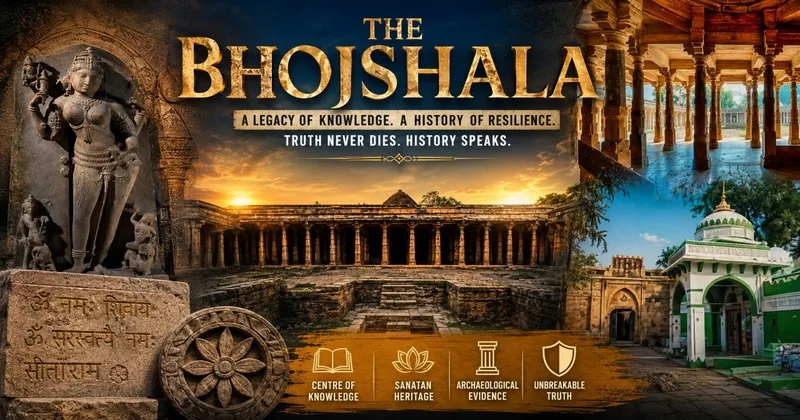
The most significant fact is that, even today, more than 300 pillars remain within this complex, upon which Hindu symbols, depictions of deities and motifs associated with Sanatan culture are clearly visible. Conversely, the absence of structures typically found in traditional Islamic architecture, such as minarets and ‘hauz’, further deepens the controversy. It is for this reason that the issue of Bhojshala has remained at the very center of historical and archaeological discourse for years.
The Kamal Maula Dargah and the Controversy Over Its Changing Character
In 1514 AD, Mahmud Shah Khilji II reoccupied the Bhojshala complex and commissioned the construction of the tomb of Kamal Maula. A noteworthy fact is that Kamal Maula passed away around 1310 AD, whereas his tomb was constructed two centuries later. The Hindu side views this as a calculated maneuver, a deliberate attempt to alter the original character of Bhojshala and re-establish it as a ‘dargah’.
Archaeological Evidence Unlocks the Doors of History
The most critical aspect regarding Bhojshala lies in the archaeological and epigraphic evidence that has steered the debate concerning its original nature in a new direction. In 1902, British official J.F. Blackman discovered a statue of Goddess Vagdevi (Saraswati) within the Bhojshala complex. This four-armed marble idol remains preserved to this day at the British Museum in London. The statue itself is regarded as compelling evidence that this site served as a center for the worship of Goddess Saraswati.
Furthermore, the ‘Vijayshrinatika’ inscription- discovered by KK Lele in 1903, holds immense significance. It records that a play was staged within the Saraswati temple in the presence of King Arjunavarman. This fact clearly indicates that Bhojshala was not merely a religious site, but a prominent hub for cultural and educational endeavors.
Sanatan History Hidden in the Inscriptions
The ‘Kurmashataka’ inscription, the ‘Sarpabandha’ inscription and various symbols related to Sanskrit grammar, all discovered within the Bhojshala complex, attest to the site’s rich scholarly tradition. The ‘Sarpabandha’ inscription, in particular, which symbolically depicts Sanskrit vowels and consonants, highlights the advanced state of the Indian educational system of that era. This site was not merely an architectural marvel, but a vibrant center of knowledge, science and linguistic studies.
The presence of inscriptions bearing phrases such as Om Namah Shivaya, Om Saraswatyai Namah and Sita-Ram is also considered to be of profound significance. The presence within the complex of a Ganesh idol, figures of the gatekeepers Jaya and Vijaya, a ‘Yajnakund’, ‘Yakshini’ sculptures and pillars adorned with Hindu symbols indicates that the original character of the Bhojshala was rooted in the Sanatan tradition.
ASI Survey Strengthens Claims
The discovery of over 1,700 antiquities during the scientific survey conducted by the Archaeological Survey of India (ASI) is considered to be of immense significance. These findings include idols of deities, symbols of the conch (Shankh) and discus (Chakra), Sanatani motifs, coins and artifacts dating back to the Parmar era. The unearthing of idols of Goddess Vagdevi, Shiva, Ganesh, Shri Krishna, Brahma and Vasuki Nag confirms that this site served as a hub for Hindu religious and cultural activities for a prolonged period.
Structures resembling a ‘Garbhagriha’, ‘Yajnakunds’ and remnants associated with temple architecture further bolster the assertion that the Bhojshala was originally a temple and a center of learning (Vidyapeeth).
Truth Ultimately Emerges
Thus, in this context, it must be stated that the struggle surrounding the Bhojshala serves as a poignant reminder of that historical anguish wherein India’s cultural identity faced numerous assaults. For centuries, attempts were made to alter history, obliterate symbols and conceal the site’s original character; yet, the verses etched into stone, the remnants of temples, and the archaeological evidence have ultimately spoken out.
The current situation surrounding the Bhojshala conveys a powerful message; truth may be suppressed, but it can never be extinguished. History never dies; when the time is right, it presents its own evidence. The Bhojshala has emerged as a symbol of that very immortal truth, one that, after centuries of struggle, has once again re-established its Hindu identity before the world.