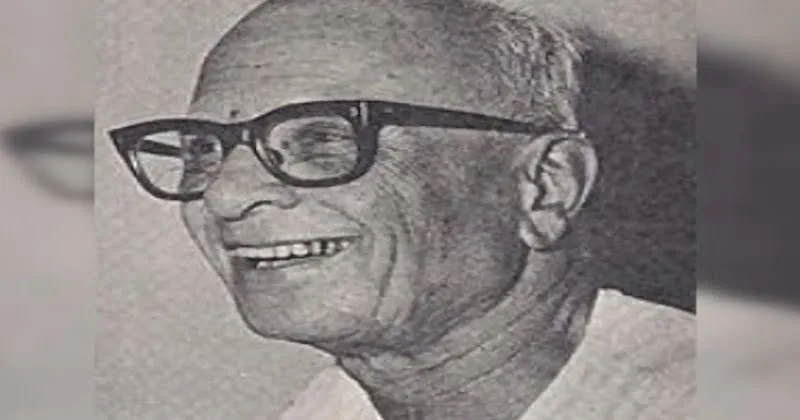
In the quiet corners of India’s nation-building journey stand individuals whose contributions often remain away from the spotlight, yet whose impact shapes generations. Bhaurao Bhuskute was one such extraordinary karmayogi who dedicated his entire life to the service of society.
He sought neither fame nor glory, nor any worldly acclaim, He walked the path of national service and gave his life a noble aim. Among the deprived, the neglected and the tribal communities, he stood as a guiding light, Sacrificing personal comforts, he dedicated himself to society with all his might.
Such stories of selfless action are rarely found in history’s pages, Where service becomes a lifelong penance that inspires generations through the ages. We bow with reverence to Bhaurao, a visionary and noble soul,
Whose life illuminated countless hearts and strengthened the nation as a whole.
India’s civilisational journey has been enriched by countless individuals who devoted their lives not to personal ambition but to the welfare of society and the nation. Among such distinguished personalities, Bhaurao Bhuskute occupies a place of great respect and admiration. His life was a remarkable example of selfless service, organisational leadership, social commitment, and unwavering dedication to national reconstruction.
His birth anniversary on June 14 provides an opportunity to remember and reflect upon the life of a man who transformed service into a mission and nation-building into a lifelong spiritual discipline. Bhaurao Bhuskute’s legacy reminds us that true greatness lies not in positions of power or public recognition but in the silent and sustained efforts made for the betterment of society.
Bhaurao Bhuskute was not merely a social worker; he was a visionary thinker, an institution builder, and a dedicated karmayogi who devoted himself to the upliftment of tribal communities and marginalised sections of society. His life embodied the Indian ideals of selfless service, social harmony, and national commitment. He believed that the strength of a nation is measured by the well-being of its most vulnerable citizens and that true development is achieved only when every section of society participates in the nation’s progress.
One of the most significant aspects of his work was his lifelong commitment to the welfare and empowerment of tribal communities. Rather than viewing tribal society as a beneficiary of charity, he regarded it as an integral and invaluable part of India’s cultural heritage. He recognised the rich traditions, values, and wisdom preserved within tribal communities and worked tirelessly to ensure that they received opportunities for education, healthcare, economic development, and social empowerment without losing their cultural identity.
Bhaurao Bhuskute firmly believed that the tribal population represented the living spirit of India’s ancient civilisation. He emphasised that development should not mean cultural displacement but rather the empowerment of communities while preserving their traditions and values. Through numerous initiatives and grassroots efforts, he helped foster self-confidence, self-reliance, and social awareness among tribal populations.
Another cornerstone of his vision was the principle of “Nation Building through Village Development.” He believed that India’s future rested in its villages and remote regions. According to him, sustainable national development could only be achieved when rural communities became self-reliant, educated, healthy, and economically empowered. His efforts focused on encouraging community participation, local leadership, and grassroots development, making rural empowerment a central component of national progress.
Bhaurao Bhuskute was also an exceptional organiser. He understood that lasting social transformation requires collective effort. Rather than seeking personal prominence, he dedicated himself to nurturing dedicated workers and creating strong social institutions. He invested his time and energy in mentoring individuals, inspiring them with a sense of national duty, and preparing them to serve society selflessly.
His leadership style was characterised by humility, simplicity, and personal example. He did not believe in commanding from the front but in empowering others to lead. Many individuals who came under his guidance went on to make meaningful contributions in various fields of social and national life. His greatest achievement was perhaps not the institutions he built, but the countless dedicated individuals he inspired.
The essence of Bhaurao Bhuskute’s life can be summed up in one word—Karmayoga. He lived according to the principles of selfless action described in the Bhagavad Gita. He performed his duties without expectation of reward, recognition, or personal gain. For him, service to society was a form of worship, and national reconstruction was a sacred responsibility.
In an era where success is often measured by visibility, wealth, and influence, his life offers a powerful alternative perspective. He demonstrated that true leadership is not about being celebrated but about enabling others to succeed. He showed that meaningful change comes through patience, dedication, and continuous effort rather than through publicity or personal ambition.
His personality reflected extraordinary simplicity. Though his lifestyle was modest, his vision was expansive. He possessed deep compassion for the suffering of others and an unwavering commitment to addressing social challenges. He was a skilled organiser, a thoughtful strategist, and a man of remarkable foresight. Above all, he remained humble despite his immense contributions.
For today’s younger generation, Bhaurao Bhuskute’s life holds profound relevance. Modern youth live in an age of unprecedented opportunities, technological advancement, and global connectivity. Yet, they also face challenges related to purpose, values, and social responsibility. His life teaches that success should not be measured solely by personal achievements but also by one’s contribution to society.
He inspires young people to develop a larger purpose in life, to remain connected to their cultural roots, to embrace social responsibility, and to become active participants in nation-building. His example demonstrates that individual growth and social commitment can go hand in hand.
As India moves toward the vision of becoming a developed nation, the values championed by Bhaurao Bhuskute—social harmony, tribal empowerment, rural development, self-reliance, cultural confidence, and national service—are more relevant than ever. His life serves as a reminder that sustainable national progress requires the participation and upliftment of every section of society.
Bhaurao Bhuskute’s journey was one of dedication without expectation, service without recognition, and leadership without self-interest. His birth anniversary is not merely an occasion for remembrance but a call to embrace the ideals for which he lived. The greatest tribute we can offer him is to carry forward his mission by practising selfless service, strengthening social unity, empowering communities, and contributing to the nation’s development.
On his birth anniversary, we pay our deepest respects to this great karmayogi, nation-builder, social reformer, and champion of tribal welfare. His life will continue to inspire generations and remain a guiding light for all those committed to the service of society and the nation.