The original princely state of Jammu & Kashmir, which included Gilgit-Baltistan, besides Muzaffarabad, Kotli, Bhimber, Rawalakot and Sudhnoti, got divided between India and Pakistan in 1947-48. Maharaja Hari Singh, the ruler of the entire area, acceded his state into India on October 26, 1947, through an Instrument of Accession and the next day, elements of the Indian Army started landing in Srinagar. To defend what had become legitimate Indian territory under international laws.
A few days before that, Pakistani soldiers disguised as Kabailis (tribal raiders) had over-run Muzaffarabad, Mirpur and many other areas besides. More than a year later, a ceasefire was declared but by that time, many areas of the erstwhile princely state of J&K, as controlled by Maharaja Hari Singh, were in the hands of Pakistan. An artificial Line of Control (LoC) got drawn where the two militaries, Indian and of Pakistan, were facing one another. Each of them has since controlled the territories they possessed.
The loser in the bargain has been India as it has, till date, not got all the territories which Maharaja Hari Singh had ruled and acceded to it. India gained possession of the Maharaja’s territories because he chose to side with it. Pakistan has got a large part of the Maharaja’s territory because it snatched that illegally through through treachery and deceit.
Some of the territories of the Maharaja with India today are known as the Union Territory (UT) of Jammu & Kashmir. The others are known as the Union Territory (UT) of Ladakh.m Across the LoC, in Pakistan, there are the areas designated by the Indian side as Pakistan-occupied Jammu Kashmir (PoJK). Pakistan calls these areas as Azad Jammu Kashmir (AJK). For political convenience and suit its narrative, Pakistan treats Gilgit-Baltistan as a distinct and separate region.
For the time being, let us stop at that. Let us examine how azad the so-called AJK is. It will be interesting to compare some indices of development on the two sides of the LoC.
PoJK lacks development in all spheres
The UT of J&K has two fully functional civilian airports at Jammu and Srinagar, with Udhampur and Awantipora being two military airports. In contrast, the PoJK region has no airport, either civilian or military. Besides, helicopter services are available for far-off areas of J&K like Poonch, Kishtwar, Gurez and a few other inaccessible places during harsh winters. These are heavily subsidised services primarily for the convenience of ordinary citizens, meant to address medical emergencies and other contingencies. No comparable service exists in PoJK.
On paper, the PoJK region has its own Prime Minister and a President as well. On the face of it, this looks like a position of wonderful autonomy. However, the skin peels off as soon as you start scratching the surface and learn about their powers. These nomenclatures are full of bombast and pomposity as the region is controlled by the Ministry of Kashmir Affairs in Islamabad! The power centre is not Muzaffarabad, the capital of PoJK, but Islamabad, rather Rawalpindi military headquarters of Pakistan Army.
Neither the PM, nor the President of PoJK have any real powers and depend on Islamabad-Rawalpindi hybrid regime for doles. They retain their positions only so long as this hybrid regime suffers them.
President, PM are mere rubber stamps
The control of the PoJK region is firmly in the hands of the Federal government, its bureaucrats and lackies. The bureaucrats at this ministry are persons chosen by the Federal government and have more actual powers than the so called PM and the President of PoJK!
In reality, PoJK is neither autonomous nor integrated into Pakistan. It is a despondent state in between, which is neither here nor there. If it were integrated, it would be governed like the four provinces of Punjab, Sindh, Khyber Pakhtunkhwa and Balochistan. Getting funds via the Federal budget will happen automatically then.
PoJK has created a peculiar situation as no funds are allotted to it in proportion to its population or needs as happens in case of the four provinces. In the next year’s budget presented by Senator and Finance Minister Mohammad Aurangzeb a couple of days ago, there is no mention of POJK, or of Gilgit-Baltistan. In short, no funds allocated as their rightful shares.
All the four provinces get funds from the Federal government based on clear formulae decided by mutual discussions. Nothing like that for PoJK or Gilgit-Baltistan.
No legislators in national assembly & senate
Like J&K on the Indian side, PoJK has a Legislative Assembly. However, for representation at the Federal level, it neither has any representatives in the National Assembly (akin to Lok Sabha of India) nor in the Senate (akin to our Rajya Sabha). On the Indian side, there are five Lok Sabha seats in J&K and four Rajya Sabha seats. These nine representatives from J&K sit in the legislature bodies at the Central level and argue for J&K’s requirements, all issues pertaining to J&K.
In PoJK, the lack of a structured representation for the locals in the Federal legislatures (the National Assembly and the Senate) means they have no voice. If they want to take up any issue with the Federal government, the people of PoJK can do that through the Ministry of Kashmir Affairs alone comprising bureaucrats. Zero political representation in Federal legislature is thus a steady instrument of disempowerment.
If PoJK were to be treated equally like the four provinces, there will be automatic accrual of funds and this accrual will not depend on the whims and fancies of the Federal government. In the PoJK assembly, there are 12 seats reserved for people living outside its boundaries. There seats located in different parts of Pakistan are used for political manipulation of the governments in PoJK.
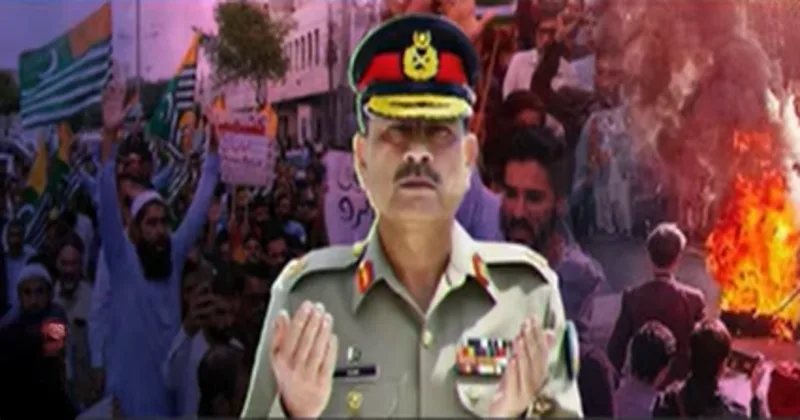
These seats are at the centre of all the unrest and violence being witnessed in the entire PoJK. But these seats are a fit subject to be dealt with separately.