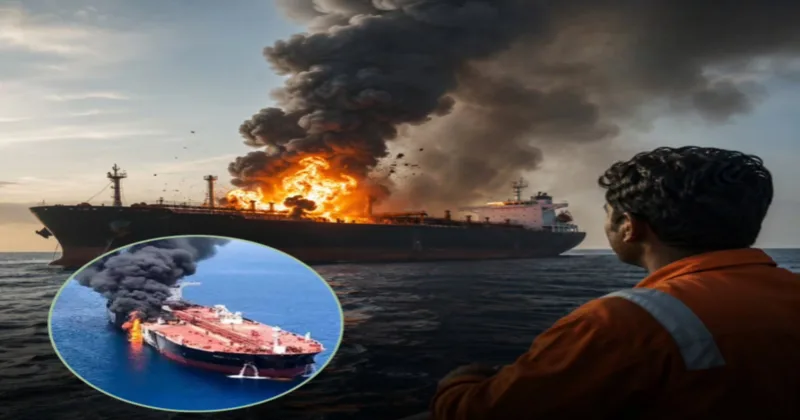
As the geopolitical wildfire escalates rigorously across West Asia, with a peace deal between the US-Israel axis and Iran hanging in doldrums, the hard-nosed contest is fuelling a steep humanitarian crisis as an impact of the extending US military muscle. In just three days, US military strikes have stuck down three commercial vessels in the vicinity of the critical maritime chokepoint, the Strait of Hormuz, leading to three deaths. This includes the death of three Indian seafarers onboard the vessel Setebello.
The increasing catastrophes in the gulf region, reflects the hegemonic military muscle flexing of the United States at the cost of innocent lives. These strikes by Washington DC indeed have regional repercussions beyond the warring parties. It is inflicting a steep energy crisis, trade hiccups, national security conundrum and humanitarian catastrophes. It is thus, high time, Washington DC considers the human cost of the military escalation. Killing the Indian seafarers, a country which always advocates for dialogue, diplomacy and peace in any conflict is highly condemnable.
In this direction, External Affairs Minister Dr. S. Jaishankar spoke to US Secretary of State Marco Rubio and exhibited strong protest against the attack on commercial vessels traversing through the Strait of Hormuz. “I reiterated India’s strong protest at the attacks by the US Navy in the Gulf that killed three Indian mariners. Such lethal actions against commercial shipping are not justified”, Dr. Jaishankar further added.
Spoke to US Secretary of State Marco Rubio this evening. I reiterated India’s strong protest at the attacks by the US Navy in the Gulf that killed three Indian mariners. Such lethal actions against commercial shipping are not justified.
— Dr. S. Jaishankar (@DrSJaishankar) June 12, 2026
Further, the Ministry of External Affairs, summoned US Charge d’Affairs Jason Meeks and reiterated a strong diplomatic protest against the US naval forces attacking commercial vessels in the Gulf of Oman carrying Indian seafarers, that led to the unfortunate death of three Indian lives. “The Ministry conveyed its deep concerns over the use of lethal and deadly force against civilian shipping. Such actions are unacceptable and undermine the safety, security and stability of international maritime commerce in a sensitive region at a difficult time”, the MEA statement further asserted.
Despite such stern warnings and mounting humanitarian crisis, the US military continued lethal strikes in the Gulf of Oman that targeted commercial vessels hailing from across the globe and the innocent seafarers who were unrelated to the war. The US is posing a blockade of the Iranian ports to cut the movement of Iranian vessels, thus rupturing the economic lifeline of Tehran. However, the US is disproportionately and indiscriminately targeting other commercial vessels traversing through the maritime passage under the veil of violating US naval blockade.
US aircraft fires Tanker Jalveer
Among the three commercial vessels attacked by the US, Jalveer is one among them. In the early hours of June 11, Thursday, tanker Jalveer reported that fire had broken out in its engine room. US Centcom later confirmed that its aircraft fired two Hellfire missiles into the ship’s engine room as the crew repeatedly failed to comply with the directions of the US military. Centcom said that the vessel violated the blockade against Iran and attempted to transport Iranian oil.
The crew immediately sent an emergency distress call to the Oman Navy and another vessel in the vicinity and pleaded for rescue. The crew also directly exposed the atrocities of the US Navy and shouted, “just targets merchant ships”. Tanker Jalveer 20 Indian seafarers and fortunately all of them were safely evacuated with the aid of the Royal Navy of Oman.
Tanker Marivex attacked for alleged links with Iran
Another commercial vessel attacked by the US Navy which had Indian seafarers was Tanker Marivex. The ship was attacked on June 8, Monday for alleged links with Iran. The Indian crew sent a distress message pleading for immediate “help”. The ship was apparently sent on fire and it was sinking. The US also sanctioned the owner of the tanker Arihant Shipping Inc, for allegedly violating US naval blockade and not complying to the restrictions. According to the Centcom statement, a US F-18 Super Hornet fighter jet propelled from the US aircraft carrier USS Abraham Lincoln fired into the engineering and steering spaces of the vessel. It was a precision attack.
As the ship’s engine failed and the crew sent a distress call, the Omanian Navy came to help and evacuated the seafarers.
US attack on Settebello led to death of 3 Indian seafarers
The most tragic was the US attack on the vessel Settebello that had 24 Indian seafarers and led to the death of 3 Indian seafarers. The US firing of the precision munitions into the engine room of the vessel, set the tanker on fire. The crew members sent an emergency distress call as the ship began to sink. 21 seafarers were safely evacuated and rescued. However, 3 went missing, who were later declared as dead.
The US military claimed that the vessel denied the US blockade and ignored other directions. However, the shipping company that manages the vessel denied such allegations of the US The company also reiterated the US to release evidence before espousing such allegations.
The global maritime workforce comprises more than 3,00,000 Indian seafarers and the gulf region alone has 18,000 Indian seafarers. Thus, the safety of the Indian crew who form the pillar of the global maritime industry is pivotal. The spiking US military muscle in West Asia and across the critical maritime chokepoints is thus inflicting paramount damage to the Indian maritime sector, energy security and most importantly harming the lives of the Indian seafarers.