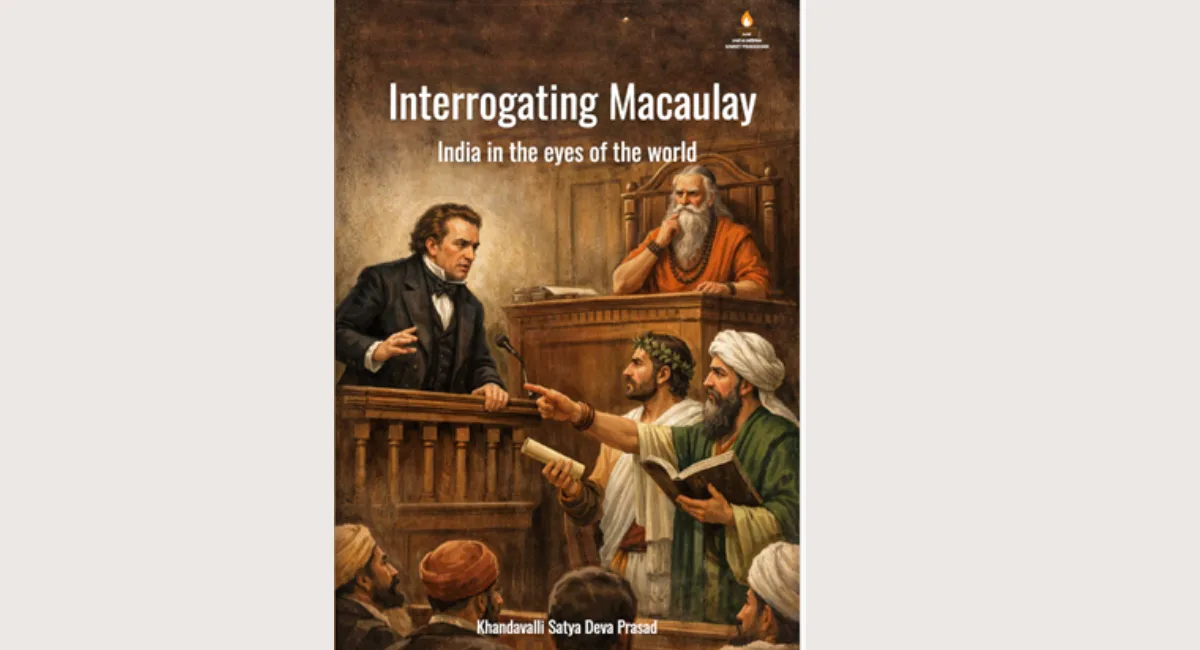
As Indians are consciously looking for decolonisation, the book titled “Interrogating Macaulay – India in the Eyes of the World”, published by Hyderabad based Samvit Prakashan, will help in understanding the design of British colonial forces and their sinister agenda in manipulating the legacy Indian knowledge systems.
This small 70-page book, authored by Khandavalli Satya Dev Prasad, is primarily divided into two parts. The first 16 pages are dedicated to the verbatim text of T.B. Macaulay’s Minute of 1835, written during his tenure as the first Law Member of the Governor-General’s Council of India, and the rest of the pages present a powerful and concise factual rebuttal to the arguments put forth by T.B. Macaulay, exposing the shallowness of his colonial mindset and its intellectual aggression against the Indians and their rich cultural and history of knowledge.
One of the key highlights of the book is the contrast in tone and style between T.B. Macaulay’s Minute and the rebuttal section.
Instead of being emotional, the author, Khandavalli Satya Dev Prasad, presents factual historical data that demolishes the arguments of T.B. Macaulay and the colonial British regime.
Though T.B. Macaulay’s arguments are widely regarded as falsehoods and acts of hegemony, the author, through his rebuttal, convinces readers to apply reason and logic in assessing his views and encourages further research.
Through this book, author cites several trusted foreign sources that place Indian culture and knowledge on a high pedestal. All this was concisely categorised into 13 chapters covering subjects ranging from maritime affairs, science, philosophy, languages, morals, wisdom, commerce and trade relations with the West, sources of Hindu history, and India’s contributions to humanity, as well as to the geopolitical and philosophical development of the world.
These sources add credibility to the arguments as they provide objectivity and an unbiased outlook. The author cites scores of sources from various different timelines to support the rebuttal of the points made in T.B. Macaulay’s Minute.
The original T.B. Macaulay’s Minute speaks highly of the English language and claims that English and other Western European languages helped Russia move from barbarism to civilisation. He keeps on gloating about the superiority of Europeans and the British in particular – the imperialistic tone is hard to miss. At the same time, the disrespect for the Indian public, its systems, and its culture is crystal clear.
T.B. Macaulay suggests how to pool around a lakh of rupees annually to fund and impose British-styled education using Indian tax revenues in the 1830s, presenting it as a favour in the name of educational reform.
The chapter also deals with how T.B. Macaulay confess that his English ancestors were refined by Greek, Latin, and Roman influences after having been barbaric for centuries. With this understanding, TB Macaulay assumes that the same situation is true for India too.
The British lawmaker pushes for English as the language of instruction, replacing the local languages. While doing so, he is dismissive and makes derogatory references to not just India but also to other non-European regions, including Russia and Egypt.
The author dissects the arrogance of T.B. Macaulay and his claims that the medical knowledge of Indians is a disgrace compared to that of a person who fits horseshoes in England. The book counters this blunder in the chapter on ‘Hindu Science and Medicine’ by citing the high praise accorded to Indian medicine by Professor Wilson, Sir William Hunter, Weber, and Elphinstone and several eminent scholars and medical practitioners of all times.
The author also points out that Charaka’s Oath predates and is as illustrious as Hippocrates’ Oath of Greeks. Further, he highlights Macaulay’s ignorance of the renowned Sushruta Samhita, an ancient Indian treatise on surgery.
The author of the book rightly finds the supremacist agenda and profound contempt for India and Indians in the TB Macaulay Minutes:
“… the orientalists themselves. I have never found one among them who could deny that a single shelf of a good European library was worth the whole native literature of India and Arabia. The intrinsic superiority of the Western literature is indeed fully admitted by those members of the committee who support the oriental plan of education.”
“..the superiority of Europeans becomes immeasurable. It is, I believe, no exaggeration to say that all the historical information which has been collected from all the books written in the Sanskrit language is less valuable that what may be found in the most paltry abridgements used at the preparatory schools in England.” Where ‘preparatory schools’ mean schools teaching up to the 7th class.
The author rebuts the above with dedicated chapters citing the well-respected foreigners for Sanskrit, Bharat’s science, depth in spirituality and philosophy, ship building and maritime navigation competence citing Greek and Roman navigation logs, as well as the cultured conduct of Bharatiyas and the widespread education in society.
The author also presents a big picture yet in brief with two dedicated chapters on scientific achievements and another two on philosophy and wisdom.
The final two chapters describe what Bharat taught the rest of the world and present tributes to India by eminent personalities, including Nobel laureates, scientists, professors, thinkers, and authors such as Romain Rolland, Erwin Schrödinger, Albert Einstein, and Professor Donald E. Knuth of modern times.
The author extensively cites the quotes and statements of globally well respected philosophers, historians like Georg Wilhelm Friedrich Hegel, Sir Charles Eliot, historian Will Durant, traveller Allen Ginsberg, Persian polymath and Al-Biruni, Belgian-American historian George Sarton, and several other global thinkers and travellers, along with their observations on Bharat and its rich cultural and philosophical heritage.
The author specifically points to the 24th paragraph of the Minute and states that the British officer sensed the potential of Bharatiya knowledge to dismantle British rule from Indian soil forever.
While reading the sentences and between the lines, it becomes clear how T. B. Macaulay shrewdly recognised that traditional Indian education would strengthen the cause of India and create opposition to British rule. He strongly advocated the destruction of the traditional education system to strengthen British rule and argued against funding it, as it would create opponents of British colonial rule.
A few paragraphs later, the British officer clearly outlines their intention to “strike the root of” the traditional Bharatiya education system. The goal to create a colonialist-induced Indian intelligentsia dependent on Western approval is clearly outlined in the TB Macaulay Minutes.
Maintaining the highly negative and critical view of India, TB Macaulay signs off with such arrogance and egoism that is not gentlemanly, but the minute comes across as an arrogant snob blatantly telling lies. He manipulates the system by offering to resign if his recommendation is not followed, and calls the existing system poisonous.
TB Macaulay’s minute was in response to an ongoing dispute within members of the Committee of Public Instruction – a sizeable section of this committee was more balanced and many were supportive of funding the traditional education system. This committee consisted of 10 members, mostly Europeans.
Macaulay, as a member of the higher-level Governor-General’s Council, was dismissive of their recommendations. A ruthless imposition of power seems to be the motive behind replacing the traditional education system with the English education system.
The Governor-General’s Council is significant as it was established after the Charter Act of 1833, which extended the East India Company charter by 20 years and restructured the governance of British India. T. B. Macaulay was the first law member of the Governor General’s Council of British India.
TB Macaulay not only caused changes to education, as a law member, but he was also responsible for drafting a uniform criminal law for the entire British India. This criminal code made governance easier for the British centralised ruling power to control and punish rebellions effectively, rather than serve public welfare in a superior manner.
The TB Macaulay’s Minutes were prepared at a time after the Maratha Confederacy was defeated in 1819, and uprisings across Maratha territory were suppressed by the mid-1830s. The Colonial & Imperial British rulers might have felt emboldened to take some strong measures to permanently bring India under their grip. It is now being felt in enlightened sections of India that not only is Sanskrit the mother language of European languages, but also that the Greeks and Romans learnt extensively from India. But their knowledge was below what was available in India.
It is a sad tragedy of history that a few imperialist and arrogant British rulers imposed an inferior version of their own knowledge on India in the English language, de-linking it from India by hiding the original source, and with the presumption that India is backward. The TB Macaulay Minute is a living testimony to that fact.
Was the appointment of TB Macaulay as the first law member to the Governor-General’s Council in 1834 with a predetermined purpose? Were the Colonial British rulers inculcating coloniality through education with the Macaulay Minute? Was the use of strong police force supported by new criminal laws in favour of British rulers to punish freedom fighters with Macaulay’s New Criminal Law? These are points for readers to think about after reading this book.
This book is available at Hindueshop:
Interrogating Macaulay – India in the Eyes of the World
at Amazon
To conclude, this book, if read during school years or introduced at an age when individuals shape their thoughts, can serve as an antidote to colonialism, which often leads to low self-esteem among students and lifelong doubts arising from feelings of inferiority generated by Western literature about India.
This book is published by Hyderabad-based Samvit Prakashan, an independent Bharatiya publishing house. To date, it has published more than 80 titles. The organisation was established with the objective of uncovering, nurturing, and publishing the forgotten histories of Bharat, interpreting historical and civilisational texts in their proper context, promoting informed discourse, undertaking contemporary socio-cultural and economic studies on relevant subjects, and translating valuable works from other languages that contribute to national understanding and integration.