Among the countless sacred sites that once defined the spiritual geography of the Indian subcontinent, few occupy as fascinating a place in history as the Sun Temple of Multan. Today, the city of Multan lies in Pakistan’s Punjab province, known primarily for its Sufi shrines and medieval history. Yet centuries before the rise of Islamic rule in the region, Multan was home to one of the most revered temples dedicated to Surya, the Hindu Sun God. Pilgrims travelled from distant corners of India to offer prayers at the shrine, and rulers regarded it as one of the wealthiest religious institutions of its age.
Unlike many ancient temples whose ruins still stand as testimony to their former grandeur, the Multan Sun Temple has vanished almost entirely from the physical landscape. What remains are the accounts of travellers, historians, and chroniclers who documented its magnificence. Through their writings, we are able to reconstruct the story of a temple that once shone brightly at the heart of India’s sacred geography before disappearing into the shadows of history.
The origins of the temple are shrouded in antiquity. Historians believe that the shrine was already an established centre of worship by the early centuries of the Common Era. Dedicated to Surya, the deity associated with light, energy, and cosmic order, the temple occupied a special place within the religious traditions of northwestern India. While temples dedicated to Shiva and Vishnu often dominated the sacred landscape, Sun worship maintained a distinct and influential presence across several regions of the subcontinent.
The most valuable early account of the temple comes from the celebrated Chinese Buddhist traveller Xuanzang, who visited India during the seventh century. His detailed observations provide a rare glimpse into the shrine at the height of its prosperity. Xuanzang described a magnificent temple housing a revered image of the Sun God that was adorned with precious metals and jewels. He noted that pilgrims arrived in large numbers to seek blessings and make offerings. His testimony confirms that by the seventh century the temple had already acquired a reputation extending far beyond the boundaries of Multan itself.
The temple’s influence was not limited to matters of faith. Like many major pilgrimage centres of ancient India, it served as an economic and cultural hub. Pilgrims brought donations, merchants conducted trade, and local communities benefited from the continuous flow of visitors. The wealth accumulated by the temple became legendary. Contemporary accounts suggest that offerings of gold, silver, and precious stones enriched the shrine to an extraordinary degree. Its prosperity was so widely known that even foreign rulers took notice.
The fortunes of the temple changed dramatically with the arrival of Arab armies in the early eighth century. In 712 CE, Muhammad bin Qasim launched the campaign that brought Sindh and adjoining regions under Umayyad control. The conquest marked the beginning of a new political era in northwestern India. Historical sources indicate that Arab administrators quickly recognized the importance of the Sun Temple, not only as a religious institution but also as a source of considerable revenue.
Rather than immediately destroying the shrine, the early conquerors appear to have adopted a pragmatic approach. Several medieval accounts suggest that the temple was allowed to continue functioning because of the substantial income generated through pilgrim activity. Taxes and levies associated with the temple provided a steady stream of revenue for the new rulers. In this sense, the shrine survived not because its sanctity was respected but because its economic value was too significant to ignore.
This period illustrates a recurring pattern in history. Conquerors often balanced ideological objectives with administrative necessities. The Sun Temple’s wealth transformed it into a political asset. For a time, its continued existence served the interests of those who ruled Multan. Yet this arrangement remained fragile. The temple’s survival depended entirely upon changing political calculations rather than secure protection.
The Persian scholar Al-Biruni, writing in the eleventh century, provides another important account. Widely regarded as one of the greatest observers of medieval India, Al-Biruni described the temple and its importance to Hindu pilgrims. His writings reveal that the shrine remained a significant centre of worship centuries after the Arab conquest. At the same time, his observations suggest that the temple’s position had become increasingly vulnerable amid shifting political and religious realities.
As successive dynasties consolidated their authority, symbols of pre-Islamic religious power often became targets of political assertion. Temples were not merely places of worship; they represented economic resources, cultural prestige, and local identities. The Sun Temple of Multan embodied all three. Its continued prominence stood as a reminder of a religious tradition that predated the new political order.
Historical chronicles differ regarding the precise circumstances of the temple’s destruction. Some accounts attribute its decline to military campaigns, while others point to deliberate policies aimed at eliminating surviving centres of non-Islamic worship. Although historians debate specific details, there is broad agreement that the temple did not survive the medieval period. Unlike some sacred sites that were converted into mosques or repurposed for alternative functions, the Multan Sun Temple gradually disappeared from the landscape.
Its disappearance represents more than the loss of a single monument. The temple had functioned as a repository of memory, faith, and cultural continuity. For generations, devotees had journeyed across vast distances to stand before the image of Surya. Priests, scholars, merchants, and pilgrims collectively contributed to a vibrant ecosystem of religious life. The destruction of such institutions disrupted networks that had evolved over centuries.
The story of the Multan Sun Temple also highlights the changing geography of South Asian heritage. Many of the most significant centres of Hindu, Buddhist, and Jain civilisation now lie outside the borders of modern India. Political partitions and shifting frontiers have obscured historical connections that once united diverse regions through pilgrimage and cultural exchange. Multan, now associated primarily with Islamic heritage, was once equally celebrated for one of the subcontinent’s most famous Hindu shrines.
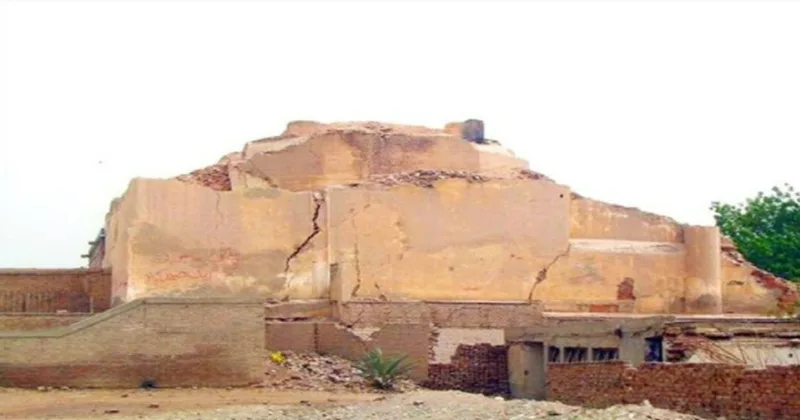
Today, no towering shikhara rises above the city skyline. No temple bells announce the arrival of pilgrims. The sacred complex that captivated travellers and accumulated immense wealth exists largely in memory and text. Yet the absence of physical remains should not diminish its historical significance. Indeed, the temple’s disappearance makes its story even more compelling. It reminds us that civilisations are not defined solely by what survives but also by what has been lost.
For modern readers, the Multan Sun Temple offers an opportunity to reflect on the fragility of cultural heritage. Monuments that appear permanent can vanish through conquest, neglect, or the passage of time. The temple’s fate demonstrates how easily even the most celebrated institutions can fade from collective consciousness when physical evidence disappears.
The Sun Temple of Multan deserves remembrance not merely because it was ancient or wealthy but because it symbolised a broader civilisational world that once stretched across the Indian subcontinent. It was a place where faith, commerce, scholarship, and community converged. Its story survives through the observations of travellers and historians who ensured that its memory would outlive its stones.
In remembering the Multan Sun Temple, we recover a fragment of a forgotten landscape. We recall a time when pilgrims crossed great distances to honour the Sun God, when Multan stood among the foremost centres of Hindu devotion, and when a magnificent shrine illuminated the spiritual horizon of the subcontinent. Though the temple itself has vanished, its legacy continues to shine through the pages of history.