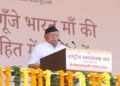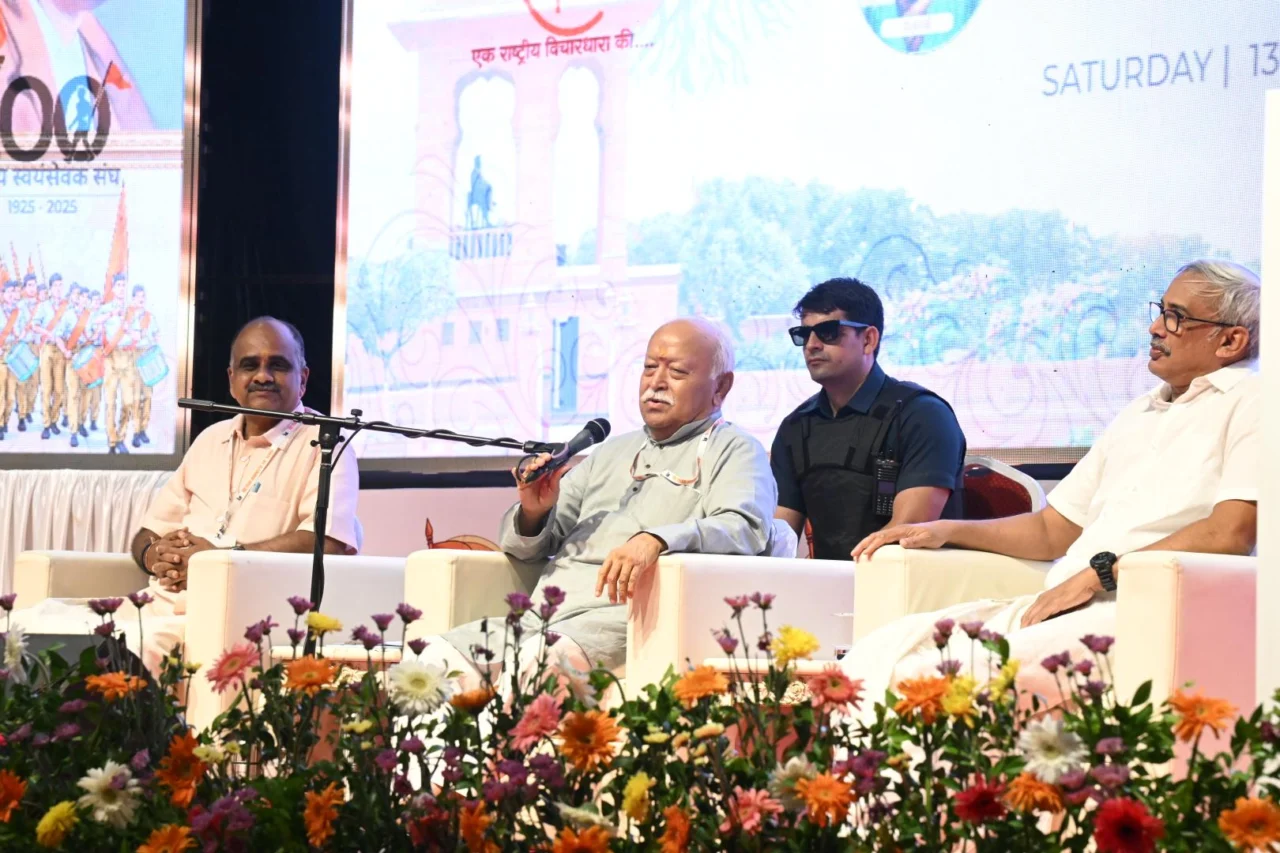
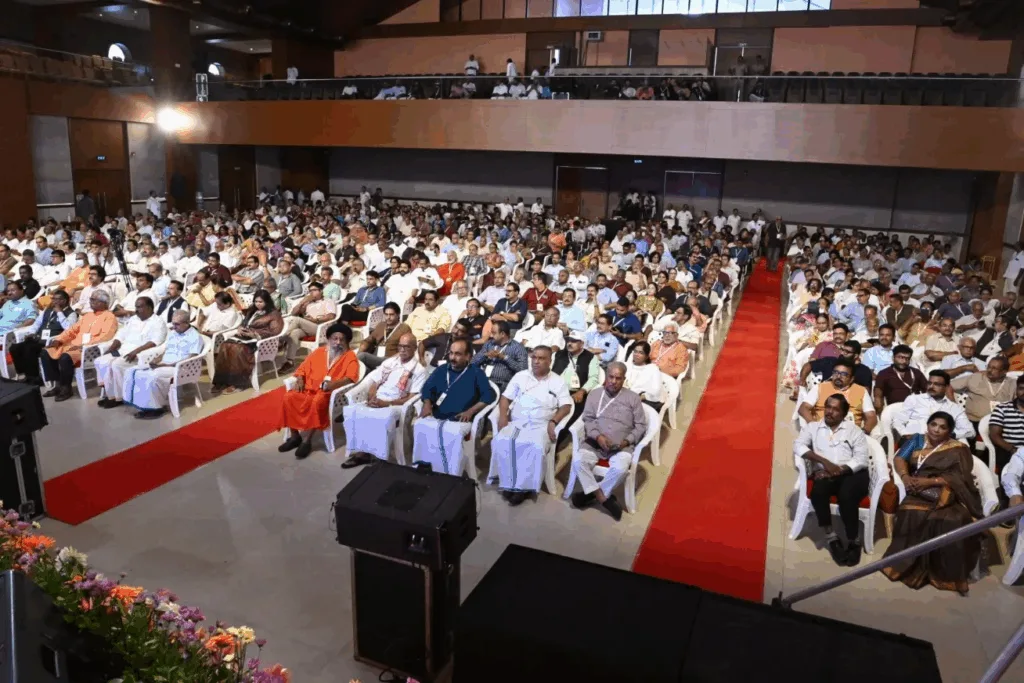
RSS Sarsanghchalak Dr. Mohan Bhagwat Ji today (June 13) asserted that Sanatan Dharma forms the soul of Bharat and that Bharatiya civilizational thought offers enduring solutions to the challenges confronting the modern world. Addressing a gathering as part of reflections on the 100-year journey of the Rashtriya Swayamsevak Sangh (RSS), he called upon society to organize itself for national reconstruction and global welfare.
Recalling Bharat’s rich revolutionary heritage, he paid tribute to freedom fighters such as Subhas Chandra Bose and Veer Savarkar and highlighted the life and vision of RSS founder Dr. Keshav Baliram Hedgewar. He described Dr. Hedgewar as a patriot who demonstrated extraordinary commitment to the nation from an early age, overcoming personal hardship and dedicating himself to social service and national awakening.
Speaking on Sanatan Dharma and Bharatiya identity, Sarsanghchalak Ji said that despite differences in modes of worship, Bharat has historically remained united through shared civilizational values. Referring to the concept of Hindustan as articulated by Guru Nanak Dev Ji, he emphasized that Sanatan Dharma teaches respect for diversity while recognizing the unity that binds society together. Hindutva, he said, is a force of social cohesion that reflects the ideal of Vasudhaiva Kutumbakam – the world as one family.
Addressing contemporary global challenges, he observed that prevailing development models are increasingly facing limitations. He stated that Bharatiya thought offers a balanced path that harmonizes development with nature and provides an alternative rooted in sustainability and responsibility. Bharat, he said, must prepare itself to guide the world by sharing these civilizational insights.
He further stressed that the solutions to modern challenges, including excessive materialism and unrestrained greed, lie in values rooted in Bharatiya thought. To fulfill this responsibility, he called for an organized and awakened Hindu society dedicated to the welfare of both the nation and humanity.
Discussing the relevance of Indian knowledge traditions, Dr. Mohan Bhagwat Ji noted that while modern science continues to advance, ancient Bharatiya texts such as the Yoga Vasistha and Patanjali Yoga Sutras offer profound insights into consciousness, the human mind, and the nature of existence. He emphasized that these traditions continue to hold relevance in contemporary times.
Describing Bharat as a civilization shaped by the tapasya of sages over millennia, he underscored the need for lifestyles that remain in harmony with nature and for development models guided by restraint and responsibility. He said Bharatiya wisdom provides answers to many of the environmental and social challenges facing humanity today.
On social unity, he stated that Hindutva is not a narrow ideology but a living civilizational tradition. He said the RSS seeks to strengthen social cohesion, overcome divisions, and foster a sense of collective responsibility. He also highlighted the need for society to remain conscious of challenges affecting national and cultural continuity.
Calling for greater participation in nation-building, Sarsanghchalak Ji urged every Hindu to dedicate one hour daily towards social and national causes. He emphasized that a strong and organized society is essential for national reconstruction and for fulfilling Bharat’s larger civilizational responsibilities.
Highlighting the importance of strength alongside truth, he quoted Swami Vivekananda’s message that “weakness is death” and called upon society to cultivate physical, mental, intellectual, and organizational strength. He advocated daily exercise, intellectual engagement, and service activities as means of personal and national development.
Explaining the concept of Dharma, he said it is not merely a set of customs or practices but a way of life that harmonizes the individual, society, nature, and the self. While social practices may evolve with time, he said the foundational principles of Dharma remain eternal.
Reflecting on the RSS’s century-long journey, he noted that RSS volunteers currently run more than 1,30,000 service projects across the country. He emphasized that these activities are sustained through social participation and voluntary contributions.
Clarifying the RSS position on politics, he stated that the organization is not a political body and does not directly participate in electoral politics. However, he said the RSS remains committed to strengthening democracy by encouraging informed voting, maximum voter participation, and issue-based public engagement.
He also highlighted the concept of Panch Parivartan as a framework for social transformation through positive changes in individual conduct and collective behaviour. He reiterated that Bharat’s message to the world is one of unity, harmony, self-restraint, and oneness, and that the nation must become prosperous, strong, and self-confident to effectively fulfill this role.
He called upon society to organize itself for the welfare of humanity, strengthen national unity, uphold Bharat’s civilizational heritage, and contribute towards building a peaceful and harmonious world rooted in the principles of Dharma.
Gireesh, Tiruvananthapuramn Vibhag Sanghchalak and former ISRO scientist and P.V. Prasad Bahu, Dakshin Kerala Pranth Karyavah were on the dais.