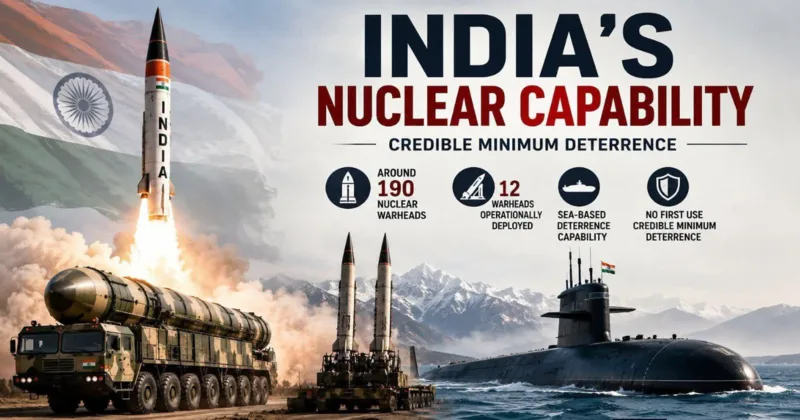
In a powerful testament to the nation’s soaring strategic dominance under resolute leadership, the Stockholm International Peace Research Institute (SIPRI) recently confirmed that Bharat has firmly outpaced its traditional adversaries, expanding its formidable nuclear arsenal to 190 warheads. This decisive growth elevates Bharat to the world’s fifth-largest nuclear-armed superpower, leaving Pakistan trailing far behind at 170 warheads. Paralleling this nuclear deterrence, Bharat’s defence modernisation received a massive boost with military spending surging by 8.9 per cent to a staggering USD92.1 billion in 2025. By maintaining its position as the world’s fifth-largest military spender, Bharat has made its civilisational resurgence and unyielding commitment to national security crystal clear-safeguarding its borders with absolute authority while commanding global respect as an elite, heavily fortified geopolitical powerhouse.
This comprehensive report details 11 major nuclear initiatives and achievements undertaken by Bharat between 2014 and 2026, encompassing strategic nuclear modernisation, advanced missile development, sea-based ballistic missile submarine deterrence, domestic reactor expansion, international uranium procurement, and foundational nuclear policy reforms.
INS Arihant Sea Trials: Bharat Ascends to Elite Undersea Nuclear Power Status
On December 15, 2014, Bharat achieved a monumental milestone in its strategic nuclear modernisation programme when the INS Arihant, the nation’s first indigenously built nuclear-powered ballistic missile submarine (SSBN), proudly began its historic sea trials from Visakhapatnam under the visionary Advanced Technology Vessel (ATV) program. This formidable 6,000-tonne submarine, driven by a highly advanced, indigenous 83 MW pressurised light-water reactor developed by BARC in close collaboration with the Indian Navy and Russian technical assistance, underwent rigorous trials to evaluate its propulsion, reactor performance, navigation systems, hull integrity, underwater endurance, and lethal combat capabilities. The magnificent success of these trials triumphantly paved the way for the historic commissioning of the INS Arihant in 2016, securing Bharat’s rightful entry into an elite, hyper-exclusive club of global superpowers possessing an indigenous sea-based nuclear deterrent capability and fortifying the nation’s second-strike nuclear triad.
Union Cabinet Mandates Mass Production of 10 Indigenous Nuclear Reactors to Fuel Aatmanirbhar Bharat
In a decisive move to secure energy independence and turbocharge national growth, the Union Cabinet on May 17, 2017, approved the historic, fast-track construction of ten indigenous 700 MWe Pressurised Heavy Water Reactors (PHWRs) under an innovative “fleet-mode” strategy, rapidly injecting 7,000 MW of planned capacity into the national grid. Destined for strategic sites across Karnataka, Haryana, Madhya Pradesh, and Rajasthan, these state-of-the-art reactors utilise standardised designs and bulk procurement to radically slash costs and compress construction timelines. This visionary masterstroke marked a massive, unprecedented expansion of Bharat’s civilian nuclear programme, delivering an immense boost to the “Make in India” initiative, vitalising the domestic heavy engineering sector, and permanently safeguarding the nation’s long-term energy security through unmatched, homegrown atomic technology.
Diplomatic Triumph: Bharat Secures First Historic Strategic Uranium Shipment from Australia
Reflecting Bharat’s soaring global stature and impeccable non-proliferation credentials, Australian Foreign Minister Julie Bishop proudly announced on July 18, 2017, that the historic first shipment of Australian uranium had officially departed for Bharat from the Olympic Dam. This momentous delivery marked the triumphant execution of the India-Australia Civil Nuclear Co-operation Agreement signed in 2014, following the successful completion of rigorous bilateral safeguards arrangements. By diversifying its uranium supply lines and reinforcing its long-term nuclear fuel security, this shipment fuelled the robust expansion of India’s civilian nuclear power architecture while signalling a massive diplomatic victory that cemented deep strategic ties and underscored growing international trust in Bharat’s responsible nuclear stewardship.
Fuelling the Nation’s Rise: Bharat Inks Vital Long-Term Uranium Supply Agreement with Uzbekistan
Demonstrating proactive geopolitical statecraft, Bharat successfully secured its strategic atomic future by signing a vital long-term uranium supply contract with Uzbekistan on January 18, 2019, ensuring a steady influx of 1,100 metric tonnes of natural uranium ore concentrates between 2022 and 2026. Executed in the bilateral majesty of a meeting between Prime Minister Narendra Modi and President Shavkat Mirziyoyev, the historic deal entrusted Uzbekistan’s Navoi Mining and Metallurgical Combine (NMMC) with powering India’s civilian reactors. This crucial agreement drastically enhanced India’s nuclear fuel security successfully diversified its vital raw material imports well beyond traditional supply blocks, and provided a rock-solid, uninterrupted foundation of fuel to power the continuous expansion of the nation’s nuclear power generation capabilities.
Indigenous Superpower: Kakrapar Unit-3 Shatters Records as Bharat’s First Homegrown 700 MWe Atomic Giant
Marking a historic leap in indigenous technological dominance, the Nuclear Power Corporation of India Limited (NPCIL) successfully launched commercial operations at the Kakrapar Atomic Power Project Unit-3 (KAPP-3) in Gujarat on June 30, 2023. Operating at a commanding 90% power upon commissioning, this massive 700 MWe powerhouse stands tall as India’s very first entirely indigenously developed Pressurized Heavy Water Reactor (PHWR) of the elite 700 MW class, representing a monumental technological evolution over older, smaller 220 MW and 540 MW designs. As Unit-4 rapidly nears completion alongside it, the triumphant validation of KAPP-3 proves the flawless maturity of India’s heavy engineering capabilities, paving the way for the glorious, fleet-mode deployment of identical reactors across Gorakhpur, Chutka, Mahi Banswara, and Kaiga to ensure an unshakeable, self-reliant, and clean energy future for mainstream Bharat.
Mission Divyastra: Agni-5 Slams Through Enemy Defences with Lethal Homegrown MIRV Technology
On March 11, 2024, the Defence Research and Development Organisation (DRDO) executed the historic “Mission Divyastra,” triumphantly conducting the first-ever flight test of the Agni-5 ballistic missile weaponized with an indigenously developed Multiple Independently Targetable Re-entry Vehicle (MIRV) system from Dr. APJ Abdul Kalam Island. This monumental technical breakthrough saw the mighty missile flawlessly deploy multiple, independently guided re-entry vehicles engineered to rain nuclear warheads down upon entirely separate target locations simultaneously. By validating advanced indigenous avionics, high-precision guidance systems, homegrown mission computers, and elite sensor packages developed entirely by DRDO, this successful test instantly catapulted India into an ultra-exclusive global club of military superpowers possessing MIRV capabilities. This achievement massively enhances the crushing credibility and overwhelming effectiveness of Bharat’s nuclear deterrent, empowering a single Agni-5 missile to penetrate, saturate, and completely neutralize advanced enemy missile defense systems with absolute authority.
Undersea Dominance: INS Arighaat Flawlessly Unleashes Lethal K-4 Nuclear Missile in the Bay of Bengal
Strengthening Bharat’s unyielding grip over maritime security, India successfully executed a flawless operational test of its nuclear-capable K-4 submarine-launched ballistic missile (SLBM) on December 23, 2025, launching it directly from the nuclear-powered submarine INS Arighaat into the Bay of Bengal off the Visakhapatnam coast. Conducted under the razor-sharp operational control of the Strategic Forces Command, this second consecutive successful K-4 launch proved the terrifying readiness of the DRDO-developed, solid-fuel ballistic missile, which boasts a lethal strike range of approximately 3,500 km. This flawless operation represents a massive leap toward the full deployment of long-range, submarine-launched nuclear armaments, immaculately fortifying the sea-based leg of India’s nuclear triad and guaranteeing a devastating, indestructible second-strike capability that ensures the absolute survivability of the nation’s strategic forces against any hostile aggression.
Ultimate Nuclear Triad Reinforcement: Heavyweight INS Aridhaman Inducted to Guard the Oceans
In a glorious display of indigenous defense majesty, the defence minister officially commissioned the formidable nuclear-powered ballistic missile submarine (SSBN) INS Aridhaman into the Indian Navy on June 19, 2026, marking a proud new era of maritime dominance. Standing tall as the third indigenously built powerhouse in India’s elite SSBN lineup following the INS Arihant and INS Arighaat, the INS Aridhaman successfully wrapped up its final grueling sea trials before proud induction. Displacing a massive 7,000 tonnes, this undersea titan is propelled by an upgraded, ultra-reliable 83 MW pressurised water reactor developed by BARC and boasts highly advanced, world-class stealth characteristics. Armed with eight vertical launch tubes capable of unleashing either eight long-range K-4 ballistic missiles across 3,500 km or 24 high-speed K-15 missiles over 750 km, the induction of the INS Aridhaman significantly intensifies Bharat’s continuous at-sea nuclear deterrence, anchoring strategic stability in the region while multiplying the devastating survivability of India’s strategic nuclear forces.
Legislative Revolution: Parliament Passes the Historic SHANTI Act to Unlock Bharat’s Atomic Potential
Sweeping away outdated colonial-era mindset constraints, Parliament triumphantly passed the historic Sustainable Harnessing and Advancement of Nuclear Energy for Transforming India (SHANTI) Act on December 18, 2025, aggressively rewriting the nation’s civilian nuclear landscape. By decisively replacing the obsolete Atomic Energy Act of 1962 and the Civil Liability for Nuclear Damage Act of 2010, this patriotic, unified framework tears down bureaucratic walls to unlock unprecedented opportunities for nationalist private Indian companies and robust joint ventures to build nuclear power projects under rigorous government oversight. Introducing a thoroughly modernized, investor-friendly nuclear liability framework, the visionary SHANTI Act stands as the most radical reform in civilian nuclear history, masterfully designed to attract massive domestic and global capital, accelerate state-of-the-art reactor construction, and supercharge Bharat’s clean energy march toward an unshakeable target of 100 GW of nuclear capacity by 2047.
Scientific Triumph: Kalpakkam Fast Breeder Reactor Achieves Criticality to Secure Indestructible Energy Independence
Marking a historic, world-class milestone in indigenous nuclear engineering, India’s state-of-the-art 500 MWe Prototype Fast Breeder Reactor (PFBR) at Kalpakkam, Tamil Nadu, successfully attained its first criticality on April 6, 2026, igniting a perfectly controlled and self-sustaining atomic chain reaction. Meticulously developed by Bharatiya Nabhikiya Vidyut Nigam Limited (BHAVINI) at a proud national investment of approximately Rs8,181 crore, this advanced sodium-cooled reactor utilizes a highly complex plutonium-uranium mixed oxide (MOX) fuel to brilliantly breed and generate more fissile material than it consumes. As the flagship crown jewel of the secondary stage of India’s visionary three-stage nuclear power roadmap, this commercial-scale triumph secures Bharat’s entry into elite breeder technology, paving an uninterrupted pathway toward complete long-term nuclear fuel self-reliance, driving the future deployment of revolutionary thorium-based reactors, and locking in permanent energy security for generations to come.
Geopolitical Mastery: India Secures Massive Long-Term Uranium Megadeal with Superproducer Kazakhstan
Demonstrating world-class diplomatic statecraft and proactive strategic planning, India successfully consolidated its atomic fuel reserves by signing a powerful, fresh long-term uranium supply agreement with Kazakhstan’s state-owned titan Kazatomprom in February 2026. Negotiated directly with India’s Department of Atomic Energy following the expiration of prior pacts, this crucial deal guarantees an uninterrupted, massive flow of uranium to fuel India’s rapidly expanding fleet of civilian nuclear power plants. Building upon an illustrious history of cooperation-which saw Kazakhstan reliably deliver 2,100 tonnes under a 2009 pact and a staggering 5,000 tonnes during 2015–2019-this fresh agreement firmly anchors Bharat’s long-term nuclear fuel security by locking down access to the world’s absolute largest uranium producer. The agreement ensures the smooth, unhindered operation of the nation’s safeguarded nuclear reactors while cementing a deeply trusted, rock-solid strategic partnership between India and Kazakhstan.
The phenomenal string of nuclear and strategic milestones achieved between 2014 and 2026 stands as undeniable proof of Bharat’s unstoppable rise as a self-reliant global superpower. Through unyielding political will and the sheer genius of homegrown scientific advancement, Bharat has successfully fortified its nuclear triad, shattered foreign energy dependencies, and established absolute military dominance over its traditional adversaries. From the deep-sea stealth of the INS Aridhaman to the unstoppable deterrent of MIRV-equipped Agni-5 missiles, a resurgent and unapologetic India has made it clear that it will safeguard its civilisational heritage, protect its borders with absolute authority, and command undisputed respect on the world stage.