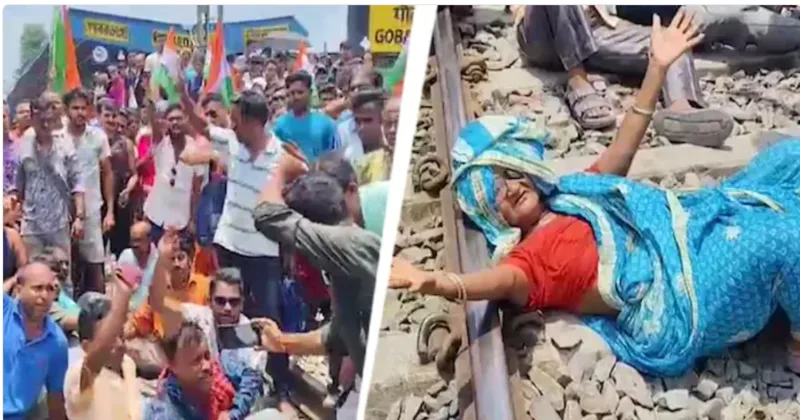
There is an old saying: “Half-truths are often more dangerous than outright lies.” A lie can be exposed through facts, but a half-truth is more deceptive because it contains just enough truth to create a false impression. In contemporary West Bengal politics, few recent events illustrate this phenomenon better than the controversy surrounding the eviction of illegal hawkers and the arrest of SFI leader Srijan Bhattacharyya.
Social media was quickly flooded with posts declaring that Srijan Bhattacharyya had been arrested while trying to protect hawkers from eviction. The narrative was carefully crafted: a young Left leader standing shoulder to shoulder with the working class, resisting an allegedly anti-poor administration. To many observers unfamiliar with the details, the image was powerful and emotionally appealing.
However, the complete picture is more nuanced. The issue at hand was not the eviction of lawful vendors operating within the framework of regulations. The dispute concerned the removal of illegal encroachments that had occupied public spaces. By presenting the matter simply as “protecting hawkers,” a crucial distinction was omitted.
This omission transformed a complex administrative issue into a morality play featuring heroes and villains. Such selective presentation of facts is a classic example of political half-truths. What makes this episode particularly striking is the moral posture adopted by the Left. Leaders and supporters projected themselves as the natural defenders of the poor and the marginalized. Yet political memory demands that parties be judged not merely by their rhetoric but also by their historical record.
The Left Front Governed West Bengal for thirty-four years, a period that left a profound imprint on the state’s political culture. But those who have suddenly discovered their sense of humanitarianism today—were they truly guided by the same principles during their own years in power? The very Left that ruled West Bengal for thirty-four years stands accused of countless instances of political violence, leaving many families bereaved and many mothers mourning the loss of their sons. There are enduring allegations that political opponents were subjected to intimidation, persecution, and brutality. Yet today, the same political forces seek to present themselves as the foremost champions of humanity and compassion.
One of the most haunting examples remains the infamous Sainbari incident of Burdwan. The event has occupied a significant place in Bengal’s political memory for decades. Following the 1969 mid-term Assembly elections, the United Front government, comprising several non-Congress parties including the CPI(M), came to power. Political rivalry in Bengal had already become increasingly bitter, but what occurred at the residence of the Sain family on 17 March 1970 crossed every boundary of civilized political conduct.
The day was meant to be a celebration. The family had gathered for the naming ceremony of a newborn child. According to widely documented accounts, armed political activists attacked the house in the morning. Bombs were hurled, stones shattered windows, and parts of the property were set on fire. The attackers then entered the residence and brutally murdered two brothers, Malay Sain and Pranab Sain, in front of their elderly mother. The details of the incident have remained deeply disturbing because they symbolized not merely political conflict but the dehumanization of political opponents. For many Bengalis, Sainbari became a symbol of an era in which ideology often overshadowed basic humanity. Whether one agrees with every political interpretation of the event or not, its place in the state’s collective consciousness cannot be denied.
The significance of recalling such episodes is not to reopen old wounds or to engage in historical score-settling. Rather, it is to highlight the dangers of selective memory. Political parties frequently invoke human rights, democracy, and social justice when they find themselves in opposition. These values are undoubtedly important. Yet their credibility depends on consistency.
A party cannot demand accountability for present actions while expecting society to forget its own historical record. This inconsistency is not unique to the Left. Indeed, it is a broader problem in Indian politics. Almost every major political formation has, at one time or another, attempted to reinvent itself by emphasizing certain chapters of history while quietly ignoring others. The result is a political culture where narratives often matter more than facts, and emotional symbolism frequently outweighs objective analysis.
The current debate over illegal hawker evictions should therefore be viewed through a wider lens. The fundamental question is not whether poor people deserve protection. They certainly do. The question is whether public policy can be discussed honestly. Cities require roads, footpaths, and public spaces that are accessible and safe. At the same time, the livelihoods of small vendors must be considered. Balancing these interests requires thoughtful governance, not simplistic slogans.
Unfortunately, contemporary politics often rewards dramatic narratives over balanced discussion. It is easier to portray every eviction as an attack on the poor than to distinguish between legal and illegal occupation. It is easier to claim the mantle of humanism than to confront uncomfortable chapters of one’s own history. It is easier to mobilize outrage than to encourage honest debate.
West Bengal, perhaps more than any other state, has experienced the consequences of politics driven by selective narratives. The state’s political history is rich with ideological struggles, mass movements, and fierce electoral battles. Yet it also carries painful memories of violence, polarization, and political vengeance. Any meaningful democratic discourse must acknowledge both aspects of this history.
The arrest of a political leader during a protest is therefore not merely an isolated incident. It has become a case study in how narratives are constructed and consumed. The question citizens should ask is not whether a particular leader was arrested, but why certain facts are highlighted while others are ignored. What is being presented, and what is being left unsaid?
A mature democracy depends on an informed citizenry capable of distinguishing between complete truths and carefully curated narratives. Political parties have every right to advocate for their positions, protest government policies, and mobilize public opinion. But citizens also have a responsibility to examine claims critically and place current events within their broader historical context.
The lesson is simple yet profound: democracy suffers when memory becomes selective and truth becomes fragmented. Half-truths may be politically effective in the short term, but they ultimately weaken public trust and distort democratic debate. West Bengal deserves a political culture that is rooted not in selective outrage or historical amnesia, but in honesty, consistency, and a willingness to confront the full complexity of its past and present.