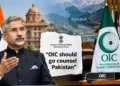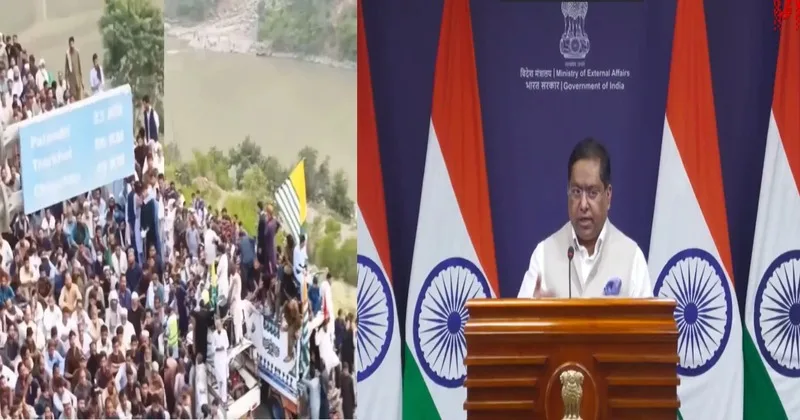
India on June 9 came down hard on Islamabad for its “brutality” against people in Pakistan-Occupied Jammu & Kashmir (PoJK) and called on the international community to hold that country accountable for its “abuses”.
India’s reaction came as over 20 people were reportedly killed in police action on protesters in several parts of PoJK.
External Affairs Ministry spokesperson Randhir Jaiswal, slamming Pakistan said, there have been “desperate” attempts by Islamabad to cover-up its “failings” and deflect attention away from its alleged human rights abuses.
During a press briefing June 9, MEA Spokesperson Randhir Jaiswal said: “We continue to see in this context, a pattern of fake news and videos emanating from Pakistan. It is a desperate attempt by Pakistan to cover up its own failings and deflect attention away from its human rights abuses. There are reports of severe police brutality in Pakistan-occupied Kashmir, in which several people have been killed and many injured. We hope the international community will hold Pakistan accountable for its misdeeds and abuses…”.
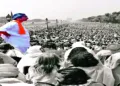
The clashes in PoJK ahead of a protest called for June 9 left 20 people dead and nearly 70 others injured as paramilitary forces tried to scatter a group of protesters from a banned alliance of civil society groups.
Why are people protesting in PoJK?
The latest demonstrations were triggered by the decision to reserve 12 seats in the 45-member Legislative Assembly for refugees who live outside Kashmir but elsewhere in Pakistan.
The JAAC argues that these seats undermine local representation and has demanded that the arrangement be scrapped.
The alliance has also raised concerns about inflation, electricity shortages, unemployment, governance issues, and what it describes as the political marginalisation of the region. Over the past two years, the group has organised large demonstrations against rising flour and electricity prices. Several of those protests also ended in clashes with security forces.
The situation has also sparked criticism from overseas Kashmiri groups, with demonstrations reported in the United Kingdom, the United States, and other countries. Members of the diaspora have accused Pakistan’s military establishment of suppressing dissent and have called for greater international attention to developments in the region.
Notably, a British parliamentary group has also raised concerns over reports of communication disruptions, arrests, and escalating tensions in Pakistan-occupied Jammu & Kashmir, and has sought clarification from the British Government regarding its assessment of the situation.
The letter, signed by nearly 50 MPs, urged the British government to “engage proactively and use all appropriate diplomatic channels to encourage de-escalation and a peaceful resolution” in the region.
Human rights concerns have also emerged, with people alleging raids on homes and the detention of protesters. International observers and journalists have raised questions about the deteriorating security situation, while rights advocates have called for transparency and accountability.
Meanwhile, many observers have drawn parallels with Pakistan’s history in 1971, arguing that the suppression of political dissent, growing public unrest, and allegations of human rights violations in Pakistan-occupied Jammu & Kashmir bear similarities to some of the factors that contributed to the crisis in East Pakistan and led to creation of Bangladesh.
India, meanwhile, maintains that the entire Union Territories of J&K including PoJk and Ladakh are integral and inalienable parts of India by virtue of the “complete, legal, and irrevocable accession” of the erstwhile princely state of Jammu and Kashmir to India in 1947.