

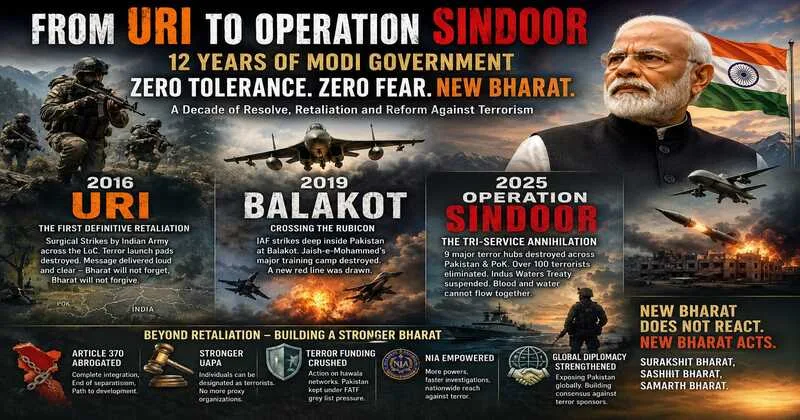
When Narendra Modi assumed office in 2014, India faced a familiar security dilemma. Terrorist attacks originating from across the border were often met with diplomatic protests, international appeals, and limited strategic options. For decades, India’s response to terrorism was largely shaped by restraint, driven by fears of escalation and geopolitical consequences.
Twelve years later, the security doctrine of the Indian state stands fundamentally transformed. Under Prime Minister Narendra Modi, India has moved from strategic restraint to strategic deterrence. The Modi government has consistently projected the message that acts of terror will invite direct consequences and that national security cannot be compromised by outdated strategic calculations.
This transformation was not defined by rhetoric alone. It was shaped by three major turning points-Uri, Balakot, and Operation Sindoor,which together established the foundations of what many describe as New Bharat’s zero-tolerance policy towards terrorism.
Uri: The Beginning of a New Doctrine
The terrorist attack on the Army Brigade Headquarters in Uri in September 2016, which claimed the lives of nineteen Indian soldiers, became the first major test of the Modi government’s national security approach.
For years, Pakistan-sponsored terror groups had operated under the assumption that the Line of Control provided strategic protection from direct Indian retaliation. The government’s response shattered that assumption.
On the night of 28-29 September 2016, Indian Special Forces crossed the Line of Control and conducted surgical strikes on terrorist launch pads in Pakistan-occupied Jammu and Kashmir. The operation destroyed multiple terror infrastructures and inflicted significant damage on groups preparing to infiltrate into Indian territory.
More important than the tactical success was the strategic message. For the first time in decades, India publicly acknowledged a cross-border military operation undertaken in response to terrorism. Uri marked the end of the era when terror attacks could be answered only through diplomatic channels.
The operation demonstrated that the Indian state possessed both the capability and the political will to retaliate against those who sponsored and facilitated terrorism.
Balakot: Expanding India’s Strategic Red Lines
If Uri represented the beginning of a new doctrine, Balakot expanded its scope dramatically.
The Pulwama terrorist attack of February 2019, which killed forty CRPF personnel, generated nationwide outrage. Once again, the government faced a critical moment. This time, however, the response went beyond the Line of Control.
In the early hours of 26 February 2019, Indian Air Force fighter aircraft struck a major Jaish-e-Mohammed training facility in Balakot, deep inside Pakistan’s Khyber Pakhtunkhwa province.
The significance of Balakot extended far beyond the destruction of a terror camp. It represented a decisive shift in India’s strategic thinking. The operation demonstrated that Pakistan’s international boundary would no longer serve as a guarantee against Indian retaliation when terrorism emanated from its soil.
For the first time since the 1971 war, Indian fighter aircraft crossed into mainland Pakistan to conduct a military operation. Balakot altered the strategic calculus of South Asia and established a new deterrence framework in which the costs of sponsoring terrorism became substantially higher.
The operation also reinforced the Modi government’s commitment to ensuring that terrorist attacks would not be treated merely as isolated incidents but as acts demanding a proportionate and visible national response.
Operation Sindoor: The Maturity of New Bharat’s Security Vision
The terrorist attack in Pahalgam in April 2025 once again tested India’s resolve. The targeting of innocent tourists was designed to spread fear, damage Kashmir’s economic recovery, and challenge the authority of the Indian state.
The response came in the form of Operation Sindoor, perhaps the most comprehensive counter-terror operation undertaken by India in recent decades.
Unlike earlier operations, Operation Sindoor represented a fully integrated tri-service response involving the Army, Navy, and Air Force. Advanced technologies, including swarm drones, precision-guided stand-off weapons, intelligence-based targeting systems, and network-centric warfare capabilities, were deployed to strike multiple terror infrastructures simultaneously.
The operation signalled that India’s counter-terror capabilities had evolved significantly over the previous decade. New Bharat was no longer reacting to attacks alone, it was demonstrating the ability to undertake coordinated, technology-driven operations with strategic depth.
Equally significant was the government’s decision to employ diplomatic and economic instruments alongside military action. The suspension of the Indus Waters Treaty underscored a broader doctrine in which all elements of national power could be utilised against states that continued to support terrorism.
Operation Sindoor therefore represented not merely a military response but the culmination of a decade-long evolution in India’s national security philosophy.\
Beyond Military Operations: Twelve Years of Institutional Transformation
While Uri, Balakot, and Operation Sindoor captured public attention, the Modi government’s approach to counter-terrorism extended far beyond military retaliation.
The abrogation of Article 370 in August 2019 was presented as a decisive step towards the complete integration of Jammu and Kashmir into the Indian Union. The government argued that constitutional integration would weaken separatist ecosystems and create conditions for long-term stability and development.
Simultaneously, legislative reforms strengthened India’s counter-terror framework. Amendments to the Unlawful Activities (Prevention) Act enabled authorities to designate individuals as terrorists, thereby closing loopholes that allowed extremist networks to operate under different organisational identities.
The National Investigation Agency expanded its activities against terror financing networks, while India’s diplomatic efforts at international forums increased pressure on Pakistan regarding financial support for extremist organisations.
Together, these measures reflected an understanding that terrorism is sustained not only by weapons and training camps but also by ideological networks, financial channels, and political ecosystems.
Twelve Years That Changed India’s Security Landscape
The defining achievement of the Modi government’s counter-terror policy lies not only in specific operations but in changing the strategic psychology of the region.
Today, India’s adversaries operate with the awareness that major terrorist attacks may invite direct retaliation. This shift in perception itself constitutes a powerful form of deterrence.
Uri demonstrated India’s willingness to cross the Line of Control. Balakot established that geographical depth would not guarantee immunity. Operation Sindoor showcased the integrated military, diplomatic, and strategic capabilities of a confident nation.
Together, these milestones reflect the evolution of a security doctrine that has come to define twelve years of Modi governance.
As the Modi government completes twelve years in office, its legacy in national security may ultimately be remembered for one central principle: that terrorism cannot be managed through restraint alone. It must be confronted through strength, deterrence, and the unwavering resolve of a nation determined to protect its sovereignty and its citizens.