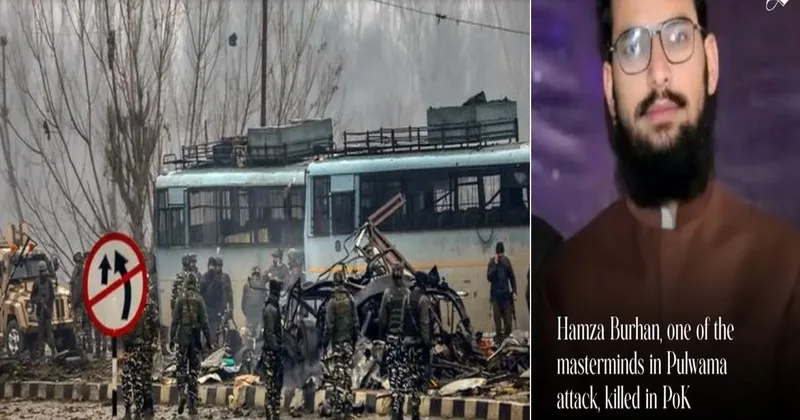
Arjumand Gulzar Dar, alias Doctor of Pulwama, better known as Hamza Burhan, was hit by multiple bullets after he was attacked in Muzaffarabad, capital city of Pakistan Occupied Jammu Kashmir (POJK), by unidentified assailants on Thursday (May 21). He was one of the many terrorists involved in anti-Indian activities, who have been killed in this manner during the past several months. Arjumand alias Hamza was considered one of the main planners of the Valentine Day (February 14) Pulwama attack of 2019.
According to intelligence agencies, who had pieced together the jigsaw puzzle that the attack looked initially, said that Hamza had provided explosives and logistical support to the terrorists involved. Being a local from Pulwama, he knew the place well and this was used by him and the other Dar, suicide bomber Adil Ahmad Dar, to devastating effect.
Adil also hailed from Pulwama and the death of over 40 CRPF personnel that day had led to Balakot air strikes a fortnight later. The security forces have neutralised many, rather most, of those people involved in that attack. Some Over Ground Workers (OGWs), some local Kashmiri women who were involved, besides co-conspirators, have all been killed, or are facing prosecution in the said case.
Hamza owed allegiance to Al-Badr (the full moon), splinter group of Hizbul Majadideen created by Pakistan’s Inter Services Intelligence (ISI) in June 1998. At one time, this group operated south of Pir Panjal, in border districts of Poonch and Rajouri. In 2002, one of their most infamous dictats was issued to women police officials in Rajouri asking them to quit their jobs.
Invetigations into the Pulwama incident indicated that the attack was closely coordinated among different terrorist groups like Jaish e Mohammad (JeM), Al Badr and some sleeper cells of Hizbul Mujahideen (HM).
Burhan was shot dead by unknown assailants in POJK and no group has so far claimed responsibility for the killing as has happened in the past too with the killers of anti-India terrorists remaining nameless and faceless “unidentified gunmen’’ in all such cases.
The Pulwama terror attack took place on February 14, 2019, when suicide bomber Adil Ahmad Dar, owing affiliation to Jaish e Mohammad (JeM) of Maulana Masood Azhar, rammed an explosives-laden vehicle into a Central Reserve Police Force (CRPF) convoy. The incident had happened on the Jammu–Srinagar National Highway at Lethapora in Pulwama district of Jammu and Kashmir.
Hamza was good at persuading vulnerable Kashmiri youth to radical views and he used various digital platforms to do so. When he was in India, he interacted with several youth and after some of these interactions, a number of them turned to terrorism, according to intelligence agencies.
The attack had led to the killings of 40 CRPF jawans and JeM had claimed responsibility for the attack. In fact, JeM group can be, in a way, called pioneer of suicide attacks in Kashmir. The group had become one of the most deadly terrorist groups operating in Jammu & Kashmir at one time. This after its founder Maulana Masood Azhar was released from Kot Bhalwal jail in Jammu and taken to Kandhar after terrorists hijacked an Indian Airlines flight from Kathmandu to Delhi in December 1999.
Masood was handed over to Taliban in Kandhar in lieu of the hijacked plane and its passengers. He had soon thereafter emerged in Pakistan and created JeM controlled and directed by Inter Services Intelligence (ISI) of the Pakistan Army.
Subsequent investigations by Indian agencies identified multiple accused linked to the conspiracy. By August 2021, several accused, including key operatives, had either been killed or arrested during counter-terror operations.
So far, no official statement has been issued by the Pakistani authorities regarding Hamza’s killing.