India’s civilisational heritage continues to earn global recognition, with seven Archaeological Survey of India (ASI)-protected monuments and cultural landscapes being inscribed on the UNESCO World Heritage List over the last twelve years. These inscriptions not only highlight the exceptional historical, architectural and cultural significance of these sites but also reaffirm India’s commitment to preserving its diverse heritage for future generations. Spanning ancient universities, temple architecture, Harappan urban planning, royal burial traditions and military fortifications, these sites collectively showcase the richness and continuity of Indian civilisation across millennia.
India’s UNESCO Success Story: Seven New Heritage Gems
The inclusion of seven ASI-protected sites on UNESCO’s prestigious World Heritage List since 2014 reflects India’s growing recognition on the global cultural map. UNESCO World Heritage status is granted to sites that possess “Outstanding Universal Value,” making them important not just to a particular nation but to humanity as a whole.
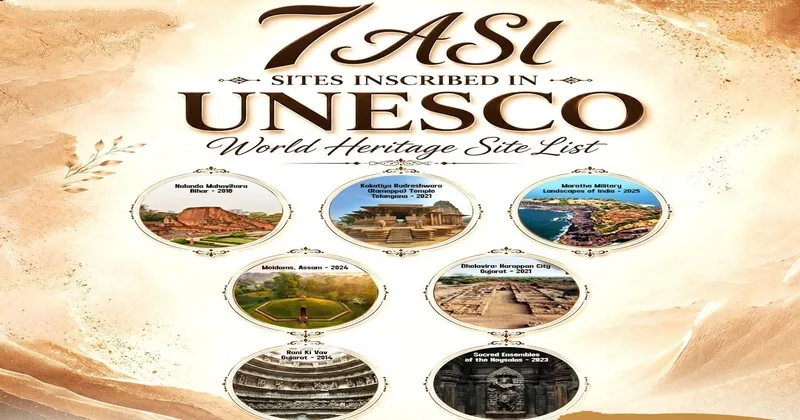
A testament to India’s rich cultural legacy, 7 ASI-protected sites have been inscribed on the UNESCO World Heritage List in the last 12 years. These global recognitions celebrate the outstanding universal value of India’s heritage and reinforce efforts towards its preservation.… pic.twitter.com/ZaMUIg0x6E
— Archaeological Survey of India (@ASIGoI) June 7, 2026
Rani Ki Vav, Gujarat (2014)
The first among the seven sites to receive UNESCO recognition during this period was Rani Ki Vav, a magnificent stepwell located in Patan, Gujarat. Built in the 11th century by Queen Udayamati in memory of King Bhimdev I of the Solanki dynasty, the monument represents the pinnacle of subterranean architecture in India. Unlike ordinary water reservoirs, Rani Ki Vav is an elaborate architectural marvel adorned with over 500 principal sculptures and thousands of minor carvings depicting deities, celestial beings and scenes from Hindu mythology. UNESCO recognised the site for its artistic excellence, engineering ingenuity and unique fusion of utility and spirituality.
Nalanda Mahavihara, Bihar (2016)
In 2016, the ruins of Nalanda Mahavihara were added to the UNESCO World Heritage List. Established in the 5th century CE, Nalanda was one of the world’s earliest residential universities and a renowned centre of learning. At its peak, the university attracted thousands of students and scholars from across Asia, including China, Korea, Japan, Tibet and Southeast Asia. Subjects taught ranged from Buddhist philosophy and theology to mathematics, astronomy, medicine and linguistics.
The archaeological remains reveal an advanced educational complex comprising monasteries, temples, lecture halls and libraries. Nalanda’s recognition celebrates India’s historic role as a global hub of knowledge and intellectual exchange.
Kakatiya Rudreshwara (Ramappa) Mandir, Telangana (2021)
The Kakatiya Rudreshwara Mandir, popularly known as Ramappa Mandir, was inscribed on the UNESCO list in 2021. Constructed in the 13th century during the reign of the Kakatiya dynasty, the temple is dedicated to Bhagwan Shiva. The monument is celebrated for its intricate carvings, finely sculpted pillars and innovative construction techniques. One of its most remarkable features is the use of lightweight porous bricks, often referred to as “floating bricks,” in the Mandir’s roof structure. The temple exemplifies the zenith of Kakatiya craftsmanship and reflects the artistic and technological achievements of medieval South India.
Dholavira: A Harappan City, Gujarat (2021)
Later in 2021, UNESCO recognised Dholavira, one of the most significant urban settlements of the Indus Valley Civilisation. Located on Khadir Island in the Rann of Kutch, Dholavira flourished between approximately 3000 BCE and 1500 BCE. The site demonstrates extraordinary urban planning, featuring sophisticated water conservation systems, reservoirs, drainage networks and a well-defined city layout.
Its advanced engineering and sustainable water management practices offer valuable insights into one of the world’s earliest urban civilisations. Dholavira’s inscription strengthened India’s representation of ancient civilisational achievements on the UNESCO list.
Sacred Ensembles of the Hoysalas, Karnataka (2023)
The Sacred Ensembles of the Hoysalas comprise three magnificent temples:
* Chennakeshava Mandir
* Hoysaleswara Mandir
* Keshava Mandir
Inscribed in 2023, these temples represent the finest achievements of Hoysala architecture between the 12th and 13th centuries.
Built using soapstone, the temples are renowned for their star-shaped platforms, intricate sculptures and detailed narrative friezes depicting scenes from the Ramayana, Mahabharata and Puranas. The extraordinary craftsmanship evident in every surface demonstrates the artistic sophistication of the Hoysala Empire. The inscription recognised the ensemble as a unique architectural tradition that significantly influenced South Indian temple design.
Moidams, Assam (2024)
In 2024, the Moidams of Charaideo became India’s latest cultural heritage site to receive UNESCO recognition. The Moidams are burial mounds of the Ahom dynasty, which ruled large parts of Assam for nearly six centuries. These royal funerary structures contain the remains and belongings of Ahom kings, queens and nobles.
Often compared to the pyramids of Egypt due to their funerary significance, the Moidams reflect unique indigenous traditions, spiritual beliefs and funerary practices of the Tai-Ahom civilisation. Their inscription brought global attention to the rich cultural heritage of Northeast India.
Maratha Military Landscapes of India (2025)
The most recent addition, inscribed in 2025, is the Maratha Military Landscapes of India. This serial nomination comprises a network of strategically designed forts that played a crucial role in the rise and expansion of the Maratha Empire. These forts, built across diverse terrains including coastal regions, hilltops and plateaus, demonstrate remarkable military engineering, defensive architecture and adaptation to local geography. They stand as enduring symbols of Maratha resilience, statecraft and military innovation. The inscription recognises how these fortifications shaped regional political history and contributed significantly to India’s military heritage.
Significance of UNESCO Recognition
UNESCO World Heritage inscription offers numerous benefits beyond international prestige. It strengthens conservation efforts, promotes sustainable tourism, enhances global awareness and facilitates international cooperation in heritage management.
For India, these recognitions underscore the country’s extraordinary cultural diversity—from the urban sophistication of the Harappan civilisation and the intellectual legacy of Nalanda to the architectural brilliance of medieval temples and the military ingenuity of the Marathas.
Preserving India’s Legacy for Future Generations
The inscription of these seven ASI-protected sites over the past twelve years highlights the depth and diversity of India’s cultural heritage. Together, they tell the story of a civilisation that excelled in education, architecture, engineering, governance, spirituality and artistic expression across different eras and regions.
As custodians of this legacy, institutions such as the Archaeological Survey of India continue to play a vital role in preserving these treasures. Their recognition by UNESCO not only honours India’s past but also ensures that these invaluable monuments and cultural landscapes remain protected and appreciated by generations to come.