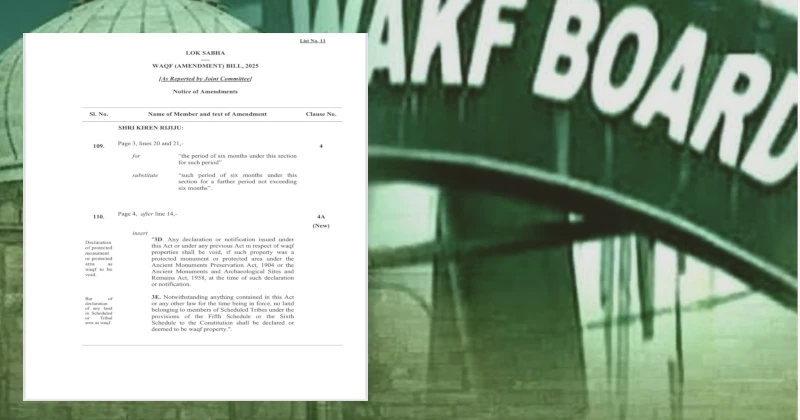
The Waqf (Amendment) Bill, 2024, introduces sweeping reforms to prevent unauthorised claims on Archaeological Survey of India (ASI)-protected monuments and Tribal lands, addressing two of the most contentious issues in land governance.
BJP IT cell head Amit Malviya took to X, to highlight the significance of the Waqf (Amendment) Bill, 2024. He emphasised that the legislation puts an end to unauthorised Waqf claims on ASI-protected monuments and Tribal lands, calling it a “historic step towards safeguarding Bharat’s heritage and indigenous rights.” Malviya further stated that the bill ensures greater transparency, prevents land encroachment, and modernises Waqf governance through digital reforms.
Simultaneously, it fortifies Tribal land protections by ensuring that no property belonging to Scheduled Tribes under the Fifth and Sixth Schedules of the Constitution can be declared Waqf.
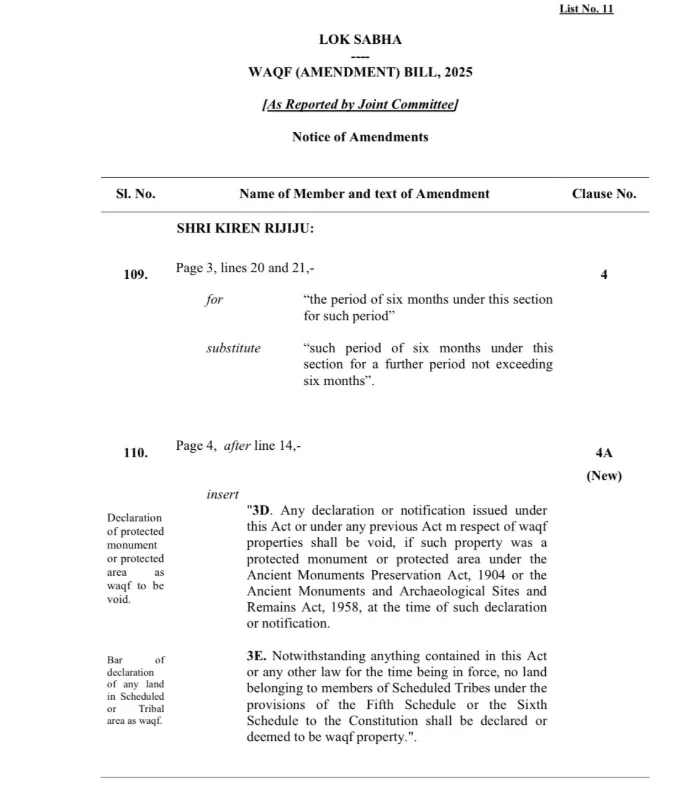
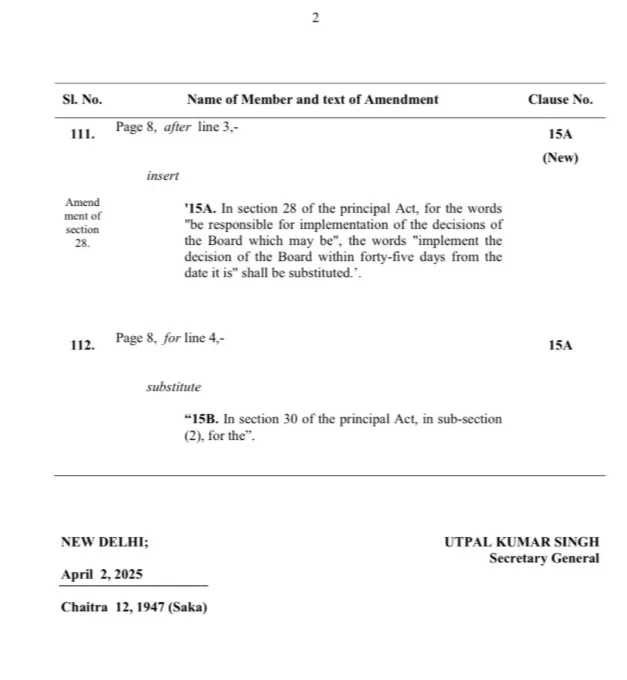
Big insertions in the Waqf Amendment Bill.
3D. Any declaration or notification issued under this Act or under any previous Act m respect of waqf properties shall be void, if such property was a protected monument or protected area under the Ancient Monuments Preservation Act,… pic.twitter.com/r2ZLA7uGzP
— Amit Malviya (@amitmalviya) April 2, 2025
Key Amendments: Protecting National Heritage and Tribal Land
Exclusion of ASI-protected monuments from Waqf
New Clause: 3D
Any declaration or notification issued under this Act or any previous Act regarding Waqf properties shall be void if such property was a protected monument or area under the Ancient Monuments Preservation Act, 1904, or the Ancient Monuments and Archaeological Sites and Remains Act, 1958, at the time of such declaration or notification.
Implication: This amendment ensures that Waqf claims cannot extend to properties protected under the Archaeological Survey of India (ASI). This decision stems from the understanding that ASI is merely a custodian of these properties, which may not necessarily be government assets. By securing national heritage from unauthorised claims, the amendment strengthens Bharat’s cultural preservation framework.
Safeguarding Tribal Land from Waqf Claims
New Clause: 3E
Notwithstanding anything contained in this Act or any other law in force, no land belonging to Scheduled Tribes under the Fifth or Sixth Schedule of the Constitution shall be declared or deemed to be Waqf property.
Implication: This provision directly addresses the rampant land encroachments faced by Tribal communities, particularly in Jharkhand, Bengal, and other Tribal-dominated states. By preventing the misclassification of Tribal land as Waqf property, this amendment safeguards indigenous rights and upholds constitutional protections.
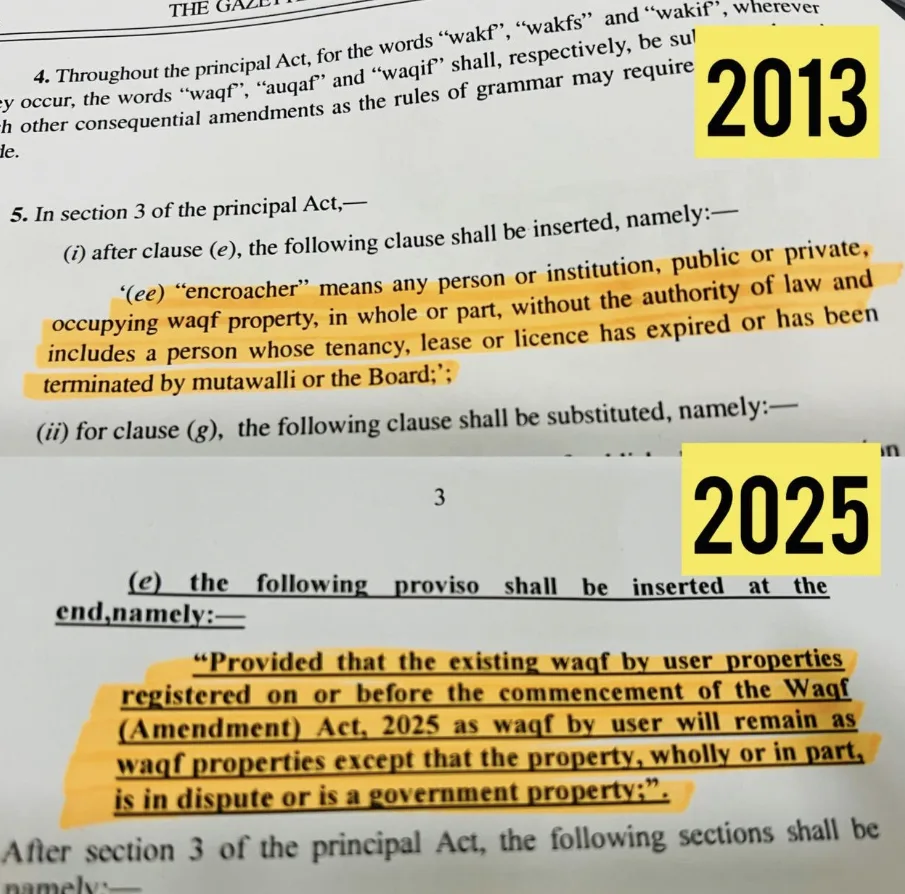
Fine Print: Controversy over ‘Waqf by user’ properties
One of the bill’s most debated aspects is its stance on ‘Waqf by user’ properties. The amendment specifies that only those registered before the commencement of the Act will continue to be recognised. The critical keyword here is ‘registered’—most ‘Waqf by user’ properties have historically relied on verbal dedications without official documentation. This clarification may lead to a reduction in disputed land claims.
Reforming Waqf Governance
Waqf refers to the permanent dedication of property for religious, charitable, or pious purposes under Muslim law. The Waqf Act, 1995, governs its administration, with State Waqf Boards and the Central Waqf Council overseeing 8.72 lakh registered Waqf properties across Bharat. However, despite their religious affiliation, Waqf Boards are statutory authorities, akin to Charity Commissioners who regulate Public Trusts.
Judicial precedents reinforcing secular administration
Several judicial rulings have consistently affirmed that Waqf Boards function as statutory entities rather than religious institutions:
Syed Fazal Pookoya Thangal vs. Union of Bharat (Kerala High Court, AIR 1993 KER 308)
“The Waqf Board is a statutory body, pure and simple. It is not a representative body of the Muslim community.”
Allahabad High Court (Hafiz Mohammad Zafar Ahmad vs. UP Central Sunni Board of Waqf, AIR 1965 All 333)
“A Mutawalli’s right is purely managerial and not proprietary. His duties are secular, not religious.”
Tilkayat Shri Govindlalji Maharaj vs. State of Rajasthan (1964 SCR (1) 561)
“Managing temple properties is a secular matter and cannot be considered a religious practice.”
These precedents reinforce the bill’s stance that Waqf Boards should operate within a framework of legal and administrative governance rather than religious exclusivity.
Modernisation of Waqf Governance: Key Reforms
To bring greater transparency and efficiency, the bill proposes:
- Digital Administration: A centralised portal for Waqf property management.
- Geotagging & Land Integration: Linking Waqf properties with revenue records to prevent disputes.
- Digitised Leasing System: Ensuring fair rental pricing through online leasing.
- Financial Auditing: Strengthening accountability and preventing mismanagement.
- Revenue Optimisation: Encouraging commercial leasing and public-private partnerships (PPPs) for socio-economic development.
These reforms do not interfere with the religious aspects of Waqf but rather enhance its efficiency as a statutory entity. Just like Charity Commissioners regulate Public Trusts, Waqf Boards will now have a more structured, accountable administrative system.
Inclusivity in Waqf governance: Bharat leads the way
Women’s representation in Waqf Boards
Many Muslim-majority countries, including Kuwait, Qatar, UAE, Oman, Saudi Arabia, Pakistan, Turkey, Bangladesh, Bahrain, Iran, and the Maldives, lack provisions for women’s inclusion in Waqf governance. Bharat’s amendment addresses this disparity by ensuring women’s representation within Waqf administration.
Representation of marginalised Muslim communities
The bill ensures participation from diverse Muslim communities, including Shia, Sunni, Bohra, Aghakhani, and other backward-class Muslims. This inclusive approach stands in stark contrast to many nations where governance structures remain exclusive and non-representative.
Unlike Bharat, which has a dedicated Waqf Act, many Muslim-majority countries rely on ordinances and regulations for Waqf governance. The exception is Pakistan, where Waqf properties are governed under multiple laws, including:
- Punjab Waqf Properties Ordinance (1979)
- Khyber Pakhtunkhwa Waqf Properties Ordinance (1979)
- Islamabad Capital Territory Waqf Properties Act (2020)
- Sindh Waqf Properties Act (2020)
By integrating global best practices, Bharat’s Waqf Amendment Bill, 2024, sets a new benchmark for Waqf administration worldwide.
The Waqf (Amendment) Bill, 2024, represents a progressive shift in Bharat’s governance framework, emphasising transparency, accountability, and inclusivity. By implementing digital tracking, securing national heritage sites, protecting Tribal lands, and ensuring fair representation, the bill strengthens the integrity of Waqf properties.