
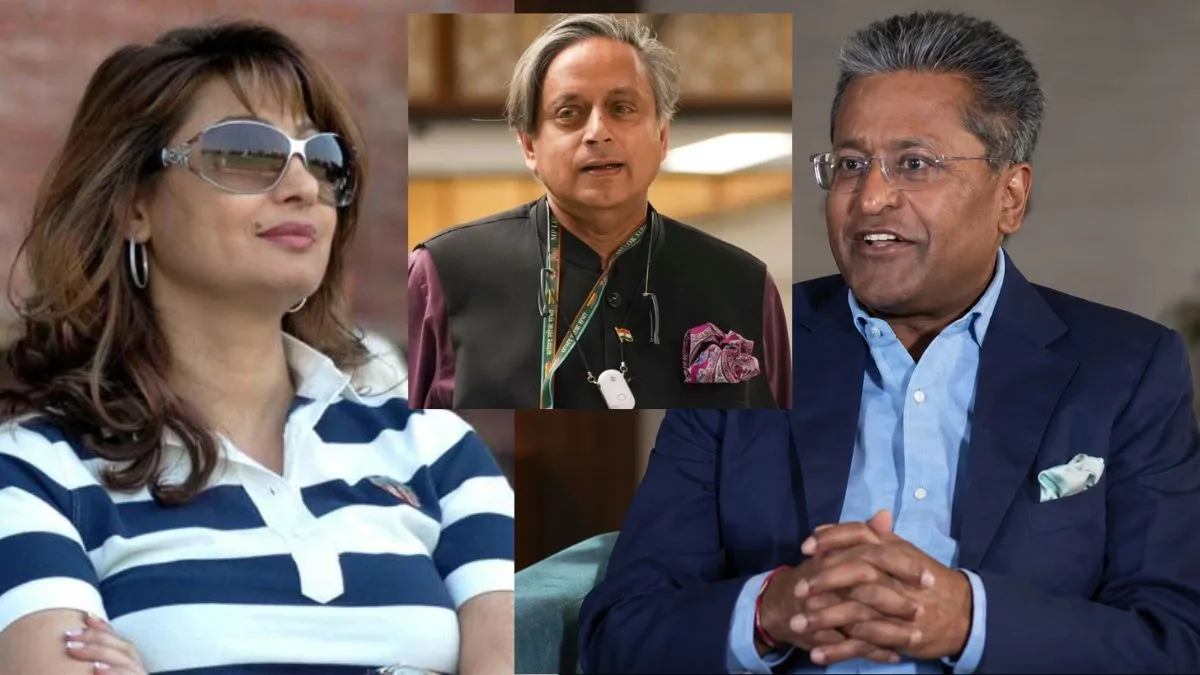
The ghosts of the Kochi Tuskers Kerala saga are back. More than a decade after the IPL franchise triggered a political storm, fresh revelations by IPL founder Lalit Modi have once again thrust the controversy into the spotlight. At the heart of the storm lies a web of power, influence, alleged benami stakes, and political intervention involving some of the most powerful names in the Congress establishment. What was once dismissed as an IPL ownership dispute is now being revisited as a story of privilege, patronage, and unanswered questions surrounding Sunanda Pushkar, Shashi Tharoor, Sonia Gandhi other top congress leadership and the Kochi franchise.
How Congress Turned the IPL Into a Patronage Bazaar
For sixteen years, the architect of the Indian Premier League Lalit Modi has held onto a memory which he opened up to ANI on Thursday.
He revealed:
It was a late-night shareholders’ meeting in Bengaluru. Twelve names appeared on the ownership documents. Lalit Modi went through them one by one. Then he stopped. One name caught his attention — a woman who was set to receive a significant stake without putting in a single dollar. That name, he claimed, was Sunanda Pushkar. What followed would trigger one of the biggest political controversies in the IPL’s history.
Sunanda Pushkar was listed as owning 25% of the Kochi IPL franchise. She invested nothing. Not a rupee or a paisa. She received free equity instead, plus 15% of all the team’s revenue. For a nominal ₹10 share, she stood to gain ₹70 crore. He added that when he was reluctant to sign it, he was threatened by then Union Minister Shashi Tharoor and BCCI president Shashank Manohar to sign the Kochi Consortium Agreement. Lalit Modi has also questioned the eligibility of Kochi being one of the IPL team. He added that what he thought had happened with the team after short two years – The collapse of the Kochi Consortium.
How Kochi Even Got a Seat at the Table
Here’s the question nobody asked for sixteen years. Modi admitted it in his ANI interview with Smita Prakash: “Nobody has asked this question. How did I allow Kochi to bid in the system? Kochi didn’t even have a stadium. So why did I allow Kochi to come into the system?”
The answer is now on record. Shashi Tharoor lobbied Modi personally and relentlessly. A city without a qualifying stadium somehow found itself shortlisted. A consortium with a strangely skewed ownership structure somehow cleared every procedural gate. When Modi raised his voice, he received calls from Ahmed Patel and Pranab Mukherjee as the dispute escalated. When asked who was backing Tharoor, Modi’s answer was clear: “Sonia Gandhi. All guns were trained on me from every side.”
The party president. The finance minister. The political secretary to the Congress chief. All of them on the phone, all pressing one man to stop asking who owned what in a private franchise document. This is what the UPA’s system of power looked like from the inside — and it wasn’t pretty.
Benami Question, Sunanda Pushkar’s stake
The legal issues with Sunanda Pushkar’s stake were not subtle. Under Section 79A of the Companies Act 1956, sweat equity can only be issued after a company has been operational for at least one year. Rendezvous Sports World was incorporated in August 2009. The Kochi agreement was signed in March 2010. The company was barely seven months old. It had no legal right to issue sweat equity. Furthermore, the ₹70 crore valuation exceeded the statutory cap of ₹5 crore and was approved without required government clearance or an independent valuation.
The word “benami” was in the air, even if nobody dared to report in 2010. A politically connected woman, soon to marry a sitting minister, receiving a massive free stake in a franchise based in that minister’s home constituency (Thiruvananthapuram, Keralam) — contributing nothing financially. If this had happened under any BJP government, the headlines would have written themselves. Instead, Parliament briefly debated it. Tharoor resigned with drama, and Pushkar offered to give up her stake — which the Congress core group noted was as good as an admission — and the story was filed away under “IPL controversies.”
The franchise agreement was signed on April 11, 2010. And then Lalit Modi, apparently unable to contain himself, went on Twitter and published the full shareholding structure of the Kochi franchise — including Sunanda Pushkar’s free equity stake.
Tharoor had to resign from his ministerial post in April 2010. However, he returned to Parliament within years, rehabilitated and celebrated. The Congress ecosystem never really punishes its own. It just relocates them.
After her name surfacing with a political back lash, Sunanda Pushkar from Dubai issued a statement through a lawyer citing the victim card.
“As a woman professional, I am shocked to find how easily certain parties with vested interests questioned my credentials mainly because I am a woman. I, therefore, voluntarily offer to return to Rendezvous the sweat equity they had offered me.”
She surrendered everything. The Rs 70 crore stake. The revenue share. All of it.
The unofficial version — What Lalit Modi articulated with surgical precision
It is that the equity was structurally designed as a benami arrangement. A benami transaction, in Indian legal terms, is one where property is held in the name of one person but financed and controlled by another, often to conceal the true beneficiary’s involvement.
Under this reading, Sunanda was the named holder of an asset whose real purpose was reportedly to give Shashi Tharoor — who could not openly hold a stake in an IPL franchise in his home state while serving as a government minister — a backdoor financial interest in the team.
Under this reading, the entire structure collapses the moment someone starts asking questions. Which is exactly why, Modi alleges, he received a phone call threatening raids the moment he began asking them.
Delhi Police, years later, were explicit about which version they found more plausible. When they investigated the IPL angle in connection with Sunanda’s murder inquiry, they noted that there were “allegations that Tharoor had misused his position in the central government to ensure that Rs 70 crore was paid to Sunanda” and stated directly that “police suspect it may have been one of the reasons behind Sunanda’s murder.”
However, a Delhi court cleared Shashi Tharoor of all charges related to the 2014 death of his wife, Sunanda Pushkar, in August 2021. The court also found no basis to proceed against him in connection with allegations linked to the Kochi IPL controversy.
“Shashi Tharoor’s” Kochi Tuskers Timeline
- Rendezvous Sports World — the consortium that would bid for and win the Kochi IPL franchise — was founded in 2009. The company was building toward the IPL auction that would take place in March 2010.
- Sunanda Pushkar was made a director of Rendezvous Sports World on February 25, 2010.
- The IPL bid was placed on March 13, 2010 — exactly eighteen days later.
- Also on March 13, 2010, Sunanda resigned from her job at TECOM Investments in Dubai — the job she had held since June 2005. A job she walked away from, permanently, one week before the Kochi team was sold.
- Eighteen days as a director before the bid. A job resigned on the day of the bid.
Why would a woman with a stable, long-held career quit her job the exact day her new company was making a Rs 1,530 crore bid? She was committing herself fully to the Rendezvous venture, excited about the future. She needed to be formally on the books before the bid so that her equity stake could be justified after it.
However, she said, she was contacted by Rendezvous Sports World to take advantage of “my extensive international experience as a business executive, marketing manager and entrepreneur.” She said that “in lieu of a salary they would grant me minor equity in Rendezvous in return for my efforts, a common practice across the world for projects of this nature.”
But Was Sunanda not able to surrender her share initially?
Here is where the story becomes genuinely complicated. Because Sunanda’s surrender was not straightforwardly voluntary — it was the act of a woman caught in a political crisis not of her making, taking the only exit available to her. She had been positioned at the center of a controversy she may not have fully understood when she entered it. And she was removing herself, with dignity, because that was the only way the man she loved could survive politically.
The BCCI, in a strange bureaucratic footnote, initially said there was “no provision in IPL rules for surrendering shares” — meaning Sunanda couldn’t technically give them back even if she wanted to. The formalities were eventually worked out.
Tharoor resigned as minister on April 19, 2010, ending a week of chaos. Lalit Modi was suspended by the BCCI eleven days later, on April 26.
Both the men who exposed the scandal and the minister it exposed lost their positions within weeks of each other.
What Happened to Kochi Tuskers and Sunanda Pushkar?
Even before it debuted in the 2011 season, the consortium faced multiple challenges: internal shareholder conflicts, a PR disaster over its proposed name “Indi Commandos,” and threats of relocation due to disputes over Kerala’s entertainment tax.
On the field, the team managed six wins from fourteen matches — a mediocre run that at least gave Kerala fans something to watch. Off the field, the real collapse was gaining force.
The team was terminated by BCCI in September 2011. The stated reason was breach of the franchise agreement — specifically, the failure to provide a mandatory 10% bank guarantee. The shareholders, caught up in internal bickering and political fallout, couldn’t function as a coherent business unit. Kerala’s cricket fans, who had waited years for an IPL team, were left with just one season and a pile of broken promises.
The Bill That BCCI Is Still Paying – Rs 538.17 crore
Here’s where the story gets truly infuriating for anyone who believes in clean governance. The consortium may have collapsed, but it didn’t do so quietly. KCPL and Rendezvous Sports World dragged the BCCI into arbitration, arguing that the termination was wrongful. In June 2025, the Bombay High Court upheld an arbitral award of ₹538 crore — directing BCCI to pay ₹384.83 crore to KCPL and ₹153.34 crore to Rendezvous Sports World.
The BCCI is not a government body in the strict sense, but it administers Indian cricket, which is a public trust in every way that matters. That ₹538 crore bill, with interest accumulating since 2011, is the direct legacy of a franchise that should never have been born how it was. Congress created the mess. Indian cricket is still cleaning it up.
A minister called to threaten an ED raid. A party president backed that minister. Senior cabinet colleagues made calls in the middle of the night. A BCCI president signed off under political pressure. A woman received ₹70 crore in free equity the night before her engagement was announced.