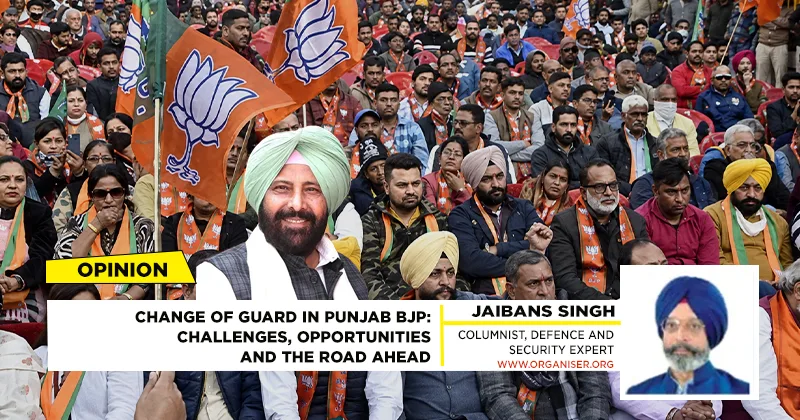
The appointment of Kewal Dhillon as the new president of the Punjab unit of the Bharatiya Janata Party (BJP) marks an important moment for the party in the state. The change has come when the previous incumbent Sunil Jakhar culminated his tenure. In any case, he had been, for a long time, expressing reluctance to hold the post and had to be assisted by a working president in the discharge of his duties.
Kewal Dhillon is a well-known political figure in Punjab with considerable experience in public life. He is a self-made man who has created not only a business empire but also spent decades in active politics and public engagement. His vast experience makes it natural for him to possess maturity, sagaciousness and receptivity. He brings with him a practical understanding of the state’s social and political realities. His administrative experience, grassroots connect and familiarity with rural Punjab are expected to assist him in navigating the challenges facing the BJP in the state. The state requires leadership that understands local sensitivities while remaining aligned with the broader objectives of the party, Dhillon’s appointment appears intended to bridge this gap.
His initial public statements have been noteworthy for their emphasis on development, governance and public welfare. Rather than beginning his tenure with abrasive attacks on political opponents, as is the habit of most political leaders in Punjab, he has focused on issues related to economic growth, and demands of the farmers. He has articulated a vision to usher Punjab back to the number one position that it earlier held among the major states of the Nation. He also spoke about granting of MSP to all crops as is being done by the BJP led Government in neighbouring Haryana. The statements point towards a progressive mind-set that focuses on Punjab rather than negative and redundant political rhetoric.
Policy Fault-lines in the Party Functioning
The appointment of a new state president inevitably invites an assessment of the outgoing leadership. Sunil Jakhar assumed charge of the Punjab BJP at a difficult time. The party was attempting to redefine itself after the end of its long-standing alliance with the Shiromani Akali Dal. The political environment was further complicated by the aftermath of the farmers’ agitation and the emergence of new electoral dynamics in the state.
Sunil Jakhar undoubtedly brought political experience and public visibility to the position. His communication skills and familiarity with Punjab’s political landscape was well appreciated. However, the larger objective of strengthening the party’s grassroots structure remained elusive under his watch. There was a perceptible reticence in spearheading engagement with party workers. As a result, the cadre base could not be sufficiently energised by creation of a strong sense of participation among the workers.
At the public communication level, the party’s messaging often appeared centred on criticism of rival parties. While opposition politics naturally involves highlighting the shortcomings of competitors, an excessive focus on criticism can sometimes prevent a party from effectively communicating its own vision. Voters are more interested in hearing what a political party intends to do than why its opponents are wrong.
Overall, Jakhar was a tall leader who had difficulty in integrating with the philosophy and working style of the BJP and went through his tenure like a reluctant prince. Nevertheless, he maintained the dignity of the high office and has much to contribute in the future if he wishes to.
Rebuilding Public Confidence
Punjab today faces multiple developmental challenges. Industrial growth has slowed in several regions, agricultural incomes are under pressure, youth migration continues at an alarming pace and concerns relating to drug abuse and unemployment remain significant. A leadership model that focuses on solutions rather than slogans may find greater acceptance among voters who are increasingly looking for tangible outcomes rather than political rhetoric. The challenge for any political organisation is therefore to move beyond reactive politics and present a persuasive developmental roadmap. It is in this context that Dhillon’s initial emphasis on development acquires significance.
The new BJP president faces the task of rebuilding trust among sections of society that remain sceptical of the party. This challenge is not unique to Punjab, but it has particular relevance in a state where political narratives are often shaped by emotion, identity and historical memory.
One of the key priorities for Dhillon will be engaging directly with citizens rather than relying solely on traditional political communication. Personal outreach, village-level interactions, stakeholder consultations and issue-based campaigns can help create a more nuanced understanding of the party’s position. The BJP also faces the challenge of countering narratives that have become deeply embedded in public discourse.
The Communication Challenge
In modern politics, perception often influences opinion as much as reality. In Punjab, social media platforms, partisan information ecosystems and politically motivated campaigns rapidly shape public attitudes. The local media, sadly, pays less attention to its primary responsibility of presenting the true face of the political parties to the people, and instead thrives on sensationalism. The BJP in Punjab has been a victim of salacious misinformation spread by its opponents and certain anti-national forces that do not wish to see a strong and stable government in Punjab.
Take for instance the perception being created of the party being anti-farmer and responsible for 700 deaths during the farmer agitation. The assertion is faulty at the very roots. India is an agriculture centric country with maximum voters from the farming community. How can a party that is against the majority voters gain power to the extent that BJP has at the centre as well as states? The fact is that BJP has done more for farmers than any other party, this aspect is understood by all except the farmers of Punjab whose psyche is deliberately targeted to think otherwise.
Regarding the unfortunate deaths that occurred during the farmer agitation. None happened due to a violent reprisal by the union government or any public upheaval organised at the party level. The causes of death were old age, sickness. road accidents, inter-group rivalry etc. How can these be attributed to the Union government that, in fact, rolled back the very relevant farmer laws only to stop further damage of life and property? Attributing all such deaths directly to the BJP or the Union Government remains a political interpretation rather than an established legal or judicial finding.
The critics of BJP conveniently ignore the Congress party which, during the period of militancy, literally ordered the decimation of Punjabi youth and launched deliberate attacks on Sri Harmandir Sahib and other Gurdwaras and institutions.
Punjab’s farmers are not a monolithic group. The BJP’s challenge is to demonstrate that it understands their concerns and is willing to engage constructively towards rebuilding relations through patience and sustained engagement. Direct interaction with farmer organisations, agricultural experts and rural communities can help reduce mistrust. Equally important is the need to communicate existing and proposed measures aimed at improving agricultural sustainability and rural prosperity. Punjab’s agricultural sector requires innovation, diversification and investment.
At the same time, it is important to convey to the people that Punjab’s development is closely linked to national development. Issues such as border security, industrial investment, infrastructure expansion, agricultural modernisation and employment creation require cooperation between the state and the Centre.
The appropriate response for the BJP would be communicative, not confrontationist. A successful strategy would involve presenting facts clearly, addressing concerns respectfully and engaging critics without hostility. Political energy would be better utilised in discussing issues than in perpetuating cycles of accusation and counter-accusation. Punjab’s politically aware electorate generally responds positively to reasoned discussion and evidence-based debate.
A New Political Narrative for Punjab
In Punjab, public discourse is often dominated by controversy, conflict and short-term political battles. The broader challenge before the BJP is to create a political narrative that resonates with Punjab’s aspirations. Dhillon has an opportunity to reposition the party as a stakeholder in Punjab’s development story. Development-centred politics does not mean ignoring political differences. It means ensuring that those differences do not overshadow the larger objective of improving the lives of citizens. If the new leadership succeeds in keeping development at the centre of its agenda, it may help broaden the party’s appeal beyond its traditional support base.
Kewal Dhillon assumes leadership of the Punjab BJP at a crucial juncture. His appointment reflects the party’s recognition of the importance of Sikh representation and a development-oriented political approach. The positive approach chosen by him may well change the abrasive narrative of character assassination of opposition leaders that holds predominance, it will expose those leaders who do nothing beyond taking press conferences and spouting venom.
At the same time, significant challenges remain. The party must strengthen its organisation, reconnect with grassroots workers, rebuild trust among sections of the electorate and engage meaningfully with the farming community. It must also effectively address perceptions that have taken root over recent years.
Whether Dhillon succeeds will depend not only on his leadership abilities but also on the party’s willingness to listen, communicate and adapt. Punjab’s voters have consistently demonstrated political maturity and independence. They are likely to reward any leadership that offers credible solutions to the state’s pressing challenges. The coming years will reveal whether the BJP under Kewal Dhillon can transform itself from a peripheral force into a more influential participant in Punjab’s political and developmental journey.