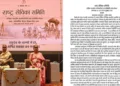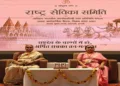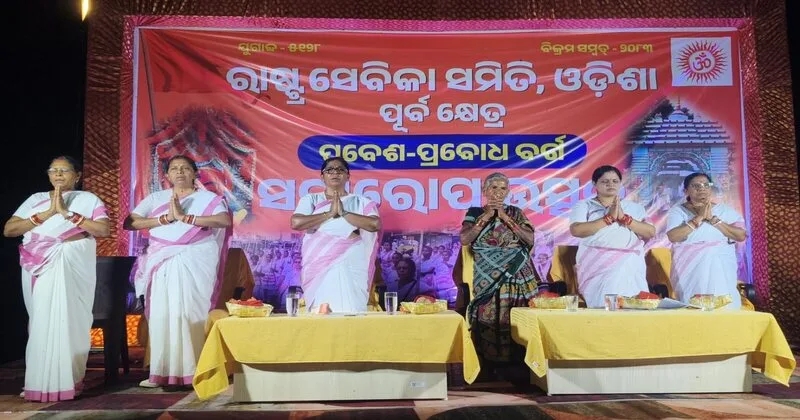
Bhubaneswar: “The role of women in taking the nation to its highest glory, fostering positive social transformation, and preserving cultural values is profoundly significant. The Rashtra Sevika Samiti actively contributes to this by focusing on personality and character development among women,” stated Neeta Devi, Akhil Bharatiya Saha Sampark Pramukh of the Rashtra Sevika Samiti. She shared these insights while addressing the valedictory program of the 15-day Pravesh and Prabodh Varga in Rayagada.
She further elaborated that the organization’s core objective is to awaken, organize, and culturally strengthen Hindu women in Indian society, inspiring them towards dedicated service to the nation. The Samiti strives to instill a sense of duty, self-confidence, leadership qualities, and patriotism in women, thereby preparing them for active participation in nation-building and social development.
She further stated that Indian culture considers the development of capable, cultured, and character-driven individuals, regardless of gender, essential for the welfare of society, the state, and the nation. Achieving this ideal is the primary objective of both the Rashtriya Swayamsevak Sangh and the Rashtra Sevika Samiti. Both organisations work to nurture personality development, cultural values, patriotism, and a sense of social responsibility, thereby contributing to the creation of a strong and harmonious society.
She said that Dr. Keshav Baliram Hedgewar founded the Rashtriya Swayamsevak Sangh (RSS) in 1925 on the auspicious occasion of Vijayadashami, with the objective of uniting Hindu society. Today, the RSS proudly celebrates its centenary, committed to the ideals of courage, organization, and national unity. Inspired by this great ideology, and exactly 11 years later, Laxmibai Kelkar established the Rashtra Sevika Samiti, recognizing the important role of women in nation-building. Its aim was to cultivate the divine feminine power of India into well-organized, cultured, capable, and patriotically driven individuals.
She stated that in Indian thought, “woman” is not merely a word, but a symbol of strength, values, sacrifice, and creation. The structure and functioning of Indian society are based on the equal contributions of both men and women, making the role of women particularly significant in preserving and promoting Indian culture.
She said that in building society and family, women fulfill their responsibilities in multiple roles. As mothers, sisters, and daughters, they enrich families and society with values and cultural traditions. The contribution of women in creating a healthy, strong, and organized Hindu society is unique and indispensable.
Skills learned and sharpened. Rashtra Sebika Samiti organises Samarop Utsav to its 15 day long training camp. pic.twitter.com/0CWkOPg0Yy
— Matrushakti90 (@matrushakti90) June 3, 2026
She stated that Indian women are not only the foundation of the family but also an important force in nation-building. Their role in bringing about positive social change and preserving cultural values has always been inspirational. Through her guidance, the trainees were motivated to fulfill their responsibilities toward the nation, society, and culture more effectively.
She also said that in Indian culture, women have been empowered since ancient times and have always remained devoted to serving society and the great Hindu nation of India in one form or another. She emphasized that India is not merely a piece of land, but a great land of spiritual penance (“Tapobhumi”) and a living embodiment of maternal power. Every individual’s duty is to remain dedicated and responsible toward serving this motherland.
She stated that India views the entire world as one family, embracing the spirit of “Vasudhaiva Kutumbakam” to foster the welfare of all humanity. Indian women, through their diverse roles and responsibilities, have significantly contributed to building a healthy, cultured, and organized society, thereby paving the way for a timeless and glorious India.
Citing examples, she asserted that girls born today are not meant to be confined within the home. Referring to great personalities and inspiring women of India, she emphasized that a woman’s life is intrinsically linked to the vital responsibility of shaping the family, society, state, nation, and the world.
A skill that gives confidence to walk on road with dignity. pic.twitter.com/0ebkLY8UfT
— Matrushakti90 (@matrushakti90) June 3, 2026
She urged the participating trainees to confront contemporary challenges and adverse circumstances with courage, fearlessness, and self-confidence. She also encouraged them to draw inspiration from Sanatan values, actively contribute to nation-building, and always be prepared to present India as a sacred land of Sanatan culture, assuming a leadership role on the global stage.
In her address, she elaborated on the contributions of women to Indian culture, their significance, and the role women across India have played in building a healthy, strong, and organised Hindu society.
The chief guest, Sumi Jhodia, a tribal woman, has been leading an anti-liquor movement in the region. In her address, she shared that although she lacked formal education, unlike many participants, she initiated the campaign to combat the damage caused to families and society by alcohol consumption in tribal areas.
She acknowledged the movement was fraught with risks and challenges. However, after receiving training, she was able to expand and strengthen the campaign. The administration’s cooperation also contributed to its success.
A 15-day Pravesh and Prabodh Varga was organized by the Rashtra Sevika Samiti, Odisha Prant, at the MITS College campus in Rayagada. The program aimed to instill a sense of duty, self-confidence, leadership, and patriotism in women, preparing them for active participation in nation-building and social development. The training, held from May 16 to June 1, hosted over 100 trainees from various districts of Odisha. Special emphasis was placed on the participants’ intellectual, mental, and physical development.
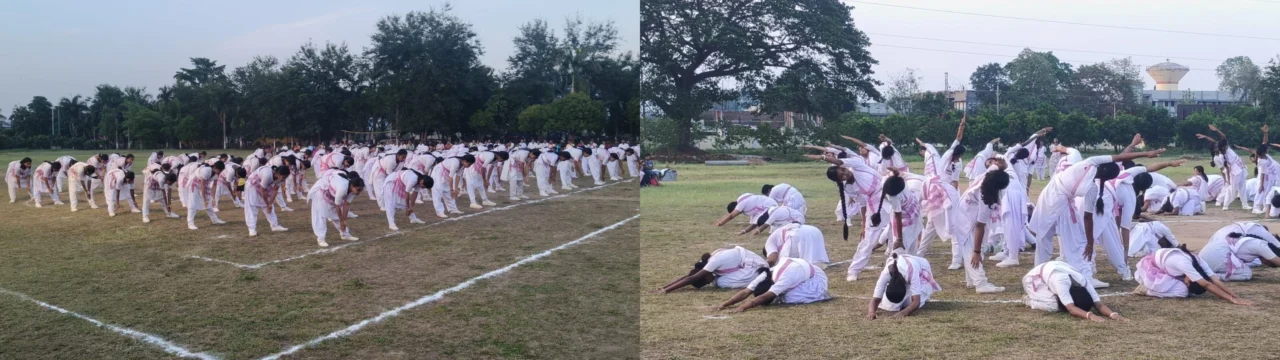
During the Pravesh and Prabodh Varga, the trainees were imparted training in yoga, physical exercises, and “Ghosh” practice. Under Ghosh training, they were taught to play musical instruments such as flute, “aanak,” and other percussion instruments. Patriotic songs and cultural programmes were also conducted to instill a sense of national pride among the participants.
Through daily intellectual sessions and discussions, senior functionaries of the Samiti highlighted several important issues related to society, the nation, and the world. The objective of these sessions was to enhance awareness, leadership qualities, organisational skills, and a spirit of national service among the trainees. The programme also aimed at motivating them to lead a life dedicated to Indian culture, national values, and social responsibility.
During the 15-day Pravesh and Prabodh Varga, the trainees were given training in various physical and self-defence disciplines such as danda, jyeshtha, niyuddha. The purpose of this training was to develop confidence, discipline, courage, and leadership qualities among the participants.
The daily Shakha activities included shloka recitation, Samiti prayer sessions, yoga practice, and various games, with special emphasis on the mental, intellectual, and physical development of the trainees. These activities helped in fostering a sense of organisation, teamwork, and dedication to national service.
The programme was attended by Akhil Bharatiya Saha Sampark Pramukh of the Rashtra Sevika Samiti, Neeta Devi, along with Kshetra Pracharika for Odisha, Andaman, Sikkim, and West Bengal, Latika Padhi; Odisha Prant Karyavahika Arati Vaishakh; and Sah-Karyavahika Vaijayanti Rana, who guided and addressed the trainees during the event.