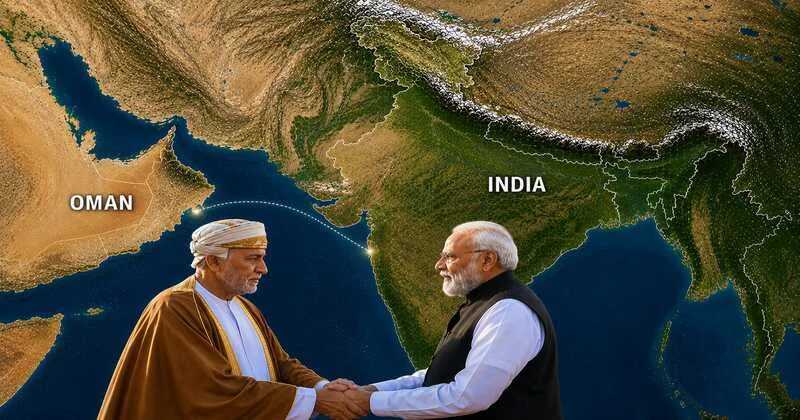
The India-Oman Comprehensive Economic Partnership Agreement (CEPA), which came into force on June 1, has assumed significance far beyond trade at a time when West Asia is witnessing deep instability and the global economy is grappling with supply-chain disruptions, energy volatility and rising geopolitical uncertainty. As the US-Iran deadlock continues to threaten maritime movement through the Strait of Hormuz, the world’s most critical energy chokepoint carrying nearly one-fifth of global oil consumption, India’s agreement with Oman is emerging as an example of pragmatic global diplomacy and a positive-sum partnership in a deeply polarised region. Signed during Prime Minister Narendra Modi’s December 2025 visit to Muscat, the CEPA is India’s second trade pact with a Gulf nation after the UAE deal and reflects New Delhi’s growing focus on resilient trade corridors, energy stability and mutually beneficial regional partnerships.
It is precisely here that Oman’s strategic geography becomes critically important. Unlike several Gulf economies whose maritime routes are tightly dependent on Hormuz, much of Oman’s coastline lies outside the Strait, directly facing the Arabian Sea and the Gulf of Oman. Major ports such as Salalah and Duqm remain operational and accessible even when Hormuz traffic becomes unstable. The current Gulf crisis has already demonstrated this advantage in measurable economic terms.
India’s imports from major Gulf economies declined sharply from nearly USD 15 billion in April 2025 to USD 9.8 billion in April 2026 as supply disruptions and shipping uncertainties intensified around the Strait of Hormuz. Indian exports to the region also fell from USD 4.4 billion to USD 2.7 billion during the same period. Oman, however, emerged as the notable exception. India’s imports from Oman surged by 246.4 per cent, increasing from USD 430 million to nearly USD 1.5 billion, driven primarily by higher purchases of crude oil and urea. At the same time, India’s exports to Oman declined by only 10.3 per cent, significantly lower than the broader regional decline. These figures have transformed the India-Oman relationship from a conventional Gulf trade partnership into a crucial stabilisation corridor for India’s energy flows and supply-chain resilience during the ongoing Gulf crisis.
Oman emerges as India’s alternative Gulf gateway
The central importance of the CEPA lies not merely in trade liberalisation but in Oman’s growing role as India’s dependable gateway to West Asia during periods of geopolitical disruption. The current crisis has shown that Oman can function as an alternative maritime and logistics corridor when the Strait of Hormuz becomes risky or congested. This explains why the agreement is being increasingly viewed as a positive-sum partnership rather than a transactional trade arrangement. Both countries stand to gain in sectors where each possesses complementary strengths.
#WATCH | Delhi: Union Minister of Commerce & Industry Piyush Goyal presides over the India–Oman CEPA Entry into Force Ceremony.
He says, “The India-Oman Comprehensive Economic Partnership Agreement, signed six months ago, is entering into force today. It is not simply a trade… pic.twitter.com/lY0h8NabEz
— ANI (@ANI) June 1, 2026
Under the CEPA, Oman has granted zero-duty access on 98.08 per cent of its tariff lines, covering 99.38 per cent of India’s exports to Oman by value. Before the agreement, only 15.33 per cent of Indian exports enjoyed duty-free access under the most-favoured nation regime. The shift is therefore substantial. The sectors benefiting from full tariff elimination include several labour-intensive industries central to India’s export and employment ecosystem, gems and jewellery, textiles, leather, footwear, sports goods, plastics, furniture, agricultural products, engineering goods, pharmaceuticals, medical devices and automobiles.
Although over 80 per cent of Indian exports were already entering Oman at relatively low average tariffs of around 5 per cent, certain products faced duties as high as 100 per cent. Their elimination significantly improves the competitiveness of Indian goods in the Omani market. India’s exports to Oman in fiscal 2026 stood at around USD 3.64 billion. The basket was led by refined petroleum products, including petrol worth USD 781 million and naphtha worth USD 746 million. Other major exports included calcined alumina at USD 277 million, iron and steel products at USD 230 million, machinery at USD 178 million and rice at USD 167 million. The Indian government expects the pact to generate an immediate export boost. Officials estimate a short-term upside of nearly USD 3 billion and believe exports to Oman could reach USD 7 billion within the next one or two years.
Energy security, fertiliser stability and the OMIFCO factor
The CEPA’s importance extends well beyond manufactured exports. At a time when the West Asian conflict has triggered concerns over fertiliser and energy availability, Oman has emerged as a critical partner for India’s agricultural and industrial stability. India imported USD 7.2 billion worth of goods from Oman in fiscal 2026. The import basket was dominated by crude oil worth USD 1.6 billion, liquefied natural gas valued at USD 1.2 billion and fertilisers worth USD 843 million. Oman also supplied methanol worth USD 465 million and ammonia worth USD 424 million, both crucial industrial feedstocks. The outbreak of conflict in West Asia and disruptions in Hormuz created a major supply shock for India’s agricultural sector because the region accounts for nearly half of India’s fertiliser imports and more than 60 per cent of its LNG imports. Shipping disruptions led to a sharp decline in domestic urea production, although the government managed to secure over 50 per cent of fertiliser requirements for the ongoing kharif season.
A new chapter in India-Oman economic ties.
The India-Oman CEPA enters into force today, unlocking opportunities for trade, investment and jobs, including for the youth.
With zero-duty access on 98.08% of Oman’s tariff lines covering 99.38% of trade value, the agreement will… pic.twitter.com/LcKrKjSQL3
— Randhir Jaiswal (@MEAIndia) June 1, 2026
Against this backdrop, Oman’s role has become even more consequential. Advisor for Foreign Trade and International Cooperation at Oman’s Ministry of Commerce, Pankaj Khimji, stated that Oman is ready to consider diverting its entire share of production from the Oman India Fertilizer Project (OMIFCO) to India if requested. OMIFCO, a joint venture between IFFCO, KRIBHCO and the Oman Investment Authority, became operational in 2006. For fifteen years, all its production was directed to India before Oman began selling its share on trading platforms. Khimji also stated that Oman would be “more than happy” to meet India’s LPG requirements if needed. These developments underline how the CEPA is evolving into a broader strategic economic compact tied directly to India’s food security, energy resilience and supply-chain diversification during a volatile geopolitical period.
A carefully negotiated win-win framework
One of the notable aspects of the CEPA is the calibrated manner in which India negotiated market access while protecting sensitive domestic sectors. India has offered tariff liberalisation on 77.79 per cent of tariff lines covering 94.81 per cent of imports from Oman by value. At the same time, New Delhi retained safeguards for sectors considered sensitive to domestic livelihoods and manufacturing competitiveness.
Products placed under the exclusion list include dairy products, cereals, fruits, vegetables, edible oils, oilseeds, rubber, leather, spices and several key agricultural items. India also incorporated Tariff Rate Quotas and Minimum Import Price mechanisms for selected industrial and agricultural products. The government further adopted a cautious approach toward petrochemicals by granting tariff concessions only on products not manufactured domestically. Some petrochemical products were placed under tariff-rate quotas, while others were excluded from tariff cuts altogether.
Chief negotiator Ajay Bhadoo identified textiles, agricultural goods, transport equipment, gems and jewellery, minerals, rubber and plastics as sectors poised for major export growth under the agreement. The CEPA also addressed one of India’s major concerns during negotiations, Omanisation, Muscat’s labour localisation programme. Commerce and Industry Minister Piyush Goyal stated that Oman had provided binding commitments ensuring preferential access for Indian workers in investments made by Indian companies in Oman. This commitment is strategically important because it protects India’s skilled and semi-skilled labour presence in the Gulf while creating opportunities for Indian enterprises operating in Oman.
The agreement also carries benefits for India’s pharmaceutical and manufacturing sectors. Oman has committed to lifting its decade-old restriction on exports of unpolished marble blocks, enabling craftsmen and processors in Rajasthan and Andhra Pradesh to directly source raw material from Oman.
Beyond Oman: India’s larger Gulf and global ambitions
The India-Oman CEPA is also being viewed as a stepping stone toward India’s broader trade and geopolitical ambitions in the Gulf and beyond. Oman is India’s second-largest trading partner in the Gulf region and serves as a gateway to the wider Gulf Cooperation Council (GCC) and East African markets through its logistics infrastructure and ports. Bilateral trade between India and Oman rose from USD 10.61 billion in 2024-25 to USD 11.18 billion in 2025-26.
Piyush Goyal described the agreement as strategically significant beyond bilateral commerce, positioning Oman as a gateway to the GCC, East Africa and the Indian Ocean economy. The agreement is also expected to accelerate India’s negotiations with the GCC bloc comprising Saudi Arabia, the UAE, Oman, Qatar, Kuwait and Bahrain. With trade agreements already concluded with the UAE and Oman, India now enters future GCC negotiations from a position of stronger regional integration.
My gratitude to His Majesty Sultan Haitham bin Tarik, the Government and people of Oman for their affection during this visit. The signing of CEPA was a major outcome, which will benefit the youth of our nations. We have also covered substantial ground in other futuristic… pic.twitter.com/RlB9JYs67y
— Narendra Modi (@narendramodi) December 18, 2025
The CEPA aligns with India’s larger export ambitions as well. Goyal reiterated that India’s target is to achieve USD 1 trillion in overall exports in the current year and USD 2 trillion within five years. Simultaneously, India is pursuing trade agreements with Israel, Canada and Chile as part of a broader strategy to integrate Indian industry into global value chains. In many ways, the India-Oman CEPA reflects a larger shift in India’s foreign economic policy under Prime Minister Narendra Modi, one that combines trade diplomacy, supply-chain resilience, geopolitical positioning and strategic market access into a single framework.
At a time when the world continues to remain trapped in cycles of confrontation and failed negotiations, India has quietly secured a dependable economic and strategic partner sitting at one of the world’s most sensitive maritime crossroads. The CEPA is therefore not merely a trade agreement. It is a geopolitical hedge, an energy security instrument and an export expansion platform rolled into one.