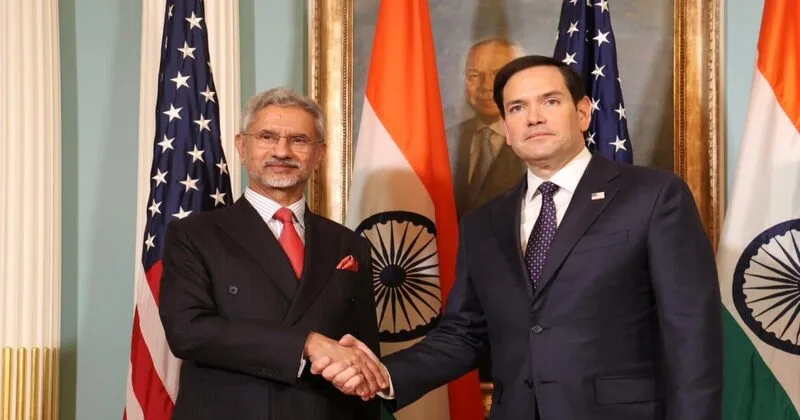
The Delhi diplomacy unravelled during the visit of US Secretary of State Marco Rubio to India was a testament to strategic smartness coupled with firmness and clarity. It illustrated how New Delhi acknowledges partnership for mutual benefit, but does not concede to hegemonic ambitions. India, being a vital maritime power of the Indo-Pacific region accepts mutual cooperation to espouse collective security, prosperity and balance of power. However, it will not bow down to disproportionate deeds that will cost the strategic autonomy and diplomatic leverage of India. It was illustrated that India can articulate high-value partnerships without compromising its strategic autonomy.
The response of New Delhi for the prolonged 4 day visit of the US Secretary of State Marco Rubio to India was a carefully calibrated strategic message. The diplomatic actions of New Delhi demonstrated how India priorities its national interests beyond loud and provisional gestures. The bilateral compatibility and partnership is weaved with a strategic caution. There is scope for cooperation and mutual prosperity, but not at the cost of national security & strategic salience pertaining to India. New Delhi acknowledged the centrality of Quad cooperation for Indo-Pacific prosperity. However, it was ensured that India will be at the epicentre of the maritime and regional discourses and not at the end of hegemonic transactionalism.
A strategic band-aid for the fissures ignited by Trump transactionalism
From an analytical lens, the visit of the US Secretary of State Marco Rubio to India is witnessed more as a diplomatic stunt to heal the fissures created across the Indo-US strategic mosaic which was ignited by Trump’s transactionalism. The tariff tussle, loud allegations on the purchase of Russian oil, dark comments, H-1B visa chaos, igniting accusations on social media platforms, demanding irrational credit and false claims of ending India-Pakistan conflict during Operation Sindoor and the list continues. US President Donald Trump unleashed a wave of assaults on India that seriously ruptured Indo-US bonhomie which was carefully woven for decades with utmost strategic patience.
In this backdrop, Rubio visit was a strategic posturing aimed at sealing the fissures and mending the ties. The visit was a strategic message from the US which noted that New Delhi is a preferred partner for Washington DC with intense scope for bilateral cooperation. The US Secretary of State spending four long days in any country in the midst of a geopolitical conflict in West Asia where the US is a key stakeholder, in itself sends a strong assertion about the importance asserted to India-US relations. The visit intended to bridge the trust deficit in the Indo-US ties, which is inflicted by the transactional and unpredictable policies of Trump.
Delhi Diplomacy: Embedded in strategic clarity, diplomatic firmness & responsible statecraft
During the bilateral meetings, there were agreements inked and ambitious announcements made pertaining to critical mineral cooperation, Indo-Pacific security, technology cooperation etc. Infact, the US Secretary of State addressed India as a “natural ally”. This was a clear sign of containing the damage stimulated by the erratic Trump policies. However, did New Delhi concede to these sudden overtures of the United States. Did India completely heed to the terms of the US for short-term gains or for diplomatic publicity. The answer is no!
India’s approach to Rubio’s visit was carefully calibrated, which was tailored with strategic realism and diplomatic firmness. New Delhi accepts cooperation with the US in a tone of strategic pragmatism, as it understands the fact that India-US relations are far beyond the Trump factor. It is a relation that is vital to navigate the geopolitical undercurrents of the decade. New Delhi-Washington relations are rooted in the principle of multi-alignment that is a pretext to secure India’s national interest. India thus welcomed Rubio with this underpinnings. New Delhi considered Washington’s repair attempt as a routine diplomatic visit and engagement. India respected the diplomatic protocols that had to be adopted when high-profile officials visit the country.
Beyond such mandatory diplomatic deeds, there was no extravagant approach and huge fanfare moment towards Rubio’s visit. There were bilateral meetings but not big billboards, no high-proflie officials or ministers rushed to escort the US Secretary of State. Diplomatic exchanges aimed at exploring areas of cooperation. While acknowledging the vitality of long-term and stable India-US relations, New Delhi did not evoke big media statements and overhype or dramatize Rubio’s visit. It did not accelerate actions that depicted the US as an “ally” of India. Instead, New Delhi respected the scope of bilateral cooperations and acted accordingly.
This shows India’s diplomatic firmness. The diplomatic playbook of New Delhi will not yield to the sudden shifts of the US foreign policy trajectory. Instead, India will steer its diplomatic path with strategic autonomy coupled with clarity, confidence and cautiousness, as it is aware of the irrational and inconsistent Trump policies. India will act as per its national security fundamentals encompassing trade, energy security and other larger national security credentials. The texture of Trump’s foreign policy demands more visible wins than fair deals, thus India operates with strategic vigilance and firmness without heeding to attractive and transitory gains. India looks for long-term national stability and security.
In this direction, External Affairs Minister Dr. S. Jaishankar during Marco Rubio’s visit openly highlighted India’s strong ties with Russia. He reaffirmed India’s multi-alignment strategy for national security and explained how New Delhi maintains solid ties with Europe, Russia, United States and other countries in line with the “India First” policy similar to the US approach towards “America First” policy. EAM also reiterated its energy priorities and in front of Rubio asserted that India buys oil from multiple sources. This testifies India’s diplomatic boldness and strategic clarity to seal its national interests without submitting to any external pressure or short-term visible gains.
India is the cornerstone of Quad strategy
India navigates its Quad strategy with utmost diplomatic firmness and strategic prudence. It is open for cooperation, but not subordination. New Delhi will not allow other players to dictate the terms of its Indo-Pacific strategy and its instrument of influence across the maritime spectrum cannot be as per the hegemonic ambitions. Instead, New Delhi ensures that the geopolitical chessboard of the Indo-Pacific must entail a fair and reasonable play to ensure collective security, balance of power and free, open, inclusive maritime domain.
During the Quad meet, a series of initiatives were unveiled and the scope of cooperation was considerably expanded. This includes joint port development in Fiji, a strategic location in the Indo-Pacific, to ensure balance of power against expansionism and assertiveness. India also agreed for cooperation to enhance maritime surveillance, real-time information sharing, critical mineral cooperation etc. However, India ensured that it is at the epicentre of these deals as a key power in the region and will not be a junior power and allow others to dominate in its vicinity.
India also rightly used the Quad platform to render a sharp message against cross-border terrorism that poses a threat to country’s sovereignty, territorial integrity and national security. In technology partnership, maritime security, ensuring supply chain resilience and in other facets of Quad, India is a key decision maker championing national and regional security. New Delhi, hence exhibited diplomatic warmth towards the US, but not excessive grandeur. Thus, India today is a rising power, fourth largest economy, trusted defence partner of the region that furnishes multilateral platforms to script its energy security, trade priorities, national interests, strategic autonomy and strengthen its fair stakes in the emerging geopolitical order coupled with regional stability, without kowtowing to geopolitical compulsions.