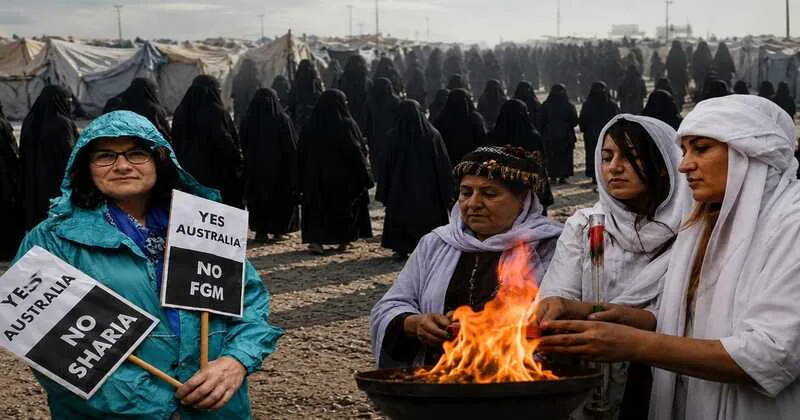
Australia, long projected as one of the world’s most stable and prosperous liberal societies, is now witnessing deep tensions over illegal-immigration, religion and national security. Public anger over illegal immigration has intensified in recent years, especially after radical Islamist groups attempted to spread slogans such as “Sharia for Australia”. The debate has affected even peaceful migrant communities, including Hindus and other skilled immigrants who moved to Australia for work.
Now, a fresh controversy surrounding the return of Australian ISIS widows and their children from detention camps in Syria has reopened old fears about extremism, integration and internal security. Years after the collapse of the Islamic State terror network in Iraq and Syria, its consequences continue to destabilise Western democracies. Australia has become the latest example of this growing crisis.
The rise and collapse of ISIS Brides
The term “ISIS brides” refers to women who fled to territories controlled by the Islamic State terror organisation in Iraq and Syria, mostly through their husbands, lovers or radical recruiters. Their backgrounds ranged from the United States and Britain to Keralam in India. Despite differences in nationality, their recruitment methods followed a similar pattern. Most women were radicalised through social media platforms, encrypted messaging groups and online propaganda networks. Several were lured through romantic relationships or Love Jihad and later pressured to convert to Islam. Others were persuaded by ISIS propaganda claiming that joining the so-called caliphate was a religious duty. Some young women travelled believing they would live in an “Islamic utopia” governed under strict Sharia law.
The reality was far darker. Once they reached ISIS-controlled territory, many were married off to terrorists. Their roles extended far beyond household life. Women associated with ISIS were involved in recruitment campaigns, enforcing social restrictions through moral policing, spreading extremist propaganda and in some cases receiving weapons training. Some became active supporters of the organisation’s ideological machinery.
At the same time, many women became victims of the very system they entered. ISIS treated women as property. Several were subjected to sexual slavery and brutal exploitation. Husbands often functioned merely as symbolic guardians while women remained under the control of terrorist networks built around violence and domination. After the territorial collapse of ISIS and the deaths of many fighters in military operations, thousands of widows and children were left stranded in refugee and detention camps across Syria and Iraq. According to available estimates, nearly 8,500 foreign nationals, mainly ISIS widows and their children, remain in Syrian camps. Including Iraqi and Syrian nationals, the total camp population is estimated at around 30,000 people. More than 60 percent are children below the age of eighteen.
Camps of stateless lives
Most of these people are held in two major detention camps in northeastern Syria controlled by Kurdish forces. The largest number of foreign women and children are housed in the al-Hol camp. Women from more than sixty countries remain trapped there, including citizens from Russia, former Soviet republics, Britain, France, North African countries and Australia. More than half the camp population consists of Iraqis and Syrians. Iraq has accelerated efforts to repatriate its citizens. Several European governments, however, remain extremely reluctant to accept the return of female ISIS-linked citizens due to security concerns and political backlash.
Some governments have gone further by revoking citizenship. Britain’s case involving Shamima Begum became one of the most controversial examples. Twenty-one women, including Begum, and more than thirty children reportedly remain stranded in the camps years after ISIS collapsed. Many Western governments continue to argue that repatriation could create long-term security threats within their own countries.
Australia has faced similar tensions. Political divisions sharpened after the government of Prime Minister Anthony Albanese initiated phased repatriation efforts based on humanitarian grounds. Initially, thirty-four Australian citizens, eleven women and twenty-three children, were believed to be held in Syrian camps. Through a series of operations, most have now returned to Australia. Human rights groups and relatives continue efforts to bring back the remaining eleven individuals. In May 2026 alone, several women and children reportedly arrived in Australian cities through Qatar as part of ongoing repatriation arrangements. Their return triggered strong protests from sections of Australian society and political groups concerned about security risks.
How ISIS built its terror network
The Islamic State’s rapid expansion during the previous decade was sustained by enormous financial networks spread across the West Asia. The organisation generated vast wealth through black-market oil sales, kidnapping for ransom, extortion and the trafficking of Yazidi women.
ISIS militants earned millions of dollars every day through the illegal sale of oil extracted from fields under their control in Iraq and Syria. Petroleum was sold through smugglers operating across regional borders. The organisation also established a highly organised kidnapping industry. The United States State Department estimated that ISIS earned nearly 20 million US dollars annually through ransom operations alone. Western powers responded by tightening international security systems, increasing surveillance and enforcing policies discouraging ransom payments. Several countries introduced legal frameworks to prevent negotiations with terrorist kidnappers. These measures significantly weakened ISIS’s bargaining power.
One of the most horrific aspects of the ISIS economy was the trafficking of Yazidi women and girls. Terrorists created detailed databases containing photographs, names and ownership records of enslaved women. Information was circulated through smartphone applications and encrypted messaging services. Advertisements often included photographs, age details and prices.
Reports indicated that girls below the age of twelve were sold for the highest amounts. In one documented case, a young mother with two children aged three and seven was reportedly listed for sale at a price of 3,700 US dollars. There were also allegations that middlemen transported Yazidi women into brothels outside ISIS territory.
Many advertisements appeared through Telegram, WhatsApp and Facebook groups. Although Islamist media networks attempted to dismiss such reports, testimonies from Yazidi survivors confirmed the scale of abuse and trafficking. Western intelligence agencies eventually launched coordinated digital surveillance operations targeting pro-ISIS social media networks. Recruitment groups and trafficking advertisements were tracked and removed. Special operations units also targeted trafficking centres inside ISIS territory, including raids connected to Mosul. Human trafficking routes gradually collapsed under military and intelligence pressure.
At the same time, falling global oil prices before 2018 severely damaged ISIS finances. The group was already under sustained military assault from United States-led and Russian-backed operations in Syria and Iraq. The Covid pandemic further disrupted remaining extremist networks. ISIS also suffered setbacks in Afghanistan before later attempting to regroup following the Taliban’s return to power. The organisation that once claimed it would establish a worldwide Islamic state was eventually reduced to scattered extremist cells struggling for survival.
Australia’s political and legal battle
The return of ISIS widows has deeply divided Australian politics and society. Many Australians fear that women who once lived under ISIS rule may have undergone radicalisation, ideological indoctrination or even military training. Security agencies remain concerned that some returnees could inspire future extremist networks. At the same time, humanitarian organisations including Save the Children argue that many children trapped in Syrian camps are innocent victims born into violence and deprivation. They insist that governments have a responsibility to protect their citizens, particularly minors raised in extreme conditions without education, healthcare or security.
Australia’s legal system has largely sided with the government’s discretion on the issue. The Australian Federal Court ruled that the government has no legal obligation to repatriate ISIS widows or children from Syrian camps. The court stated that such decisions fall within the political and security judgment of the government rather than enforceable legal duty.
The Australian High Court, which holds a constitutional position similar to the Supreme Court of India, later refused to hear an appeal filed by Save the Children challenging the Federal Court decision. This effectively confirmed that the government cannot be legally compelled to bring back ISIS-linked citizens.
Nevertheless, the Albanese government has continued controlled repatriation efforts. Since the Labor government came to power in 2022, four women and thirteen children have officially been returned from Syrian camps after extensive security assessments.
The government has repeatedly stated that national security remains its highest priority. Authorities insist that every repatriation decision is made only after consultation with intelligence and counter-terrorism agencies. Women returning to Australia are not being granted immunity. They face investigation, monitoring and possible prosecution under Australian counter-terrorism laws for voluntarily entering or remaining in ISIS-controlled territory.
The opposition Liberal-National Coalition has taken a far stricter position. Coalition leaders argue that individuals who abandoned Australian values to support terrorist movements should not be permitted to return. The opposition has proposed stronger laws imposing severe prison sentences on anyone assisting ISIS brides in re-entering Australia. Other political groups have also intensified criticism of the repatriation program, warning that the return of ISIS-linked individuals could threaten public safety and social stability.
The case of Mariam Rad
The case of Mariam Rad became one of the most closely watched examples in Australia’s debate over ISIS widows. Rad grew up in Sydney and married Mohammed Sahab when she was eighteen years old. Sahab worked as a mathematics teacher before later becoming one of the most influential ISIS recruiters operating from Australia. He eventually rose within the military structure of the Islamic State organisation. Sahab left Australia for Syria in 2013. In early 2014, Mariam Rad travelled to Syria with her children to join him. The family settled in Al-Raqqa, the city declared by ISIS as the capital of its so-called caliphate.
Mohammed Sahab was killed in an airstrike in Syria in 2018, leaving Mariam Rad an ISIS widow. Following the collapse of ISIS territory, she and her children were transferred to the al-Roj detention camp in Syria, where they spent nearly three years in harsh and impoverished conditions. In October 2022, Rad and her children were among four women and thirteen children repatriated to Australia through a special government operation. Soon after returning, Australian counter-terrorism authorities launched investigations. She was arrested in January 2023 and charged with entering and remaining in territory controlled by a terrorist organisation without authorisation, an offence carrying a maximum prison sentence of ten years. During court proceedings, Mariam Rad pleaded guilty. However, she argued that she had not fully understood her husband’s position within ISIS and that fear, psychological pressure and coercion prevented her from leaving Syria.
The final judgment was delivered by a New South Wales court in June 2024. The court considered several mitigating circumstances, including her young age at marriage, the controlling behaviour of her husband and the psychological trauma she experienced. Instead of imprisonment, the court ordered her release under strict conditions requiring good behaviour and close supervision for twenty-five months, along with mandatory psychological treatment.
The court also noted that Rad came from a Muslim family and entered a traditional arranged marriage while still attending school. Judges concluded that she had limited awareness of the extremist world her husband later entered. Her case, however, is unlikely to become a universal precedent.
Australian authorities have made clear that future returnees will continue to face strict surveillance, prosecution where necessary and long-term de-radicalisation programs. The collapse of ISIS may have ended the terror group’s territorial ambitions in Iraq and Syria, but the political, legal and ideological consequences continue to haunt Western democracies. Australia’s struggle over ISIS widows reflects a larger global dilemma, balancing national security, humanitarian responsibility and the long shadow of extremist violence.