In one of the most consequential decisions taken in the very first days of his tenure as West Bengal Chief Minister, Suvendu Adhikari has done what his predecessors refused to do for decades: hand over land to the Border Security Force (BSF) to fence the porous, infiltration-prone border with Bangladesh. The move, announced at the first Cabinet meeting of the new BJP Government, marks a seismic shift in the State’s posture towards national security — and its long-fractured relationship with central border management agencies. The decision, and the philosophy driving it, can be summed up in three words that Adhikari used himself at a press conference alongside senior BSF officials: “Detect, delete, deport”.
The India-Bangladesh border stretches 4,096.7 kilometres, running through five States — West Bengal, Assam, Tripura, Meghalaya, and Mizoram. Of this vast frontier, West Bengal accounts for approximately 2,200 kilometres. Yet, as of early 2025, only around 3,232 kilometres of the entire border had been covered with fencing nationwide, leaving significant gaps. In West Bengal specifically, roughly 600 kilometres remained unfenced even as infiltration concerns intensified year after year.
What makes this particularly troubling is that the obstruction was not primarily geographical. While difficult terrain, riverine stretches, and marshland account for some unfenced sections, the bigger barrier was political. The Trinamool Congress Government under Mamata Banerjee consistently refused to cooperate with the Centre on land acquisition and transfer to the BSF — land needed not just for fencing but for building border outposts and other critical infrastructure. Union Home Minister Amit Shah had personally requested the former Chief Minister to transfer the required land. The request was turned down.
Mamata Refused Border Fencing
Adhikari has been blunt about this. He has alleged that land for nearly 555 kilometres of fencing could have been handed over years ago, but was withheld for reasons of electoral calculation — the “vote bank and appeasement politics” of the TMC that prioritised the demographic preferences of border constituencies over the security needs of the nation.
The Calcutta High Court, too, had intervened in January 2026, directing the West Bengal Government to hand over land in nine border districts to the BSF by March 31 for the installation of barbed wire fencing. The court had emphasised that land already acquired and funded by the Centre must be transferred immediately, and that procedural excuses would not be entertained. The order came on the back of a Public Interest Litigation (PIL) by a retired Army officer who alleged that the State’s negligence in land transfers had directly facilitated illegal smuggling and infiltration.
Transferring Land to BSF
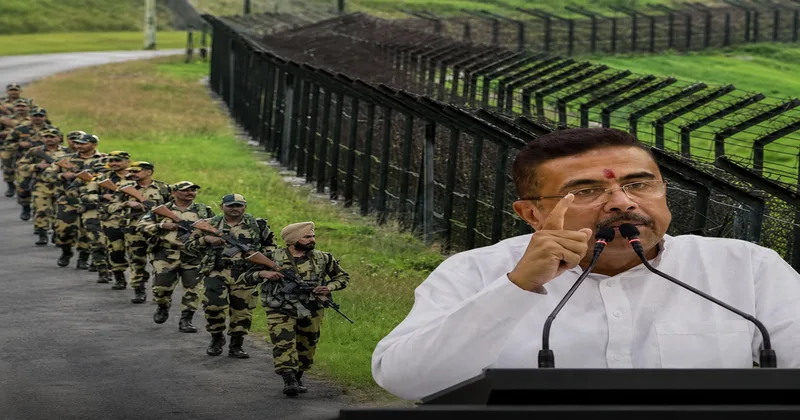
Days after taking oath, Shri Adhikari approved the transfer of 600 acres of land to the BSF in his first Cabinet meeting, committing to complete the process within 45 days. Then, on May 20, 2026, he went a step further. Addressing a press conference alongside BSF Director General Praveen Kumar, the Chief Minister announced the immediate handover of a 27-kilometre stretch of land for fencing and infrastructure — the first tangible delivery on his Cabinet’s promise.
“We are ready to hand over the land along with a few border outposts and BSF infrastructure development land”, Adhikari said. The BSF DG’s response was telling: “We have seen a change, and we are sure we will find this synergy with the State Government”. It was an acknowledgement of how deep the gulf had been between the previous State administration and the force tasked with guarding the border.
The new Government also announced the revival of coordination meetings between the BSF, West Bengal Police, and district administrations in border areas — meetings that had simply stopped happening for years under the previous Government. Such institutional coordination is not a bureaucratic formality; it is the connective tissue of any effective border management system.
The urgency behind these decisions is underscored by the scale of the problem. The BSF’s Eastern Command reported that it had apprehended over 10,263 Bangladeshi nationals in a single year while they were attempting to infiltrate or exit through the border. This was amid the political unrest in Bangladesh, when BSF troops were pushed to their limits to prevent a surge in illegal crossings. Narcotics worth Rs 376 crore, contraband valued at over Rs 170 crore, and over 51 kilograms of gold were also seized in the same period — a reminder that infiltration and trans-border crime are deeply interlinked phenomena.
Demographic Change
The problem is not new. Districts such as Murshidabad, North 24 Parganas, and Malda have for years been at the centre of debates about illegal Bangladeshi settlements, demographic change, and the integration of infiltrators into voter rolls and welfare schemes. When the Special Intensive Revision (SIR) of electoral rolls was launched in West Bengal in late 2025, thousands of illegal Bangladeshi immigrants began leaving through border check posts on their own, with around 1,600 Bangladeshi nationals returning through just the Hakimpur check post in Swarupnagar alone. The voluntary departures were, in themselves, a measure of how deeply embedded the problem had become.
The significance of the Adhikari Government’s decisions extends beyond the fencing of 27 kilometres or even the eventual completion of the remaining 600 kilometres of unfenced border. It represents a fundamental alignment of the State Government with the Centre’s national security architecture — an alignment that had been conspicuously absent for over a decade. The new government has announced the implementation of the Immigration and Foreigners Act 2025 in West Bengal, under which infiltrators will be identified, detained, arrested, and deported. Crucially, the West Bengal Police will now arrest individuals not covered under the Citizenship Amendment Act and hand them over directly to the BSF, which will coordinate with Bangladesh’s Border Guard (BGB) for deportation. A Ministry of Home Affairs directive of May 14, 2025, mandating the detention and deportation of illegal infiltrators from Bangladesh and Myanmar, is now being implemented in the State — something the previous Government had summarily ignored. Those who have applied under the CAA or belong to the seven persecuted religious minorities eligible for citizenship are exempted from this process — a distinction the new BJP Government has been careful to draw, separating the targeted deportation of illegal Bangladeshi migrants from the protection of genuine refugees.
Dhaka’s reaction has been expectedly critical. A senior Bangladeshi source, responding to the fencing announcements, said the country was “not afraid of barbed wire” and would take up relevant issues with New Delhi as required. Bangladesh has long argued that single-row fencing along certain stretches violates a 1975 bilateral agreement prohibiting defence structures within 150 yards of the border, a position that led to direct tensions in early 2025 when Bangladeshi Border Guards physically attempted to stop fencing construction near the Dahagram-Angarpota enclave. India summoned Bangladesh’s acting High Commissioner in January 2025 over Dhaka’s objections to fencing in Malda and Cooch Behar. These tensions are unlikely to disappear. But with a State Government now actively cooperating with the Centre rather than working at cross-purposes with it, India’s ability to manage and resolve these diplomatic frictions from a position of greater domestic coherence has markedly improved.
What Suvendu Adhikari has done in the opening weeks of his Government is convert years of Muslim appeasement and bureaucratic slumber into real, on-ground action. The transfer of land to the BSF, the revival of coordination mechanisms, the implementation of deportation frameworks, and the invoking of national legislation — taken together, these are not incremental gestures. They represent a comprehensive reset of West Bengal’s relationship with its own borders.
The national security implications are significant. A fully fenced, better-monitored 2,200-kilometre stretch of the India-Bangladesh border in West Bengal would dramatically reduce the entry points for illegal migrants, curb trans-border smuggling of drugs, gold, and cattle, and restore the state as a functioning partner – hitherto obscured – in India’s eastern security architecture. It will also reinforce the message that India’s borders are not available for either negotiation or abuse. One hopes this political momentum will continue whether or not the political moment remains celebratory. But for now, the barbed wire is going up — and that is, unambiguously, a step in the right direction. Most importantly, it has serious, unambiguous consequences for national security.