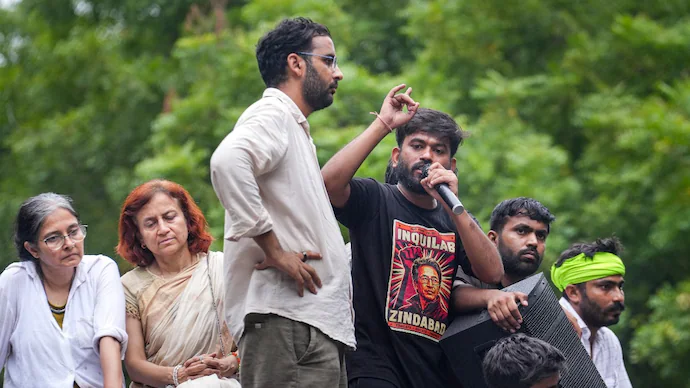
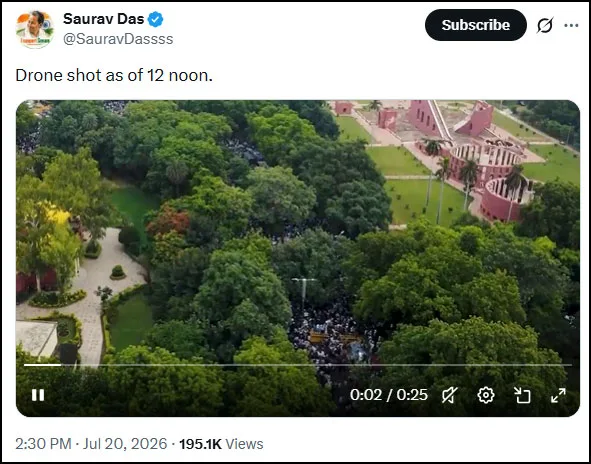
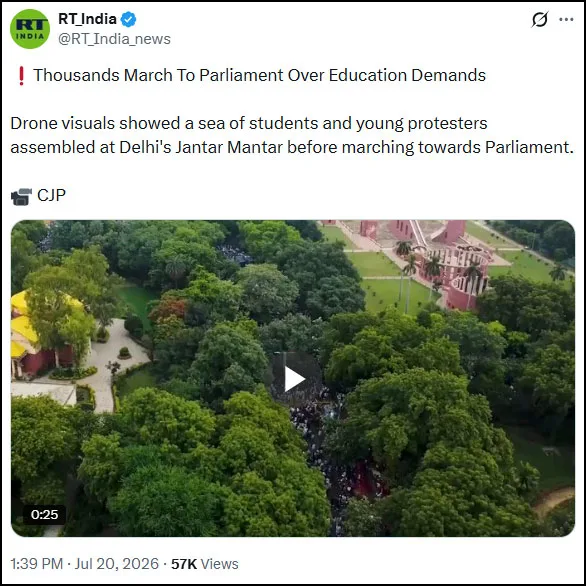
The Cockroach Janta Party (CJP) has landed in the middle of a major controversy after drone footage of its ‘Sansad Chalo’ protest at Delhi’s Jantar Mantar emerged on social media despite the venue being located inside one of the country’s most heavily restricted drone airspaces.
The aerial videos, shared by CJP and its spokesperson Saurav Das throughout July 20, were widely circulated on social media and forwarded to national and international media organisations to showcase the scale of the protest. However, instead of merely highlighting crowd strength, the footage has triggered serious questions over whether an unauthorised drone was flown inside a prohibited red-zone airspace in the heart of the national capital.
The protest itself had not received permission from Delhi Police. The emergence of professionally shot aerial footage has therefore raised another pressing question: if the gathering itself lacked official permission, who authorised the drone flight over one of Delhi’s most sensitive security zones?
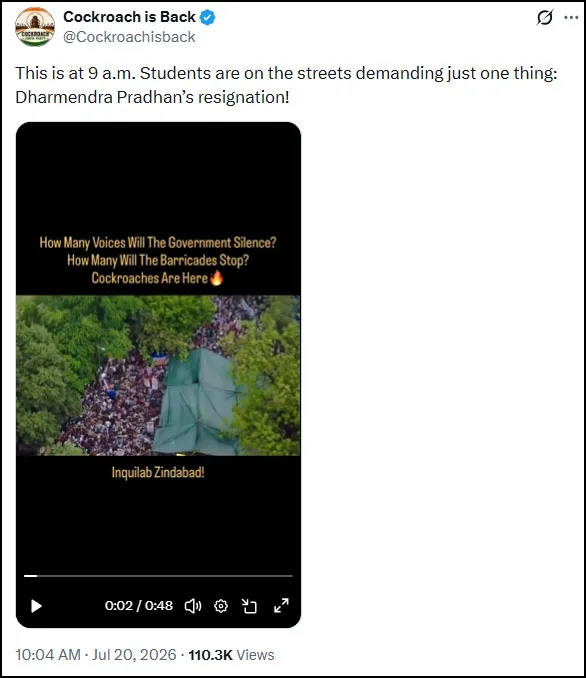
Jantar Mantar falls inside multiple red zones
According to the Government of India’s Digital Sky platform, Jantar Mantar lies within overlapping red zones, making it one of the most tightly regulated areas for drone operations.
Under Rule 22 of the Drone Rules, 2021, no drone, irrespective of its size, purpose or flying altitude can be operated inside a red zone without prior permission from the Central Government.
Unlike green zones, where civilian drones can fly without prior approval, or yellow zones, where clearance is obtained from Air Traffic Control authorities, red zones are categorised as complete no-drone areas, permitting flights only under exceptional circumstances with explicit approval from the Central Government.
This restriction applies equally to media organisations, photographers, political parties, content creators and private individuals.
If no such authorisation existed, the drone flight used to capture the protest was prima facie unauthorised.
Serious questions that demand answers
The incident has now sparked a series of uncomfortable questions for CJP and its organisers.
Who operated the drone?
Was the drone registered on the Digital Sky platform?
Did the operator possess a valid Remote Pilot Certificate wherever required?
Most importantly, who granted permission to fly inside a notified red zone?
Unless CJP produces documentary evidence of Central Government approval, the operation appears to have violated India’s drone regulations.
The issue assumes greater significance because the protest itself was reportedly organised without police permission.

No drone is too small for red-zone restrictions
A common misconception is that lightweight drones are exempt from restrictions.
However, the Drone Rules make it clear that even nano drones weighing below 250 grams cannot be flown inside a red zone without prior Central Government permission.
The exemption available to nano drones relates only to remote pilot certification and certain compliance requirements, not restricted airspace.
Whether the drone weighed 249 grams or 10 kilograms is therefore legally irrelevant once it entered prohibited airspace.
Similarly, using the drone for journalism, political publicity or social media documentation does not exempt the operator from compliance.
Publicity cannot override national security
Authorities have repeatedly maintained that restrictions are imposed based on location, not purpose.
Whether a drone is being used to record a political rally, wedding, documentary or news report, the legal requirement remains unchanged.
Once a location is designated as a red zone, every operator must obtain prior approval before take-off.
Claiming that the footage was shot merely to display crowd size offers no legal defence if mandatory permissions were absent.
Why authorities treat such flights seriously
The government has consistently argued that modern commercial drones are far more than flying cameras.
High-resolution imaging, live video transmission, GPS navigation, automated flight paths and payload capability make even civilian drones potential security risks near Parliament, government buildings and other strategic installations.
Security agencies cannot determine the operator’s intentions merely by observing a drone in flight.
The same commercially available platform used for photography can also be employed for surveillance, reconnaissance or transporting prohibited objects.
This is precisely why India’s drone regulations impose stringent restrictions over sensitive government zones.
Operation Sindoor reinforced drone threat
India’s security establishment has become even more cautious after Operation Sindoor demonstrated the rapidly evolving role of drones in modern warfare.
During the military operation, Pakistan allegedly attempted to target Indian military installations using drones and missiles, while India employed loitering munitions and advanced drone systems during precision strikes.
The conflict underscored how inexpensive commercial drone technology can be adapted for hostile purposes, reinforcing the need for strict enforcement of drone regulations in sensitive locations.
Against this backdrop, any unauthorised drone activity over restricted areas naturally attracts heightened scrutiny.
Possible legal consequences
Violations of the Drone Rules may invite penalties of up to Rs 1 lakh under the regulatory framework.
Additionally, authorities can suspend or cancel drone-related authorisations and certificates.
In more serious circumstances, provisions of the Bharatiya Vayuyan Adhiniyam, 2024 prescribe punishment of up to two years’ imprisonment, a fine of up to ₹1 crore, or both, if an aircraft is wilfully operated in a manner that endangers people or property.
Whether those provisions become applicable would depend upon the findings of the competent investigating authorities.
CJP must explain the drone flight
The controversy now extends beyond political messaging.
If CJP had secured lawful approval from the Central Government, it should disclose the permission, identify the drone operator, provide details of the drone’s registration and clarify under what authorisation the flight was conducted.
If no such approval exists, the incident raises troubling questions about how a drone was flown over one of Delhi’s most sensitive no-drone zones without apparent enforcement.
Security regulations exist precisely to prevent unauthorised aerial activity over strategic areas. Any selective enforcement or failure to investigate such incidents risks undermining the credibility of India’s drone governance framework and sending a dangerous message that violations in high-security zones can go unchecked.