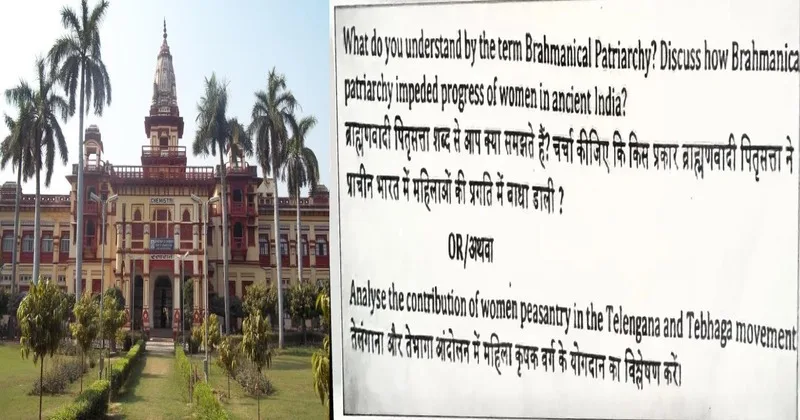
Uttar Pradesh, India’s most politically consequential state is once again witnessing an intensification of caste-based vocabulary and social discourse, a pattern that historically sharpens as the drumbeat as the assembly elections grows louder. In this charged atmosphere, where every word carries electoral weight and every institution is scrutinised for ideological alignment, Kashi Hindu University (BHU) in Varanasi has found itself at the epicentre of a controversy that goes far beyond a single exam question.
UP political landscape has long been shaped by the interplay of caste arithmetic and social messaging. Every institution, from the bureaucracy to the university is inevitably drawn into this vortex. In such an environment, the language used in academic settings is not merely pedagogical, it becomes a signal, a provocation or a statement of ideological allegiance. The question is not only what is being taught, but what is being normalised. BHU, one of India’s most prestigious central universities and a cultural symbol of Hindu civilisational heritage.
On May 19, 2026, a question paper in BHU MA History fourth paper asked students: “How did ‘Brahminical Patriarchy’ hinder the progress of women in ancient India?” The phrase rooted in a specific ideological tradition that critics argue conflates caste with gender oppression in a targeted manner exploded into a full-blown controversy. Brahmin community leaders, academics and political figures condemned the framing. Ex IIAS fellow Prof Jairam Singh said Its “unfortunate and concerning”, by saying terms like ‘Brahmanical patriarchy’ in question papers, create a negative perception against a particular section of society and the founder of University. This incident cannot be read in isolation. It is the latest chapter in a revealing pattern across India’s education system, where question papers have increasingly become sites of ideological contestation.
Who coined it
The term “Brahminical Patriarchy” was coined by feminist historians to reflect the centrality of caste to patriarchy in India. In a seminal 1993 article, The article titled “Conceptualising Brahmanical Patriarchy in Early India: Gender, Caste, Class and State” was published in the Economic and Political Weekly, Vol. 28, Issue No. 14, on April 3, 1993. Historian Uma Chakravarti explored the relationship between caste and gender. According to Chakravarti, the term captures “the need for effective sexual control over women to maintain not only patrilineal succession but also caste purity. The phrase migrated from academic journals into Left-wing campus activism and eventually into examination paper.
The JNU Connection: From campus walls to the world stage
To understand the BHU question paper in its full ideological genealogy, one must look at Jawaharlal Nehru University (JNU) in New Delhi, the institution that has served for decades as the intellectual incubator of the very vocabulary now appearing in central university examination papers. The phrase ‘Brahminical Patriarchy’ did not emerge organically from Indian historical scholarship, it has a specific ideological lineage, cultivated in Left-dominated academic departments and amplified through campus activism.
The phrase entered mainstream international discourse dramatically in November 2018, when Twitter CEO Jack Dorsey was photographed in New Delhi holding a poster reading “Smash Brahminical Patriarchy” during a closed-door meeting with women journalists, activists and writers. The former CFO of Infosys, Mohandas Pai, accused Dorsey of ‘hate-mongering’ against Brahmins. Prominent voices across the spectrum demanded a Twitter apology. The episode revealed how a phrase nurtured in left-wing academic circles could, when given international amplification, appear as a legitimised form of community targeting.
Four years later, in December 2022, JNU itself became the scene of something far more alarming. On the night of November 30, walls of several buildings on the JNU campus including the School of International Studies were defaced with openly threatening anti-Brahmin and anti-Baniya slogans. The messages read: “Brahmins Leave The Campus,” “Brahmins-Baniyas, we are coming for you! You will not be spared,” and “Brahmin Bharat Chhodo.” The slogan ‘Shakha Laut Jao’ was scrawled on the door of a female professor cabin the same professor who had reportedly been held hostage for three days by Left-wing students in 2019.
The trajectory has appeared from poster slogans at activist meetings, to campus walls and examination papers at central universities. The ideological vocabulary of ‘Brahminical Patriarchy’ has moved from the fringes of activist discourse to the institutional authority of the question paper, with each migration lending it greater legitimacy and coercive power. When a student at BHU reads this phrase in a university examination, they are not encountering an invitation to debate, they are receiving a certified academic verdict.
A Recurring Pattern: Recent cases that cannot be ignored
- Instance 1: UP Police Sub-Inspector Exam — ‘Pandit’ as Synonym for Opportunist (March 2026)
Just two months before the BHU row, the UP Police Sub-Inspector recruitment examination conducted on March 14, 2026 for 4,543 posts with over 15.7 lakh applicants who appeared in Hindi paper question asking candidates to identify a one-word substitute for “a person who changes according to opportunity.” The options were Pandit, Opportunist, Innocent, and Virtuous. The inclusion of ‘Pandit’ a term of religious and intellectual reverence in Brahmin tradition as an equivalent of opportunism triggered immediate outrage. UP BJP Secretary Abhijat Mishra wrote to Chief Minister Yogi Adityanath and Deputy Chief Minister Brajesh Pathak declared that any question “hurting the dignity of a community is unacceptable.” The recruitment board ordered an inquiry. The timing, coming amidst accusations of the BJP government being ‘anti-Brahmin,’ gave the episode significant political resonance in the pre-election atmosphere.
- Instance 2: Meerut College — RSS Equated with Insurgent Groups (April 2025)
At Meerut College under Chaudhary Charan Singh University, an MA Political Science paper positioned the RSS as the primary driver of religion and caste-based politics, and in another question placed it alongside the Jammu & Kashmir Liberation Front, Naxalites and Dal Khalsa organisations that are associated with insurgency and extremism. The ABVP staged protests, an inquiry confirmed the paper was set by Dr. Seema Panwar, Head of the Political Science Department. The case demonstrated how ideological biases, when embedded in examination papers, carry institutional endorsement that no classroom remark ever could.
- Instance 3: Samrat Vikramaditya University, Ujjain — Theology in a Commerce Exam (April 2026)
A Foundation Course examination for third-year B.Com and BCA students at Samrat Vikramaditya University in Ujjain contained a question framed in Islamic theological language “There is no one other than Allah” with answer options including Someshwar, Khuda, Shaktivan and Dand Dene Wala. Hindu organisations in Ujjain and Ratlam strongly objected, noting the double standard that a question rooted in Hindu theology in a secular paper would have been swiftly condemned as sectarian. The university launched a high-level inquiry. The episode underscored the inconsistent manner in which religious neutrality is enforced across Indian educational institutions.
Examination paper as ideological instrument
What unites these cases are separated by geography, institution type and academic level, but have a common thread the examination paper used as a vehicle for ideological messaging. Unlike a classroom lecture or a published textbook, a question paper carries the implicit authority of the institution. Its framing is not presented as one perspective among many, it presents a question to which a correct answer is expected. When a paper asks “how did Brahminical Patriarchy hinder women’s progress,” it does not invite debate it presupposes the conclusion. The student who disagrees with the premise must either argue against it at the risk of losing marks or accept the premise to succeed. This coercive dimension distinguishes examination room ideology from open academic debate.
According to Assistant Professor Manoj Singh, Dept of History, U.P. College said Indian examination system carries enormous social and economic stakes for millions. When ideological framing enters this space, it does so armed with structural authority. The political context in Uttar Pradesh adds another layer with caste consolidation a live electoral strategy for multiple parties, the vocabulary of caste grievance finds easy amplification. A controversy at BHU travels further, resonates longer and shapes community perceptions more decisively than a similar incident at a lesser-known college.
Neutrality as non-negotiable
The demand emerging from these controversies is not censorship of academic inquiry. Questions about patriarchy, caste and religion are legitimate subjects of historical and sociological study. The issue is framing. A question that asks “Analyse the social structures that affected women’s roles in ancient India” opens genuine intellectual inquiry. A question that asks how ‘Brahminical Patriarchy’ hindered progress directs the student to validate a pre-loaded conclusion.
India’s examination system requires urgent structural reform with independent, multi-member paper-setting committees, mandatory sensitivity reviews before papers are finalised and strict consequences for those who weaponize the question paper for community targeting. The slogan appearance from JNU campus walls to BHU examination hall must be controlled. The examination room must remain a space of intellectual merit and constitutional equality, not a battlefield for culture wars conducted at the expense of students who have no choice but to answer.