Prime Minister Narendra Modi’s May 2026 Norway visit exposed a transnational ecosystem across Europe engaged in shaping and amplifying hostile narratives against India. The controversy erupted when Norwegian journalist Helle Lyng Svendsen of the Oslo-based newspaper ‘Dagsavisen’ shouted at PM Modi during a joint press interaction with Norwegian Prime Minister Jonas Gahr Store, asking: “Why don’t you take questions from the freest press in the world?” The video was immediately amplified across international media circles and rapidly circulated by Indian opposition figures including Rahul Gandhi. The institutional background surrounding the controversy highlighted that the episode extended far beyond the actions of a single journalist. It is as part of an interconnected ecosystem involving European media organisations, journalism-funding institutions, philanthropic foundations, advocacy groups, and transnational ideological platforms that repeatedly target India through themes such as democratic decline, authoritarianism, caste discrimination, minority persecution, and press suppression.
‘Dagsavisen’ itself has deep roots in Norway’s Labour movement. It functioned for decades as the official newspaper of the Norwegian Labour Party before becoming formally independent, though it continues to operate within Norway’s centre-left media ecosystem and state-supported media structures. The framing reflected a larger ideological tendency within sections of Europe’s liberal establishment toward politically assertive non-Western powers, particularly a rising Hindu-majority India. The controversy intensified when Norway’s liberal newspaper ‘Aftenposten’ published a caricature portraying PM Modi as a “snake charmer” during his Oslo visit. Critics described the imagery as racist and rooted in colonial stereotypes historically used to depict India as backward and exotic. ‘Aftenposten’ forms part of the influential Schibsted media ecosystem. The Oslo episode exposed deeper civilisational biases within sections of Europe’s liberal media establishment toward India’s growing geopolitical and civilisational assertion.
May 2025, Norway Embassy hosted Indian left-liberal media puppets (Newslaundry & NewsMinute) for a closed-door dinner.
Now Newslaundry is interviewing the Norwegian journalist who did the hit job on PM Modi.
This is how the globalist soft war on India operates! pic.twitter.com/Svk7pYzTEX
— STAR Boy TARUN (@Starboy2079) May 21, 2026
The Norway Connection: Fritt Ord, press networks and the liberal media establishment
One institution repeatedly referenced during the Norway controversy was the ‘Fritt Ord Foundation’, among Norway’s most influential free-expression and journalism-funding organisations.
Fritt Ord finances investigative journalism projects, documentaries, academic discussions, media initiatives, freedom-of-expression campaigns, and public debate programmes across Norway. A review of publicly available institutional associations showed that several journalists and personalities linked to Norway’s media establishment have interacted with the Fritt Ord ecosystem through grants, fellowships, collaborations, or awards. Dagsavisen journalist Nina Johnsrud, for instance, received the Fritt Ord Honorary Award.
The controversy highlighted how Norway’s media environment functions through interconnected institutional circles involving state subsidies, media houses, philanthropic foundations, academia, rights-based organisations, and political networks aligned with European liberal internationalism.
Norwegian Prime Minister Jonas Gahr Store himself leads the Labour Party, historically connected to broader European centre-left political traditions supportive of democracy-promotion initiatives, global human-rights advocacy structures, and liberal governance frameworks. This ideological climate has often shaped how India is portrayed within sections of European public discourse, where themes such as democratic backsliding, suppression of dissent, press intimidation, religious nationalism, and minority insecurity are repeatedly amplified. The Oslo episode also demonstrated how rapidly local incidents involving India are absorbed into transnational media circuits. Within hours, the exchange involving Helle Lyng Svendsen was amplified across international commentary networks, digital platforms, advocacy ecosystems, and opposition-linked social media spaces in India. The concern raised by critics was not criticism itself, but the recurring pattern in which India is framed almost exclusively through crisis-oriented narratives while comparable complexities within Western societies receive far less coordinated scrutiny.
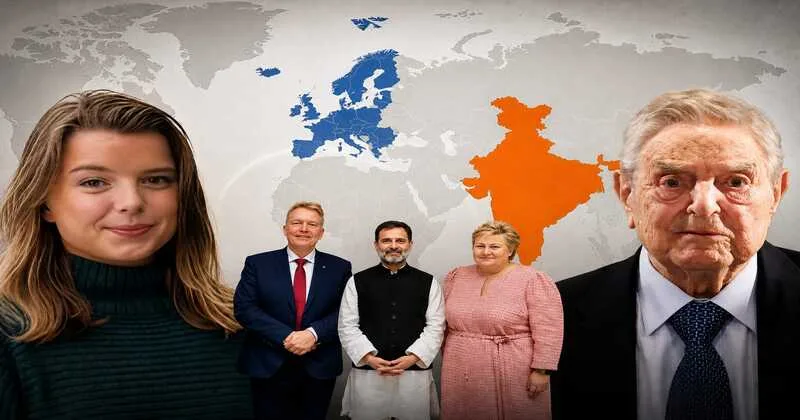
Can Rahul Gandhi explain why he went to Norway in 2023 and met with Erna Solberg, who is part of Norway's opposition party and senior member of European Council on Foreign Relations (ECFR) an organisation funded by George Soros
The "Dagsavisen" newspaper whose journalist… https://t.co/v6crBwDj5A pic.twitter.com/q6dn7PZlnU
— Muji Singh Rangi (@mujifren) May 19, 2026
The controversy later moved beyond the journalist herself and toward institutional and funding networks linked to Dagsavisen. Links between billionaire financier George Soros, the Open Society Foundations, Journalismfund Europe, and Norway’s Fritt Ord Foundation began drawing attention. Open Society Foundations has been identified as a donor to Journalism fund Europe, while journalism-related grants in Norway are routed through or linked to Fritt Ord. Reports also indicated that Fritt Ord had provided grants to Dagsavisen, where Helle Lyng Svendsen works as a commentator. Attention also returned to Congress leader Rahul Gandhi and his 2023 Norway visit, during which he met former Norwegian Prime Minister Erna Solberg, who has links with the European Council on Foreign Relations. The ECFR has previously received support from Soros-linked Open Society Foundations, prompting renewed online discussion and political commentary following the Oslo controversy.
‘Reporters Without Borders’ and the Politics of press freedom rankings
Another major institution repeatedly criticised in India is Reporters Without Borders (RSF), the Paris-based organisation responsible for publishing the annual World Press Freedom Index. Norway consistently ranks at the top of RSF’s global rankings, while India has repeatedly been placed significantly lower. Helle Lyng Svendsen herself referenced Norway’s press-freedom status while defending her public intervention against PM Modi.
The role of RSF within the broader European media ecosystem and found that the organisation’s assessments frequently shape international perceptions regarding India’s democratic and media environment. RSF reports have repeatedly cited concerns regarding journalist safety, online harassment, media ownership concentration, internet shutdowns, and political pressure on independent journalism in India. However, RSF functions less as a neutral evaluator and more as part of a larger ideological ecosystem that repeatedly portrays India as increasingly authoritarian. Moreover, RSF rankings are regularly cited by international newspapers, advocacy NGOs, think tanks, university programmes, European parliamentary discussions, and global rights networks, creating a self-reinforcing cycle of perception building.
🇳🇴🇮🇳 : A major Norwegian newspaper published a cartoon showing PM Modi as a snake charmer during his visit to Oslo.
The headline described him as “a clever and slightly annoying man.” pic.twitter.com/FK0p851yuo
— War Flash (@WarFlash_2630) May 19, 2026
The same ecosystem frequently amplifies fake reports relating to Kashmir after the abrogation of Article 370, the 2020 Delhi riots, alleged democratic backsliding, internet shutdowns, caste discrimination, minority rights, surveillance claims, and accusations of “Hindu majoritarianism.” However, issues relating to Islamist violence, radical networks, separatist mobilisation, and geopolitical security concerns often receive comparatively limited emphasis in international reporting frameworks. Such asymmetrical framing contributes to a global perception of India as a state under democratic decline despite India remaining one of the world’s largest and most electorally active democracies.
‘Journalismfund Europe’ and the architecture of narrative financing
The debate surrounding India’s global image increasingly focuses on ‘Journalismfund Europe’ and associated grant-making ecosystems that finance cross-border investigative reporting projects. ‘Journalismfund Europe’ claims to supports international reporting collaborations involving themes such as surveillance, digital governance, religious conflict, environmental disputes, corruption, democratic institutions, minority rights, and political accountability. According to the reports, the institutional funding structures associated with ‘Journalismfund Europe’ and found connections with several influential European philanthropic and governmental entities. Among the major associated funders are the European Commission, Arcadia Fund, Porticus Foundation, Adessium Foundation, Oxfam Novib, Fritt Ord Foundation, King Baudouin Foundation, Melior Foundation, and other European grant-making institutions.
The European Union itself has become one of the largest financiers of transnational journalism initiatives through programmes linked to :Creative Europe’, ‘DG CONNECT’ media programmes, media-freedom initiatives, journalism partnerships, anti-disinformation projects, and cross-border investigative collaborations. Critics in India argue that these funding structures create ideological incentives favouring stories aligned with liberal political frameworks. Investigations focusing on nationalism, religious tensions, caste inequality, surveillance, democratic decline, and majoritarian politics in countries like India receive disproportionate institutional support and international amplification.
Arcadia Fund, established by Lisbet Rausing and Peter Baldwin, has funded environmental, archival, cultural, and media-related initiatives globally. The ‘Arcadia’ expanded funding support for Journalismfund Europe after the Open Society Foundations reduced direct involvement. Porticus Foundation, linked to the Brenninkmeijer family in the Netherlands, finances projects connected to social justice, migration, media literacy, inclusion, and civil society activism. ‘Adessium Foundation’ supports investigative journalism, transparency campaigns, governance initiatives, climate activism, and democracy-promotion projects. ‘King Baudouin Foundation’, among Belgium’s most influential philanthropic institutions, funds governance, democracy, civic participation, and public-debate initiatives across Europe. ‘Oxfam Novib’ finances governance projects, rights-based advocacy, inequality campaigns, and social-justice media initiatives. These interconnected funding ecosystems collectively shape the ideological environment within which India-related reporting increasingly operates. Observers say that journalism, advocacy, academia, rights-based activism, and philanthropy now function through overlapping transnational networks capable of generating international consensus narratives within hours.
Soros, Open Society Foundations and the transatlantic activist ecosystem
Among the most controversial entities within this ecosystem is the Open Society Foundations (OSF), established by billionaire George Soros. OSF has financed governance programmes, rights-based advocacy initiatives, media projects, civil society campaigns, and academic activities across the world. In India, Soros-linked initiatives have repeatedly attracted controversy over campaigns targeting on democratic backsliding, minority rights, caste discrimination, media freedom, and alleged authoritarian tendencies under the Modi government. George Soros himself triggered political backlash in India after remarks suggesting that political developments in India could produce a “democratic revival.” Critics interpreted the remarks as external interference in India’s democratic processes.
Pee pee poo poo George Soros institute ranked India lower than most intolerant nations on press freedoms because it is not freedom but freedom to spread western propaganda that is being measured. And those NGOs have been rightly systematically shut down by Modi's BJP.
Modi did… https://t.co/9l8j3W4sVa pic.twitter.com/MFV3Aq48l2
— Indian Tintin (@IndianTintin_) May 19, 2026
The recent developments involving OSF-linked entities and found that in 2025 the Enforcement Directorate conducted searches connected to entities associated with OSF over suspected FEMA violations and routing of funds to NGOs through indirect channels. The Open Society ecosystem has played a significant role in funding or amplifying rights-based campaigns relating to Kashmir, minority issues, caste discrimination, surveillance allegations, digital freedoms, and institutional accountability narratives targeting India. Fake narratives surrounding the Pegasus surveillance controversy, 2020 Delhi riots, post-Article 370 Kashmir restrictions, and the farmers’ protests frequently highlighted allegations of democratic suppression, civil-liberty concerns, media intimidation, and state overreach. The result has been the creation of a persistent global narrative portraying India as a democracy under collapse precisely at a time when India is emerging as a major geopolitical, technological, and civilisational power.
The Europe-based pressure networks and the Bastar narrative
A newer example of this debate involves Europe-based organisations connected to Pakistan-linked advocacy structures and U.S.-based Jamaat-associated fronts. According to material from the open-source intelligence commentary, the Netherlands-based Foundation The London Story (FTLS) has emerged as a significant actor within this ecosystem. FTLS has partnered with organisations such as ‘Stand With Kashmir’, ‘India Justice Project’, ‘London Mining Network’, and ‘Indian Alliance Paris’. In 2023, FTLS collaborated with Pakistan-backed ‘Stand With Kashmir’ to campaign against the 3rd G20 Tourism Working Group Meeting held in Srinagar in Jammu & Kashmir. The details of subsequent initiatives and found that FTLS also hosted Washington Post journalist Rana Ayyub in 2022 to discuss alleged attacks on Indian journalism before European audiences.
More recently, FTLS co-organised a briefing focused on the Adivasi community in Bastar in the Chhattisgarh state alongside the left- activists and academics including Bela Bhatia, Professor G. Haragopal, Binota Moy Dhamai, and Ana Celestial. These events are strategically designed to influence European policymakers by portraying India as an oppressive state violating tribal, minority, and human rights.
Bela Bhatia herself has remained controversial in India. In 2016, local protests in Chhattisgarh accused her of links with Maoist ecosystems and of fabricating allegations against security forces. In 2017, surrendered Maoist cadre Podiyam Pandu alleged connections between Bhatia, activist-academic Nandini Sundar, and Maoist insurgents. Nandini Sundar had earlier faced legal controversy in connection with allegations relating to violence in Sukma district. Bhatia is married to Belgian-born economist Jean Dreze, an outspoken critic of several government policies including the abrogation of Article 370. Dreze co-founded the Centre for Equity Studies (CES) alongside Harsh Mander. CES faced regulatory scrutiny after its FCRA licence was suspended in 2023. In 2024, the Central Bureau of Investigation conducted raids linked to allegations involving diversion of funds from FCRA accounts.
Critics further highlighted controversies surrounding CES-linked children’s homes following complaints filed by the National Commission for Protection of Child Rights. These overlapping activist, academic, and advocacy networks increasingly operate through transatlantic structures involving European institutions, American advocacy groups, diaspora activism, and digital media ecosystems.
India’s rise and the battle over Global perception
The controversy surrounding Prime Minister Modi’s Norway visit ultimately exposed a larger geopolitical reality: India’s rise as a major civilisational and strategic power is increasingly accompanied by intense narrative contestation. India asserts itself as a confident Hindu-majority democracy and an independent pole within the emerging multipolar order, sections of the Western liberal establishment have responded through ideological resistance, rights-based pressure campaigns, media framing, and perception management.
According to the multiple controversies repeatedly cited by Indian critics, including the Pegasus investigations, Kashmir reporting after Article 370, the Delhi riots coverage, the farmers’ protests, caste-discrimination campaigns, surveillance allegations, and democracy-index narratives and found recurring institutional overlap involving media outlets, philanthropic donors, journalism networks, advocacy organisations, and transnational activist platforms.
The debate has also intensified inside India following the revelation by BJP spokesperson Sambit Patra in November 2025 that several anonymous or overseas-operated X accounts linked to Congress-aligned and Left-leaning ecosystems were functioning from locations including the United States, Ireland, Pakistan, Bangladesh, Singapore, Malaysia, Thailand, Europe, and West Asia to run coordinated campaigns targeting Prime Minister Modi and India’s global image. According to Patra, these digital campaigns pushed narratives relating to “vote theft,” “Operation Sindoor,” and attacks on the RSS while receiving support from foreign networks. Experts increasingly describe this phenomenon as “narrative warfare”, a process through which international media reports, NGO publications, academic papers, rights campaigns, journalism grants, and social-media amplification collectively generate global perceptions regarding India.
India today faces not only geopolitical competition but also information warfare operating through sophisticated transnational ecosystems rooted in Europe and North America. The central concern is that criticism of India increasingly appears selective, synchronised, and ideologically structured rather than organically journalistic. For India’s nationalist discourse, it symbolised a larger confrontation between a rising post-colonial civilisation-state asserting strategic autonomy and entrenched transatlantic ideological ecosystems seeking to shape how the world perceives India. As India rises economically, technologically, strategically, and culturally, the battle over global narratives is likely to intensify further, not merely across governments and institutions, but across media systems, activist networks, digital platforms, philanthropy, and international civil society itself.