
“Political factions in Assam who claim to inherit the legacy of the Assam Agitation and to be forerunners of Assamese interests are choosing to co-exist with historical adversaries for momentary political gains, a severe case of historical amnesia”
Political movements rarely arise suddenly; they usually result from ignored warnings, dismissed fears, and mounting grievances that eventually foster collective resistance. The Assam Movement from 1979 to 1985 illustrates this: it was more than a protest over electoral lists; it stemmed from decades of demographic worries and political mistakes. Today, its legacy persists through successors who loudly claim its memory. Yet, those same voices that defend Assamese identity quietly ally with the political powers that once used force against movement leaders, branded them traitors, enacted laws to protect illegal migrants, and held elections against the people’s wishes and even their own intelligence agencies’ advice. This article does not employ insinuation. It is based on documented history. What follows is a case built on specific decisions, named officials, and verifiable dates—an account of who opposed Assam and who supported it. The paradox of modern Jatiyatabad is not merely ironic; based on evidence, it appears to be a betrayal.
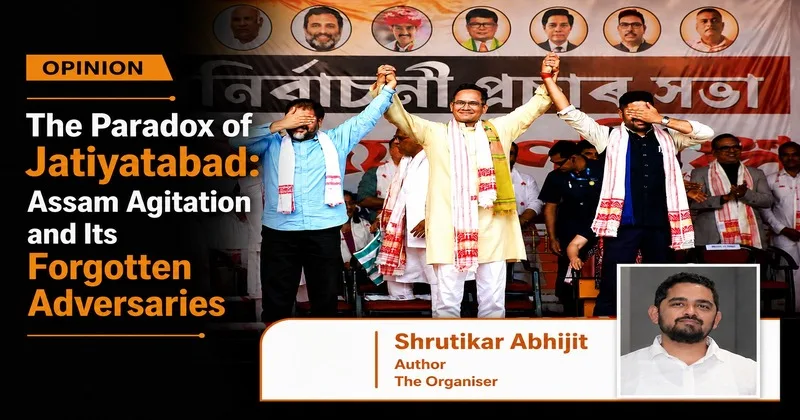
The need to revisit and re-analyse the Paradox of Jatiyatabad is especially relevant today, as the Assam Assembly elections conclude and the people of Assam voice a clear mandate. It is even more important to walk down the memory lane of the Assam Agitation, as Jatiyatabadi political parties, like the Assam Jatiya Parishad (AJP), founded by Lurinjyoti Gogoi, a former General Secretary of the All Assam Students Union, and Raijor Dol, founded by Akhil Gogoi, a communist-turned-Jatiyatabadi politician, contested elections as alliance partners of the Congress-led front. What was particularly interesting was the choice of these two parties in a few constituencies and their initial propensities regarding candidate selection.
While the entire agitation was about detecting and deleting illegal Bangladeshi Muslim voters, both Jatiyatabadi political parties in the recently concluded Assam Assembly election had originally targeted constituencies where these voters held hegemony, initially demanding 15-20 seats each before settling for around 10 & 13 seats each.
Both AJP and Raijor Dol targeted constituencies, mostly dominated by non-indigenous Muslims. However, with Congress refusing to let go of these seats, fearing poor performance in seats dominated by the indigenous community, both parties had to settle for fewer seats in these areas, for example: Mehboob Muktar from Dhing LAC, Abul Mia from Gauripur LAC, Abdur Basid Mondal from Goalpara East LAC, Azizur Rahman from Dalgaon LAC, and Alhaaj Rezaul Karim Chowdhury from Binnakandi LAC. While AJP contested around 10 seats, it lost all of them. For Raijor Dol, out of the 13 seats it contested, it won only two: Mehboob Muktar from Dhing and Akhil Gogoi himself. The Congress tally of winners was even more interesting. While it contested 101 seats, it won 19, and 18 of those 19 were won by non-indigenous Muslim candidates from seats heavily favouring demographic hegemony. The lone Hindu candidate, JP Das, managed to win the Naoboicha assembly constituency, given that it was an SC reserved seat and Congress couldn’t field any non-indigenous Muslim, even after their overwhelming hegemony on electoral demographics.
Therefore, the overall inclination displayed by the Congress and its Jatiyatabadi allies was heavily skewed in favour of one particular demographic, the very same demographic against whom AASU had led a 6-year-long struggle, for which 855 patriots laid down their lives and for which numerous others endured unbearable torments. The very same demographic on whose shoulders the former AASU General Secretary, Lurinjyoti Gogoi, led AJP, and Communist-turned-Jatiyatabadi leader, Akhil Gogoi, dreamt of riding into the corridors of power in Dispur.
Therefore, it is of utmost importance that we revisit the turn of events that led to the legendary Assam Agitation and, as responsible patriots, remind the world, especially the self-styled brokers who take every opportunity to bake their bread over the flames of regionalism.
The Assam Movement did not begin in 1979; rather, its roots lie in warnings that were raised, recorded, and deliberately suppressed for three decades. In 1951, M.S. Golwalkar, the then Sarsanghchalak of the RSS, visited Assam and wrote a detailed letter to the Prime Minister warning that a large-scale systemic migration from East Pakistan was altering Assam’s demographic balance for posterity in ways that would generate long-term political instability (Bhattacharjee, 2016, p. 85). This was among the earliest documented instances of any national socio-political voice framing the migration issue in Assam as a national security concern rather than a mere administrative inconvenience.
From the early 1960s, a weekly Assamese newspaper called Aalok, again run by RSS workers, published sustained investigative reporting on the growing volume of illegal entries from East Pakistan (Bhattacharjee, 2016, p.83-85). This was decades before AASU even existed, long before any student movement had coalesced around the issue. The warning was there, in print, in Assamese public discourse, for anyone willing to read it, but it was conveniently ignored.
In the meantime, the Congress-led central government was systematically moving in the opposite direction. In 1964, Prime Minister Nehru instructed Chief Minister Bimala Prasad Chaliha to slow down the Prevention of Infiltration Programme (PIP), which security officials described as highly effective, with detection cells identifying and deporting hundreds of infiltrators nightly (Pisharoty, 2019, p. 66). The decision was driven by political pressure from pro-immigrant factions within Congress. Security analysts later described this as the moment Assam missed the bus on resolving the migration issue (Pisharoty, 2019, p. 389).
By 1969, the programme was abandoned entirely. Congress leaders Fakhruddin Ali Ahmed and Moinul Haque Chaudhary had successfully lobbied Prime Minister Indira Gandhi to issue a directive halting all police searches for foreigners in Assam (Nath, 2021, p. 69). Annual deportations dropped to near zero. The specialised border police units became inactive. The political consequences were immediate: the effective opening of the border signalled to migrants that their presence in Assam would be protected (Nath, 2021, p. 72).
In 1972, the Indira-Mujib Agreement was signed, which unilaterally shifted the cut-off date for identifying illegal migrants from 1951 to March 25, 1971, for Assam alone and was not applicable to any other state in the Indian Union (Nath, 2021, p. 96). This effectively regularised millions who had entered the state illegally over the past two decades. And in 1975, Congress president Dev Kanta Barooah made the electoral calculus explicit: as long as the “Alis, Kulis, and Bongalis” supported Congress, the party did not need to concern itself with anyone else (Pisharoty, 2019, p. 320-321). The message to the indigenous Assamese population could not have been plainer.
The immediate trigger arrived in 1979 during the revision of electoral rolls for the Mangaldoi parliamentary by-election, when officials discovered approximately 45,000 suspected foreigners on the voter lists (Baruah, J., 2019, p. 303). The Assamese public’s response was constitutionally grounded: elections could not be held legitimately on rolls that contained the names of illegal voters. The slogan “No Deletion, No Election” was not a call for secession. It was a demand for constitutional integrity. The central government, on the other hand, was hell-bent on proceeding with elections using the same unrevised 1979 rolls, overlooking citizens’ concerns. J. Baruah (2019, p. 303-305) describes this as an “unconstitutional” act that transformed what might have remained a manageable dispute into a state-wide civil disobedience movement lasting six years.
What did the Congress leadership have to say about the men and women leading this constitutional protest?
In 1980, Union Home Minister Giani Zail Singh called agitation leaders “traitors” (Gupta, 1984, p. 40). Prime Minister Indira Gandhi publicly attributed the unrest to “foreign powers” and raised the possibility of CIA involvement, framing AASU’s leadership as external puppets rather than representatives of genuine local grievances (Pisharoty, 2019, pp. 62, 64, 305). This was not ambiguity or rhetorical excess; this was the Government of India formally telling Assam that its constitutional protest was treasonous.
In December 1980, the Congress high command installed Syeda Anwara Taimur as Chief Minister, a minority government specifically chosen, Gupta (1984, p. 42) records, “to consolidate the party’s immigrant electoral base at the height of the movement”. Her administration conducted mass transfers of middle-level Assamese officials, replacing them with officers perceived as anti-agitation, a deliberate “de-Assamization” of the state bureaucracy (Gupta, 1984, p. 42). She reportedly had her personal secretariat, which was completely composed of Muslims, devoid of any representation from Native Hindu Assamese or Tribal communities (Gupta, 1984, p. 42; Baruah, S., 1986, P. 1197). The National Security Act was invoked against student leaders, and Press censorship was imposed with an iron hand. The Gauhati High Court eventually struck down the pre-censorship notifications as an overreach of administrative power (Pisharoty, 2019, p. 77).
The most damning episode in Congress’s relationship with the Assam Movement came in February 1983. Despite explicit intelligence warnings that conditions were unsuitable for polling, and a near-total boycott by the indigenous Assamese population, the Indira Gandhi government forced Assembly elections on the unrevised 1979 rolls. In ethnic Assamese areas, voter turnout was near zero, rendering the resulting government constitutionally illegitimate from the moment it was sworn in (Goswami, 2020, p. 49).
The elections triggered a series of outbreaks of violence in the state’s post-Independence history. Over 3,000 people died in the resulting violence surrounding the polls (Baruah, J. 2019, p. 308; Saikia, 2011, p. 548-549). The causes were complex and deep-rooted, with decades of demographic displacement, land dispossession, and administrative neglect that had built explosive pressures across multiple communities. The Congress government, by forcing elections at precisely this moment, acted as the detonator. The administrative callousness underpinning that decision was captured starkly by a senior Home Ministry official who warned that violence was inevitable and was dismissed with a lame counter-question, asking: “Didn’t hundreds die in the Bihar Panchayat elections?” (Gupta, 1984, p. 18).
What did Prime Minister Gandhi say in the aftermath?
Touring Assam, she issued public statements blaming the “agitators” for the violence, holding AASU and AAGSP leadership responsible for what followed the elections she had ordered against the advice of her own intelligence agencies (Pisharoty, 2019, p. 93). The label of “communalism” became Congress’s standard instrument for two decades to isolate native Assamese concerns from national democratic sympathy (Saikia, 2011, p. 544-545). The communities whose lands and livelihoods had been eroded by decades of unchecked infiltration were systematically recast as the perpetrators, blaming the victims for trying to resist a systematic onslaught.
The Congress government then passed the Illegal Migrants (Determination by Tribunals) Act in 1983, a law that applied exclusively to Assam and reversed the standard burden of proof, where instead of a suspected illegal migrant being required to prove his/her citizenship, the complainant now had to prove the person was a foreigner (Goswami, 2020, p. 55). Over two decades of its operation, only 1,481 persons were physically deported under its provisions (Nath, 2021, p. 90-93). The Supreme Court of India ultimately struck the Act down in 2005 as unconstitutional and an impediment to national security (Pisharoty, 2019, p. 196).
The Assam Accord of 1985 ended the agitation. Still, it entrenched the 1971 cut-off, effectively regularising all illegal entrants from 1951 to 1971 and creating a large immigrant voting bloc that critics argued altered the state’s electoral arithmetic permanently (Nath, 2021, p. 95-96). The following year, Section 6A was inserted into the Citizenship Act, creating, exclusively for Assam, a legal framework for migrants that was applied to no other state in the Union (Nath, 2021, p. 56,144). The Supreme Court continues to adjudicate a constitutional challenge to Section 6A to this day.
While Congress confronted the agitation, suppressed its leaders, and passed laws to shield the very migrants the movement opposed, a different set of organisations was building support for the Assamese cause in Delhi drawing rooms, university seminar halls, and on the floor of Parliament. The historical record on this point is not merely suggestive. It is specific, dated, and documented in contemporaneous sources.
On 6 December 1979, the Akhil Bharatiya Vidyarthi Parishad (ABVP) sent a national delegation to meet Chief Election Commissioner S.L. Shakdher, presenting a formal memorandum demanding postponement of Assam elections until the rolls were cleansed of foreign names, providing institutional backing to AASU’s “No Deletion, No Election” position (“ABVP for Postponing Poll in Assam,” Times of India, December 11, 1979, p. 3). This was within days of the Mangaldoi discovery, before the movement had coalesced into a national story.
Subsequently, on 9 June 1980, the ABVP organised a 24-hour hunger strike outside Parliament House in New Delhi. The protest was attended by national leaders, including Chandra Shekhar, George Fernandes, and Madhu Dandavate, and submitted a memorandum to the Prime Minister demanding that the infiltration issue be declared a matter of national unity and security (Manojkant et al., vol. 1, 2022, p. 260). The same organisation brought AASU leaders to JNU, Utkal University, and Hyderabad University, providing the Assamese movement with an academic platform in an intellectual space where the Left-liberal consensus was largely hostile to the agitation (Manojkant et al., vol. 1, 2022, p. 260; Goswami, 2020, p. 52).
On 4 January 1981, the ABVP organised the National Conference on the Assam Crisis at the Constitution Club in New Delhi. The event was attended by representatives from twelve major Assamese civil society organisations, including AASU, the Assam Sahitya Sabha, the Assam College Teachers’ Association, the Assam Government Employees Association, and the Guwahati University Teachers’ Association (Manojkant et al., vol. 1, 2022, p. 261; “ABVP Condemns Assam Policy,” Times of India, January 28, 1981, p. 11). The conference produced a Permanent Committee of writers, sociologists, and legal experts, and submitted a memorandum to the Prime Minister demanding Detection, Deletion, and Deportation, an early formal articulation of what would eventually become the NRC framework (Manojkant et al., vol. 1, 2022, p. 262).
Between 23 August and 1 October 1983 , in the immediate aftermath of the violence-marred elections, the ABVP conducted the Shaheed Jyoti Yatra, led by Sushil Modi, carrying a martyrs’ flame from Rajghat in Delhi to Guwahati, covering 6,118 kilometres across five states, holding over 300 public meetings, reaching an estimated 200,000 people, and securing pledges of support from 25,000 students (Manojkant et al., vol. 1, 2022, p. 266–267). The same period saw the ABVP’s Sadbhavana Yatra visit violence-affected districts, collect independent evidence of administrative failures, and present findings to national media to contest the government’s claim of a “peaceful poll” (Manojkant et al., vol. 1, 2022, p. 266).
The BJP’s parliamentary role ran in parallel. In late 1979, BJP and Jana Sangh members in Parliament led the demand to postpone elections until the rolls were revised, marking the first Delhi-based political support the movement received. This shifted the foreigners’ issue from the streets of Guwahati to the floor of the national legislature (Baruah, J., 2019, p. 309). In January 1981, Atal Behari Vajpayee visited Guwahati and proposed a settlement formula anchored in the 1951 NRC and constitutional documentation (Gupta, 1984, p. 45). In February 1983, senior BJP leaders, Vajpayee, Jaswant Singh, and L.K. Advani, visited Assam during the peak of election violence and formally boycotted the polls (“BJP Boycotts Assam Poll,” Times of India, January 9, 1983). The BJP National Executive passed a resolution demanding that the government cease its repressive operations against the movement (“Stop Repressive Steps, Says BJP,” Times of India, April 23, 1980, p. 9).
Prime Minister Gandhi herself confirmed this alignment in June 1980, publicly stating that the RSS and Jan Sangh were encouraging the Assam Movement (“PM Ready to Solve Assam Issue,” Times of India, June 12, 1980). This was not a rhetorical flourish, but rather an admission by the head of government that these organisations were, in her own words, behind the agitation, the same agitation she was simultaneously portraying as CIA-sponsored and treasonous.
The RSS’s organisational contribution to the movement’s ground operations is equally well documented. By the mid-1980s, the organisation was running daily shakhas across 360 blocks in Assam and Meghalaya (Bhattacharjee, 2016, p. 86). RSS cadres participated in bandhs, oil blockades, and mass pickets organised by the AAGSP (Bhattacharjee, 2016, p. 86). Even the movement’s critics on the Left acknowledged the organisational reality: CPM leader Niren Ghosh publicly acknowledged “large-scale infiltration by RSS elements in AASU” (“MPs Allege Govt. Foul Play: Assam,” Times of India, May 7, 1983, p. 9). Communist parties demanded that the government refuse to negotiate with AASU and AAGSP precisely because of this RSS presence. Political opposition was inadvertently confirming organisational fact.
Against this documented backdrop, consider the political landscape of contemporary Assam. Several parties that emerged directly from AASU, or that define themselves as its heirs and guardians of Assamese interests, like the AJP and Raijor Dol, have entered into formal electoral alliances with the Indian National Congress. These same parties and their leaders are simultaneously vocal in their criticism of the BJP and the RSS, organisations that, according to the contemporaneous record, organised hunger strikes at Parliament for Assam, carried a martyrs’ flame from Delhi to Guwahati, boycotted the 1983 elections in solidarity with the movement, fought the IMDT Act in Parliament for two decades, and whose cadres were as alleged by certain section was embedded within AASU’s own volunteer force.
The inversion is not subtle, on one side of the ledger sits an organization whose Home Minister called the agitation’s leaders traitors; whose Prime Minister blamed the movement for the violence her forced elections triggered; which installed a Chief Minister who described the Assamese people as “lazy and docile”; which passed the IMDT Act specifically to shield illegal migrants; which suspended the NRC pilot project in the face of minority pressure; and which as late as 2015 formally opposed defining “Assamese people” by the 1951 baseline. This organisation is today’s alliance partner of the self-proclaimed Jatiyatabadi political parties.
On the other side sit organisations that raised the alarm about infiltration in 1951, documented it through the 1960s, organised national solidarity campaigns in 1979-1983, fought the IMDT Act legislatively for 22 years, and whose supporters carried the movement’s martyrs’ flame across 6,000 kilometres of India. These organisations are today’s enemies.
The self-proclaimed Jatiyatabadis are entitled to their electoral choices. Political pragmatism is a reality, and contexts evolve. But what they are not entitled to is the uncontested claim to the moral authority over Assam’s interest, while simultaneously erasing the historical record that underpins it. Jatiyatabad, if it means anything at all, must mean accountability to that history, including the history of who the movement’s actual friends and foes were.
The Assam Movement was not an abstraction. It was built by specific people, opposed by specific governments, and supported by specific organisations. The record is there, in Parliamentary debates, in newspaper archives, in the memoirs of participants. It does not require interpretation. It requires only the political honesty to read it.