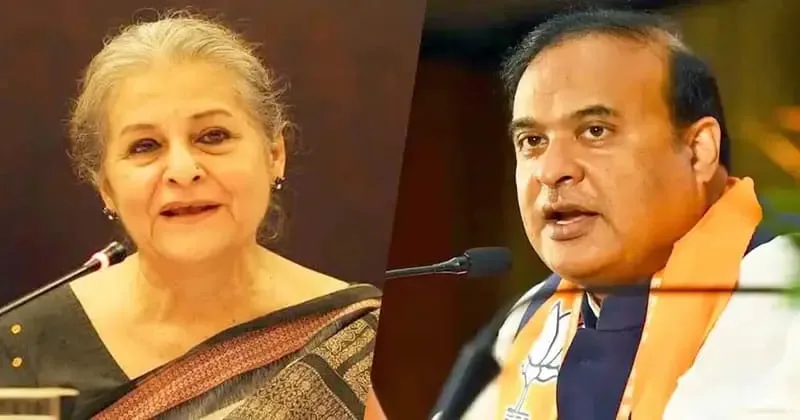
Assam has always stood as a land of natural beauty, cultural resilience, and proud diversity. It has absorbed waves of migration and endured upheavals across centuries, yet it has preserved its unique identity and sense of belonging. But today this identity is under unprecedented pressure, not because of natural historical change, but due to the relentless inflow of illegal migrants from across the border and the tendency of certain voices to trivialise Assamese concerns in the name of humanitarianism. It was in this context that Syeda Hameed, speaking under the banner of Assam Nagarik Manch in Guwahati, chose to argue for the retention of those who entered Assam illegally from Bangladesh. Such interventions, wrapped in the vocabulary of compassion, strike at the very root of Assam’s survival. Assam cannot, and will not, be reduced to a dumping ground for illegal entrants, no matter how eloquently outsiders may demand it.
The struggle of the Assamese people is not directed against any particular community or religion. It is a struggle for existence, for justice, and for dignity in their own homeland. The burden of history must not be forgotten. Since Partition, Assam has had to carry demographic and economic pressures unmatched elsewhere in India. The refugee influxes of 1947 and again in 1971 during the Liberation War of Bangladesh placed an extraordinary strain on the State’s limited resources and fragile cultural balance. The six-year-long Assam Movement from 1979 to 1985, during which thousands of young people gave their prime years and hundreds sacrificed their lives, was not a movement of exclusion but of survival. Its culmination, the Assam Accord of 1985, was a solemn promise between the Assamese people and the Union of India. The Accord clearly fixed March 24, 1971, as the cut-off date for citizenship in Assam. Those who entered after this date were to be detected, deleted from rolls, and deported. That compromise was not easily won—it was paid for in blood and sacrifice. To now suggest, as Syeda Hameed has done, that post-1971 entrants should be legitimised in the name of compassion is to undermine this solemn covenant, to insult the memory of those who sacrificed their lives, and to reopen wounds that were meant to be healed.
Demographic data makes the Assamese anxiety undeniable. In 1971, Muslims comprised 24.56 per cent of Assam’s population; by 2011, that figure had risen to 34.22 per cent. In districts such as Dhubri, Barpeta, Goalpara, and Nagaon, the indigenous Assamese have already been reduced to minorities—Dhubri now records 79 per cent Muslim population, Barpeta 70 per cent, Goalpara 58 per cent, and Nagaon 56 per cent. A 1997 report of the Home Ministry estimated that Assam then had over 40 lakh illegal migrants, nearly a quarter of the population at the time. The 2019 update of the National Register of Citizens, though flawed, still excluded nearly 19 lakh applicants. These are not fabrications or hysteria; they are statistical realities recorded by official agencies. They point clearly to a transformation so stark that it threatens to marginalise Assamese people in their own homeland.
This crisis is also written across the land. Government records from 2017 revealed that more than 63,000 hectares of Assam’s forest land had been encroached upon, much of it linked to illegal settlers. Farmers in riverine areas lose their fields, fisherfolk see their ponds seized, and entire villages are displaced. The erosion is not only of territory but of culture itself. For the Assamese farmer, the loss of ancestral fields is not just economic but existential—it tears apart his connection to the land, the language, and the traditions that have defined his family for generations. The situation is compounded in the labour market. Assam’s unemployment rate has long remained above the national average, yet Assamese youth are forced to compete in low-wage sectors against migrants willing to work for less. This has created a cycle where locals are steadily edged out of opportunities in their own land.
In such circumstances, to speak of compassion only for the illegal entrant and not for the host community is both morally shallow and politically dishonest. If compassion is invoked, it must extend equally to the Assamese farmer dispossessed of land, to the unemployed youth who sees his chances narrowed, and to the family fearful of becoming a minority in its ancestral home. A humanity that ignores the host while glorifying the trespasser is not humanity—it is hypocrisy.
It is important to stress that Assam has never lacked compassion. For centuries, the State has welcomed migrants and enriched itself with diverse traditions. But there is a limit beyond which accommodation becomes erasure. That threshold has already been crossed in Assam. To resist further erasure is not parochialism; it is self-respect. It is the assertion of a people’s right to survive as themselves. No society can be asked to commit cultural suicide in the name of humanitarianism.
The role of local enablers of such narratives must also be examined. The Assam Nagarik Manch, led by Ajit Kumar Bhuyan, chose to offer a platform to Syeda Hameed, thereby lending legitimacy to a position that undermines Assamese interests. This is a betrayal of the memory of the Assam Movement and of the sacrifices made during those turbulent years. Intellectuals who champion such causes must ask themselves whose interests they truly serve. Do they serve the Assamese villager whose land is encroached, the indigenous family that has lost its home, or the youth denied employment? Or do they merely serve abstract ideals of inclusivity that have little relevance to the lived realities of Assam?
The moral posturing of Syeda Hameed and her enablers may be cloaked in lofty language, but it is, in truth, a false moralism. It is easy to speak of humanity when one does not live with porous borders, when one does not have to protect a fragile language, when one does not have to guard cultural survival. For the Assamese people, these are not abstract debates but questions of daily existence. They have already sacrificed more than any society should be asked to, and they cannot be expected to sacrifice their very identity for hollow slogans.
Assam will always remain hospitable, but it cannot be expected to shoulder endlessly the burden of Partition, of 1971, of decades of political negligence, and of porous borders. The Assamese people must assert with dignity but firmness that their rights cannot be bargained away in the name of misguided compassion. The survival of their identity, the sanctity of the Assam Accord, and the memory of the sacrifices of the Assam Movement all demand vigilance. To resist this fate is not exclusionary; it is just. To deny Assamese people this right is to perpetrate yet another injustice upon them.
This is not a narrow or parochial demand; it is a universal right. Every person, everywhere, has the right to exist, to preserve their culture, and to flourish in their homeland. Assam is no exception. Outsiders who make pronouncements without bearing the consequences of their words, and local intellectuals who enable them, cannot dictate Assam’s destiny. The message must be clear and unequivocal: Assam will not be reduced to a dumping ground. Assam will not yield.