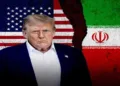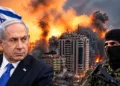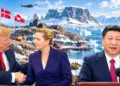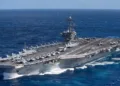
The particular type of hypocrisy which exists in international relations exists only for major powers because it forms a permanent aspect of their diplomatic conduct. The Trump-Xi summit in Geneva produced the customary language of managed coexistence: “constructive strategic stability,” “well-regulated competition,” “predictable peace.” The two leaders brought their billionaire followers to perform the diplomatic customs which capitalists use as their diplomatic methods. The two most important global conflicts continued to exist outside their ceremonial display because their opposing elements created a fundamental understanding of great power behavior. The Strait of Hormuz and the Taiwan Strait. The two waterways of Iran and Taiwan create two separate conflicts which lead to a central paradox that exists between both situations.
The geography of leverage
Every schoolchild learns that geography is destiny. What they are less often taught is that geography is also political theatre. The Strait of Hormuz, through which roughly a fifth of the world’s oil flows, and the Taiwan Strait, through which trillions of dollars in global trade and virtually all advanced semiconductors pass, are not merely maritime passages. They are pressure points. Whoever threatens them holds a gun to the global economy. Whoever defends them claims the mantle of civilization itself.
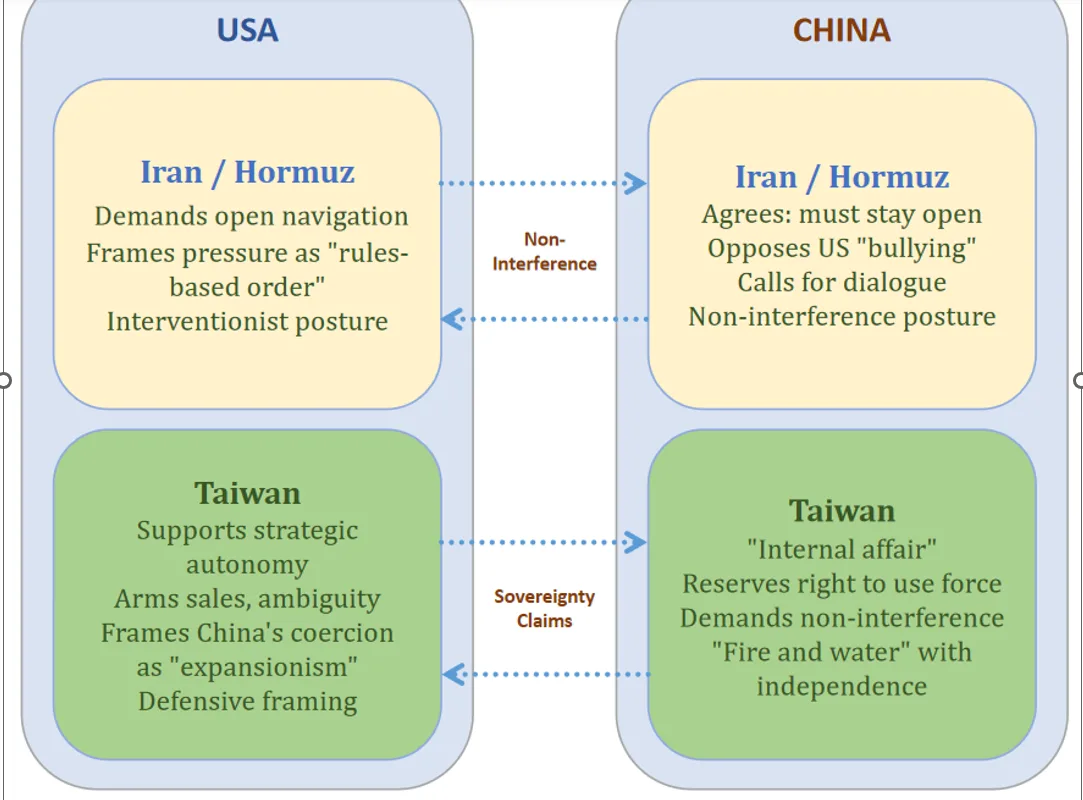
Washington argues that Iranian threats to Hormuz are intolerable acts of revisionist aggression against the international order. Beijing, dependent on Gulf energy for a significant share of its industrial needs, agrees. Here, the two powers find rare common ground: the strait must remain open.
But then the logic inverts, completely and without embarrassment.
China asserts that Taiwan belongs to its internal affairs and that it has the authority to use military force against the island because of its right to reclaim sovereignty over Taiwanese territory. The United States maintains that China’s military actions throughout the Taiwan area demonstrate authoritarian expansionism, which endangers the stability of the entire region. Each power, in effect, demands that its own core security anxiety be treated as legitimate, while dismissing the other’s as pretextual.
The hall of mirrors
The present time period creates an extreme intellectual disturbance for all people who experience it.
United States actions toward Iran represent an interventionist approach which uses economic sanctions and naval deployments to force the country to change its sovereign operations. China operates as a non-interventionist power by advocating for dialogue while rejecting what it describes as “unilateral bullying” to China. The two sides of the situation establish completely different positions about their territorial rights. China becomes the party asserting sovereign rights over territory it does not control. The United States operates as a stabilizing power because it maintains “strategic ambiguity” yet supplies arms to a government that Beijing considers illegitimate.
The two powers establish rules against interfering with other nations while they continue to intervene in foreign affairs and to maintain control over their own territories.
This is not hypocrisy born of malice. It is hypocrisy born of structure. Great powers have always bent the principles of the international system to match their strategic interests, what changes is the sophistication with which they do so. What is novel about this moment is that both the United States and China operate within the same globalized order, depend on the same supply chains, and invoke nearly identical legal and moral vocabulary while reaching opposite conclusions.
The economic paradox within the geopolitical one
The presence of Elon Musk, Tim Cook, and Jensen Huang at these negotiations is not incidental. Their companies sit at the exact intersection of the two crises. Tesla’s manufacturing ecosystem runs through China. Apple’s supply chain is deeply entangled with both Chinese factories and Taiwanese semiconductors. Nvidia’s advanced chips, the fuel of the artificial intelligence race, are simultaneously coveted by Beijing and restricted by Washington.
These men represent a global capitalism that has quietly become dependent on the mutual vulnerability of rival powers. Their corporations need American security guarantees and Chinese manufacturing capacity and Middle Eastern energy stability and continuous maritime trade operations. The two blocs need to maintain enough cooperation to prevent their system from collapsing while their competition needs to be strong enough to justify the massive strategic expenditures which both sides make.
The current international system shows its main contradiction because it depends on powers which prepare for warfare while they maintain economic ties with each other.
The weapons used in this economic battle become increasingly dangerous. Tariffs and export restrictions on advanced chips serve as Washington’s primary tools for economic warfare. Beijing controls access to rare earth elements which are vital for F-35 fighter jets and wind turbine production and green energy battery manufacturing. The flow of fentanyl precursors from Chinese chemical facilities to American streets creates a situation where Washington gains moral authority in its leverage battle against China. The two parties engage in a lavish celebration of their achievements while they hold each other’s essential industries as hostages.
Thucydides, revised
Xi Jinping’s invocation of the Thucydides Trap, the ancient Greek historian’s diagnosis that war between a rising and an established power is nearly inevitable, is revealing precisely because it is incomplete. The classical version of power transition theory imagined two distinct economies, two separate systems, colliding as one rises and the other declines. The current version of today is more disordered and unusual and hazardous than ever before. The United States and China need to maintain economic ties because complete decoupling would result in catastrophic consequences for both nations. The two nations engage in a conflict which resembles the direct battle between Athens and Sparta. The two climbers who share a rope together believe their partner will cut it at any moment yet they both refuse to release their grip on the rope. They are trapped together inside an unstable system, competing to shape rules neither can unilaterally impose.
This is why the Iran question matters so acutely in a Taiwan conversation. Beijing fears that Washington is building a template, a “rules-based” coalition that can justify intervention wherever American interests are threatened, and that Taiwan will eventually become a theater for exactly such intervention. The United States government believes that any acceptance of Chinese pressure against Taiwan will create a precedent which permits all territories to claim their own rights to territorial changes.
The two parties assess each other through their most negative possible views which lead to them developing worst-case assessment systems that demonstrate complete logical validity based on actual behaviors displayed by their opponents.
Stability as mutual hostage-taking
The most chilling phrase from Geneva was not a threat but a reassurance. Xi’s language of “manageable differences” and “predictable peace” signals something important: neither side believes genuine trust is any longer achievable. What they are building is not partnership. It is mutual deterrence dressed in diplomatic clothing, stability constructed not on shared values or genuine cooperation, but on the recognition that miscalculation would be catastrophic for both.
That is a genuinely dangerous foundation. History suggests that systems held together by mutual fear rather than mutual interest tend to fracture suddenly and violently, not because either party wants war, but because the complexity of managing so many interlocking pressure points eventually exceeds the capacity of even the most sophisticated diplomacy.
The Gulf and the Taiwan Strait are not merely the world’s two most critical maritime chokepoints. They are the two places where the paradox of great-power conflict is most likely to resolve itself, not through negotiation, but through the accident that negotiation was designed to prevent.
The summit was not a solution. It was a demonstration that the world’s two most powerful nations increasingly understand they are trapped together, and have not yet found a way out.