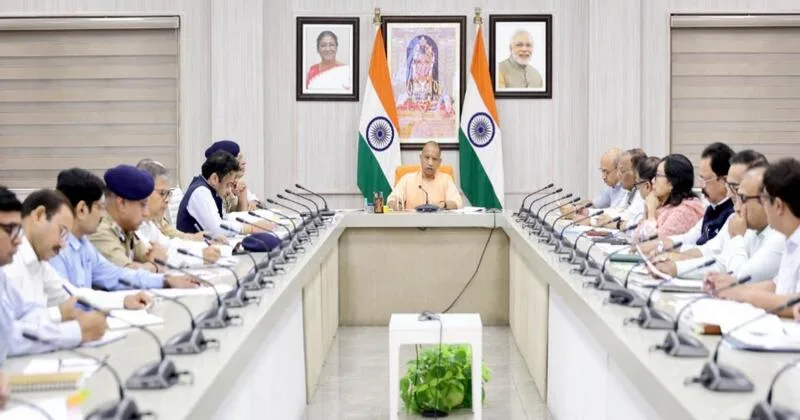
Lucknow: In a significant policy push that could reshape both healthcare delivery and economic development in India’s most populous state, Uttar Pradesh Chief Minister Yogi Adityanath chaired a high-level review meeting of the AYUSH Department in Lucknow, issuing a comprehensive set of directives to transform the state into a nationally and internationally recognised wellness destination.
The meeting centred on the effective implementation of the ‘AYUSH Health and Wellness Policy-2026’, a landmark framework that the Yogi government envisions as the backbone of a new health economy, one that weaves together traditional medicine, modern management, quality standards and tourism into a seamless whole.
A Vision Beyond Medicine
Speaking at the review, Chief Minister Yogi Adityanath made it clear that his government’s approach to AYUSH goes far beyond clinics and dispensaries. He called for Uttar Pradesh to be developed as a premier wellness destination through the coordinated expansion of AYUSH services, yoga, Panchakarma therapy and naturopathy, both for the country’s citizens and for visitors from across the world.
“AYUSH-based wellness economy will become a new foundation for health services, investment, tourism and employment generation in the state,” the Chief Minister said, setting an unmistakably ambitious tone for the direction ahead. He instructed that AYUSH institutions should not merely function as treatment centres but evolve into integrated hubs for wellness, training, research and job creation, a multi-dimensional reimagining of what publicly funded traditional medicine infrastructure can achieve.
Spiritual Tourism Meets Healing
The Chief Minister’s vision was his directive to develop wellness and healing-based tourism around the state’s major religious sites. Varanasi, Ayodhya and Mathura. These cities are already drawing millions of pilgrims and tourists who have specifically identified them as locations with tremendous potential to host world-class AYUSH wellness retreats.
The idea reflects a distinctly Indian approach to integrated development by honouring the spiritual significance of ancient cities while creating new economic ecosystems around traditional healing knowledge. For domestic and international visitors coming to these sacred destinations, a curated wellness experience rooted in Ayurveda and yoga could become a compelling value addition.
PPP Model and New Institutions
To translate vision into infrastructure, the government is moving ahead with the establishment of modern AYUSH Wellness Centres and 100-bed Integrated AYUSH Medical and Training Centres through the Public-Private Partnership (PPP) model. This reflects a pragmatic understanding that scaling quality healthcare and wellness services requires private sector participation alongside state investment.
The Chief Minister also directed that Integrated AYUSH Colleges be established in the divisions of Mirzapur, Gonda, Meerut, Agra, and Basti, a geographically spread initiative that aims to decentralise educational and healthcare access across the state. Emphasis was also placed on improving OPD services at existing AYUSH institutions, ensuring adequate availability of medicines and actively promoting traditional therapies such as Panchakarma.
Modernising Police Communication: The Other Agenda
The Sunday session was not limited to AYUSH. In a separate but equally consequential review, Chief Minister Yogi Adityanath also chaired a high-level meeting on the state’s police communication infrastructure, giving directions to strengthen the Police Radio Unit as part of a broader push to make UP Police more modern, secure and technology-driven.
He directed that the confidentiality of police locations, movements and communication activities must be treated as the highest priority. A Central Dashboard for live CCTV monitoring of all police stations across the state is to be developed, and uninterrupted, secure communication must be ensured even in remote regions.
On organisational restructuring, the meeting deliberated on establishing the headquarters of DIG Radio (Eastern Zone) at Azamgarh and DIG Radio (Western Zone) at Aligarh, a move aimed at improving field-level supervision and response.
A significant outlay of Rs 47 crore has been earmarked to roll out digital wireless services across 12 districts, while the development of a modern handheld wireless communication system for the Lucknow Police Commissionerate was also discussed.
The Chief Minister directed that all personnel data be kept updated on the Manav Sampada Portal and that service-related work, including character registers, leave records, and other administrative functions, be conducted entirely through digital platforms. Regular training in the latest technologies, computer skills and communication systems for police personnel was also emphasised.
Governance With a Clear Direction
These dual review meetings offer a window into the Yogi government’s governing philosophy, one that combines a civilisational pride in India’s traditional knowledge systems with a results-oriented, technology-forward approach to public administration. Whether it is turning Ayodhya into a wellness hub or ensuring a constable in a remote district can communicate securely with his headquarters, the emphasis is on building systems that are both rooted and modern.
A state long associated more with administrative challenges than policy innovation, these institutional moves could, over time, define a different trajectory of development.