
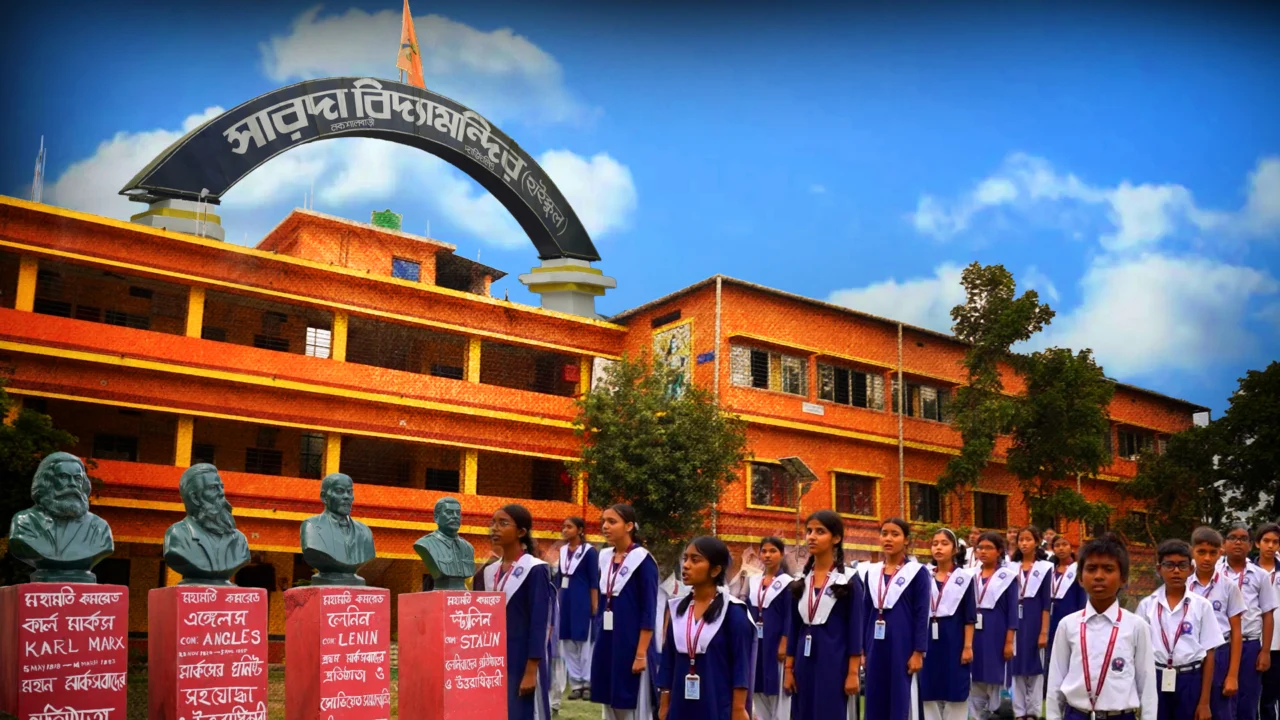
Making a change when things are in your favour seems easy, but when you enter a place where you are disliked, even borderline hated, for your way of thinking, bringing about a visible change becomes phenomenal. And that phenomenon has taken place in West Bengal’s Naxalbari, where a RSS-inspired school, Sharda Vidyamandir (High School), has slowly put down roots – one day at a time, bit by bit.
For decades, Naxalbari symbolised ‘armed revolution’ and radical Left politics. The small town in North Bengal that gave birth to the Naxalite movement in 1967 became synonymous with violence, ideological extremism and anti-India rebellion. But, in this tough terrain only, this school, amid tea gardens and narrow village roads, is rapidly changing social realities. Guns or political slogans are not leading this transformation; rather, classrooms, textbooks, prayers, cultural education, and a slow churn are.
I have also been to this school before, during the 2021 Assembly Elections in the state. In the past five years, a lot has changed in this school – from infrastructure to educational techniques. However, there is one thing that has not changed at all, and that is the values it inculcates in its students. This school is different because it not only focuses on modern education but also on moral values and a sense of national identity. At the entrance to the school stands a Bharat Mata Mandir, which underscores the institution’s emphasis on cultural consciousness and national identity even before one steps into the classrooms. Further, when you enter the prayer halls, you see portraits of Maa Saraswati, Swami Vivekananda, Bhagwan Birsa Munda, Chhatrapati Shivaji and RSS founder Dr Keshav Baliram Hedgewar.
While touring the school, I met the Principal, Sujit Das, who told me that the institution has primarily emerged from an effort to create an education system deeply rooted in Indian civilisational thought.
“The thought was that education should create ideal human beings,” he said. “A system rooted in Indian thought, where physical, mental, intellectual and spiritual growth happen together.” According to Principal Das, the institution is not merely about academic learning but about rebuilding social consciousness in a region historically shaped by the Communist politics. “Naxalbari was once the centre of Communist ideology,” he said. “But gradually, through social work and educational efforts, people developed faith in Indian thought and values.”
That change is reflected in the school’s growth. As mentioned earlier, when I first visited the institution during the COVID period in 2021, there were roughly 700 students enrolled. Today, the number has risen to nearly 1,300.
“We want students from common families to come here,” Principal Das said. He stressed that the school deliberately keeps fees affordable despite rising commercialisation in the education sector.
‘Nationalism & Education Can’t Be Separate’
Walking through the classrooms, I encountered students who spoke about the institution with emotional attachment, which is rarely seen in the metropolitan educational environments. “My school is unique for me,” said Surya Das, a Class IX student studying there since nursery. “This school teaches us our tradition and culture along with modern education,” he added.
What stood out was not merely the word themselves, but the ease with which students articulated ideas about values, discipline and identity. “We do not merely study things here, but we practice it,” Surya added. Asked whether he ever feared being left behind in the modern world because of the school’s strong cultural orientation, the student rejected the idea outright. “When we meet our teachers outside school, we greet them with folded hands. It is not just a rule, it is our tradition.”
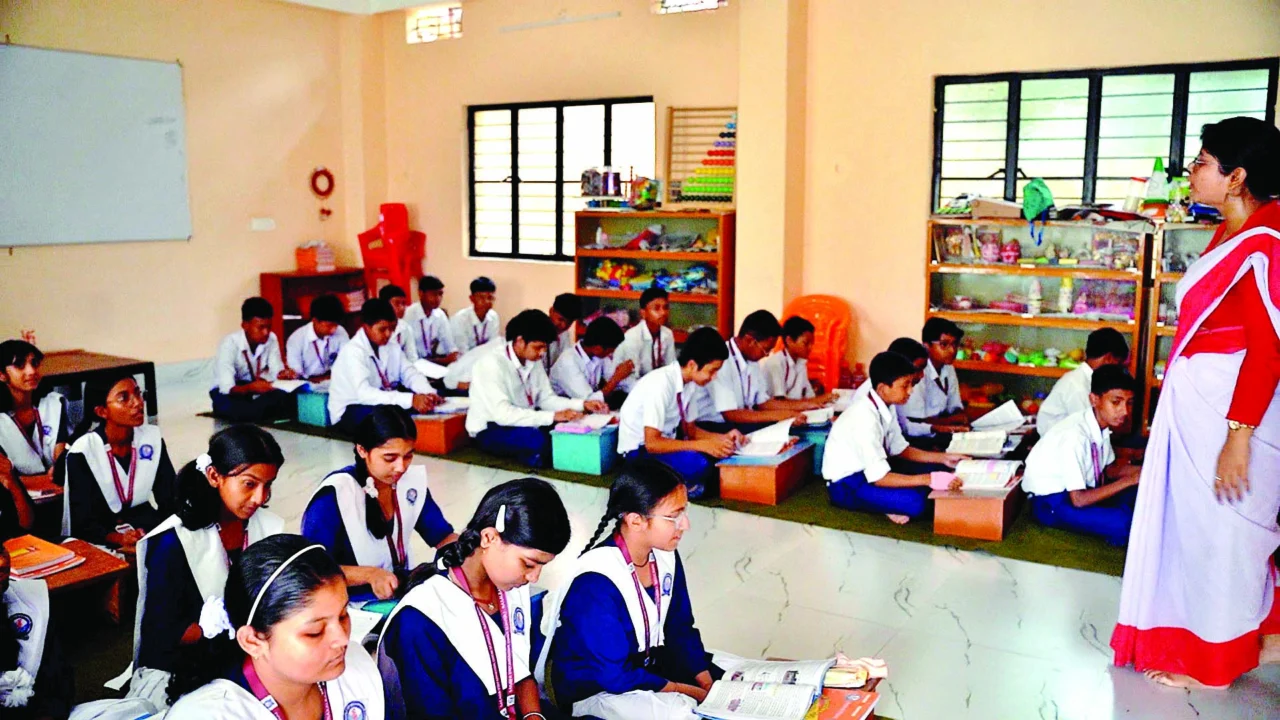
I spoke to teachers as well, and for them, this emphasis on conduct is central to the school’s educational philosophy. “Education is not limited to textbooks,” said teacher Manosij Das. “Its reflection should be visible in one’s conduct and personality.” Quoting Swami Vivekananda, he added, “Education is the manifestation of perfection already existing in man.” The teacher explained that the institution places equal emphasis on “nature and nation”. “We do not teach only textbooks,” he said. “We connect children with the nation and with nature.”
For me, this represented something larger than routine schooling. “In Naxalbari, the battle of ideologies is no longer being fought only through politics,” he observed. “It is now unfolding through education.” One of the most striking interactions during the visit came when I asked students which historical figure inspired them most. Without hesitation, Surya Das answered, “Swami Vivekananda, who teaches us to stay rooted even amidst rapid changes,” as he innocently narrated the story of Vivekananda’s speech at the Parliament of Religions in Chicago in 1893.
Another student said, “I admire Khudiram Bose because he sacrificed everything for the country”. Several other students also spoke about the Bhagavad Gita and Sanatan philosophy with striking confidence. Another student, Prashansa Sharma, talked about the phrase Vasudhaiva Kutumbakam. Teacher Manosij Das also talked about it during our conversation. “Vasudhaiva Kutumbakam itself is an ideology,” he said. They proudly speak of their connection to the Bharatiya Gyaan Parampara and to an RSS-inspired educational philosophy.
Cultural Grounding, Technological Adaptability
I directly raised the allegation often levelled against RSS-inspired schools, that they are “saffronising education”. Principal Sujit Das firmly rejected the charge. “We only teach the true history of Bharat,” he said. “Truth remains truth. There is no question of saffronisation.” For him, the institution’s purpose is not political indoctrination but cultural grounding. “We teach students to respect parents, teachers and society,” he said.
At the same time, the school consciously projects itself as modern and technologically adapting. In one classroom interaction, when I asked students about AI, a student spoke about fears surrounding AI replacing jobs and transforming society. All the students repeatedly emphasised that the school has good science laboratories that they participate in Olympiads, with the help of lessons that are taught in smart classrooms. Teacher Arpita Ghosh argued that tradition and modernity are not contradictory. “Children here play in the mud and also learn about AI,” she said.
Gurukul-like Setting
As I moved further and interacted with more students and teachers, I observed that the school’s environment itself reflects a blend of rootedness and aspiration. The greenery, open spaces and Gurukul-like setting were consciously designed. “We wanted to create an environment in Naxalbari similar to Shantiniketan,” Principal Das explained, “An environment where learning happens naturally.”
Teachers also consciously adopt traditional attire. Male teachers wear a dhoti-kurta, while female teachers wear a saree. The emotional relationship between teachers and students appears unusually strong. “When our students meet us outside school, they touch our feet and greet us respectfully,” Arpita said.
The way teachers and students alike spoke about social responsibility as an essential part of education was really touching. A teacher, Surdeep Dutta, who has been associated with the school for nearly a decade, shared that he once considered moving elsewhere for better career opportunities. But over time, he decided to stay. “This institution gave me a platform where I can teach children about Indian culture along with academics,” he said. “The transformation of Naxalbari cannot be understood only through elections,” he reflected. “It must also be understood through institutions like these.”
Towards the end of the visit, when I interacted with some parents outside the school premises, one of the parents pointed out that private school fees today have become unaffordable for many ordinary families, especially in semi-rural and lower-middle-class regions, but this is one school where ordinary families can still afford to give quality education to their children. Besides affordability, emphasis on discipline, values and cultural grounding alongside academics is the added bonus at the Sharda Vidyamandir.
As the day slowly came to an end, the school grounds began to echo with the sound of Vande Mataram. Students, teachers and staff stood together in the prayer ground, singing the entire national song together as the evening light faded over the campus. For a moment, it was difficult to ignore the symbolism of the scene unfolding. This was the same Naxalbari that once became synonymous with violence, now singing Vande Mataram together with conviction.