For a long time, discontent has simmered in the Union Territory (UT) of Ladakh over demand for statehood, an elected legislature and constitutional safeguards. After several rounds of discussions between leadership of Ladakh and senior Ministry of Home Affairs (MHA) officials, May 22 proved to be a day of a breakthrough as broad agreement was reached on contours of empowerment for the UT.
Trying to address both political empowerment and safeguards for Ladakh, the Central government has proposed a UT-level body having legislative, executive and financial powers vested with elected representatives. All bureaucrats of the UT, including the Chief Secretary, will be answerable to the executive head of the this newly elected body. This actually means that the legislative body in Ladakh will have more powers than the elected government of J&K. It needs to be mentioned here that the All India Services (AIS) in J&K fall in domain of the Lieutenant Governor.
The decisions were reached at a meeting of the Sub-Committee in the Union Ministry of Home Affairs (MHA) held in New Delhi. It was attended by senior officers of the MHA, UT administration of Ladakh and the leaders including those from Leh Apex Body (LAB) and Kargil Democratic Alliance (KDA).
A statement issued after the meeting by Chering Dorjay Lakrook and Asgar Ali Karbalai, said following detailed and constructive deliberations, both sides have arrived at an in-principle understanding on several critical points. “In this model, the legislative, executive and financial powers will rest with elected representatives through a UT-level legislative body. All bureaucrats of the UT, including the Chief Secretary, will come under the executive head of the UT-level elected body,’’ according to the joint statement.
Tashi Gyalson, BJP leader and former Chairman-cum-Chief Executive Councillor (CEC) Leh Autonomous Hill Council, was one of the leaders who attended the meeting. Tashi said the exact details of the UT-level legislative body, its powers, name, mode of elections and other issues will be decided through further meetings.
Senior Ladakh leader Thupstan Chhewang, who remained Lok Sabha MP from Leh twice, said the nomenclature for UT-level new Constitutional dispensation will be finalized after due deliberations. Chhewang had quit the BJP prior to 2019 Lok Sabha elections after major differences with the party over several issues.
He said all seven districts will have Zila Parishads and will be accorded appropriate autonomy within their respective areas of jurisdiction, especially in matters related to culture and land. Due to a vast area and a very small population, the local Ladakhis are hostile to unregulated influx of outsiders (from outsider Ladakh) into the UT. This sensitivity and agitation over related issues had led to unprecedented violence in the UT at one time, leading to the arrest and subsequent incarceration of Sonam Wangchuk under Public Safety Act (PSA) for several months.
Statehood Demand Shelved for Now
According to the joint statement, the MHA authorities explained that the only reason why Ladakh cannot be made a state at the moment is that it currently lacks adequate revenue generation to meet the revenue expenditures like salaries of employees. However, it added, this set-up will lead Ladakh towards full Statehood as and when it meets the revenue criteria. This means that for the foreseeable future, the grant of statehood to this UT born in November 2019 is a very long shot.
“The LAB and KDA today reached an in-principle understanding with the Government of India on restoring democracy in Ladakh and providing Constitutional safeguards on the lines of Article 371 A, F, and G (as applied to Nagaland, Sikkim and Mizoram),’’ the joint statement said. The KDA and LAB look forward to closely working out the finer operational details with the MHA in consultations with legal and constitutional experts, it added.
Special Provisions Under Article 371
Under Article 371A, there are special provision with respect to the State of Nagaland regarding (i)religious or social practices of the Nagas, (ii)Naga customary law and procedure, (iii)administration of civil and criminal justice involving decisions according to Naga customary law, (iv)ownership and transfer of land and its resources. Similar safeguards will be drafted in the coming days for the UT of Ladakh also.
Under Article 371F, which deal with Sikkim, powers inherent in the Legislative Assembly of Sikkim have been defined. The proposed elected body of Ladakh will be modelled broadly on the far away North Eastern state. The nomenclature, powers and certain other aspects have been left to be decided in future discussions.
Under Article 371G, there are special provisions with respect to the State of Mizoram regarding (i)religious or social practices of the Mizos, (ii)Mizo customary law and procedure, (iii)administration of civil and criminal justice involving decisions according to Mizo customary law, (iv)ownership and transfer of land.
This Article 371G was introduced into the Indian Constitution through The Constitution (Fifty-Third Amendment), 1986. It had helped diffuse the tensions that had prevailed for decades in Mizoram and put it on the way of peace.
It is expected that the new agreement reached between the Centre and the Ladakhi leadership will open the way for a thaw between the two sides. It can also lead to many development projects that had got stalled getting back into focus and then execution.
Sources said the MHA will prepare draft for UT level legislative body with suggestions from LAB and KDA before its implementation. The MHA has not given any timeline for implementation of the proposals though the Ladakhi leaders asked for it. However, the ministry officials assured that it will be done as early as possible.
Thupstan Chhewang’s Leadership
Thupstan Chhewang said: “The agreement to secure Ladakh’s status under Article 371 of the Constitution—incorporating provisions of the Sixth Schedule along with meaningful financial and administrative empowerment of local institutions, an elected Union Territory-level Legislature with a leader having status equivalent to a Chief Minister—represents a historic step forward for the people of this region’’.
He has been one of the most prominent political voices of Ladakh in articulating the aspirations and demands of the locals. Chhewang added that the finer details of the consensus will be worked out by the Home Ministry. All stakeholders will have the opportunity to submit their suggestions and recommendations in writing for the sake of an inclusive and participatory process.
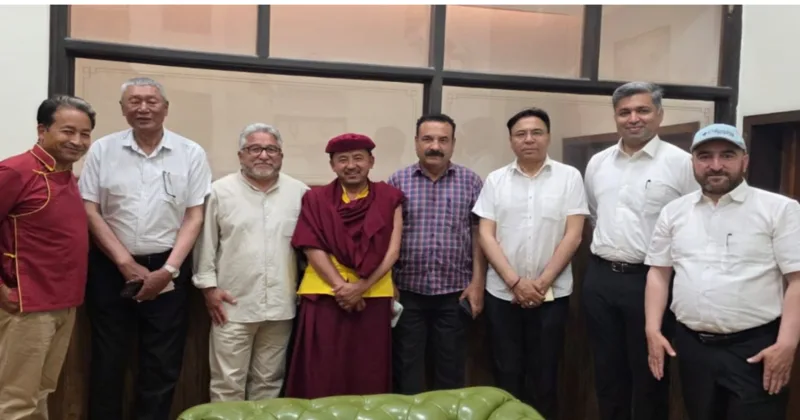
Today’s meeting among others was attended by senior officers of MHA and UT administration of Ladakh; Thupstan Chhewang, Haji Hanifa Jan, MP, Dr Mohd Jaffer Akhoon, chairman-cum-CEC of Ladakh Hill Council, Tashi Gyalson, BJP leader and former CEC Leh Council; Chering Dorjay Lakrook, Sonam Wangchuk and Dorjey Stanzin; all from LAB; Asgar Ali Karbalai, Sajjad Kargili and Ghulam Rasool Nagvi from KDA.
The LAB and KDA had been agitating for more than five years demanding Statehood and Sixth Schedule status to Ladakh.
A series of meetings were held by the MHA including that of High Powered Committee (HPC) headed by Union Minister of State for Home Nityanand Rai and the Sub-Committee in which issues of domicile and reservation etc were addressed.