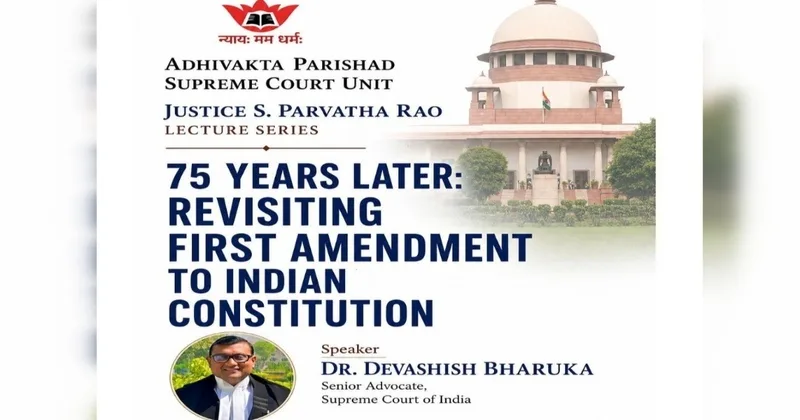
The Supreme Court Wing of the Akhil Bharatiya Adhivakta Parishad organised an intellectually significant online lecture under the prestigious Justice S. Parvatha Rao Lecture Series on the theme “75 Years Later: Revisiting the First Amendment to the Indian Constitution.” The programme brought together members of the Bar, constitutional scholars, jurists, academicians, researchers, and law students from across the country for a serious engagement with one of the most transformative constitutional developments in the history of the Republic of India.
The lecture assumed immense constitutional significance because the First Constitutional Amendment Act, 1951, was not merely an amendment to the constitutional text, but a defining constitutional moment that fundamentally reshaped the relationship between Fundamental Rights, parliamentary authority, judicial review, freedom of speech, and the socio-economic obligations of the State in independent India. The discussion also revisited the historic role played by the RSS-backed weekly Organiser, whose legal battle against pre-censorship imposed by the Nehru Government became one of independent India’s earliest constitutional confrontations concerning press freedom and civil liberties.
A significant focus of the lecture was the historic role played by Organiser in shaping India’s earliest constitutional battle over freedom of expression. The lecture reflected upon how Organiser emerged as one of the first publications after Independence to openly challenge governmental restrictions on press freedom and executive censorship. The publication’s legal battle against pre-censorship imposed by the Nehru Government became one of the earliest constitutional confrontations concerning civil liberties in independent India and ultimately contributed to the constitutional developments that culminated in the First Amendment.
The keynote address was delivered by Dr Devashish Bharuka, Senior Advocate, Supreme Court of India, who presented a historically grounded, jurisprudentially nuanced, and constitutionally rich analysis of the circumstances that led to the enactment of the First Amendment under the leadership of Prime Minister Jawaharlal Nehru. The lecture examined the constitutional tensions that emerged immediately after the commencement of the Constitution in 1950, when the newly established democratic framework encountered the practical challenges of governance, public order, social justice, and economic transformation.
Dr Bharuka observed that the Constitution, as originally adopted, reflected an expansive and liberal vision of civil liberties and individual freedoms under Part III relating to Fundamental Rights. However, within a short period after the Constitution came into force, a series of landmark Supreme Court judgments created significant constitutional challenges for the Government, particularly in matters concerning freedom of speech, reservations, and agrarian reforms.
The lecture extensively discussed the landmark Supreme Court judgments that directly led to the enactment of the First Constitutional Amendment. The three most direct and universally acknowledged constitutional triggers behind the Amendment were Romesh Thappar v. State of Madras, Brij Bhushan v. State of Delhi, and State of Madras v. Champakam Dorairajan.
In Romesh Thappar v. State of Madras, the Supreme Court struck down the Madras Government’s ban on the journal Cross Roads and held that restrictions on freedom of speech could only be imposed on grounds expressly mentioned under Article 19(2) as it originally stood. The Court clarified that “public order” did not fall within the permissible constitutional limitations on free speech under the unamended Constitution.
Similarly, in Brij Bhushan v. State of Delhi, arising directly from the censorship imposed upon the weekly Organiser, the Supreme Court invalidated the pre-censorship order issued under the East Punjab Public Safety Act and strongly reaffirmed constitutional protection for press freedom and political expression. The judgment became one of the earliest and most important constitutional assertions against executive censorship in independent India. The lecture highlighted how Organiser, through the legal efforts of its publisher Brij Bhushan, effectively became one of the first publications to challenge State censorship before the Supreme Court of India.
The lecture further examined State of Madras v. Champakam Dorairajan, wherein the Supreme Court struck down caste-based reservations in educational institutions on the ground that they violated Article 29(2) and the constitutional guarantee of equality. Dr Bharuka explained that this judgment directly resulted in the insertion of Article 15(4) through the First Amendment, thereby empowering the State to make special provisions for socially and educationally backward classes as well as the Scheduled Castes and the Scheduled Tribes.
A substantial portion of the lecture was devoted to the constitutional dimensions of agrarian reform and the abolition of the zamindari system. Dr Bharuka explained that the newly independent State viewed land redistribution and agrarian reform as essential components of social justice and economic transformation. However, several land reform laws enacted by State governments faced constitutional challenges on the grounds that they violated the Fundamental Right to property guaranteed under Articles 19(1)(f) and 31 of the Constitution.
In this context, the lecture referred to constitutional disputes and property rights litigations, including Kameshwar Singh v. State of Bihar and State of Bihar v. Maharajadhiraja Sir Kameshwar Singh, which reflected the constitutional tensions surrounding compensation, land redistribution, and the scope of legislative power in agrarian reform matters. Although these judgments were delivered shortly after the enactment of the First Amendment, the constitutional controversies surrounding zamindari abolition substantially influenced Parliament’s decision to insert Articles 31A and 31B and create the Ninth Schedule in order to immunise agrarian reform legislation from judicial invalidation.
The lecture highlighted that the First Amendment represented one of the earliest constitutional confrontations between individual liberty and the objectives of a welfare-oriented democratic State. While the Amendment enabled affirmative action policies, socio-economic redistribution, and agrarian reforms, it also initiated enduring constitutional debates concerning parliamentary supremacy, judicial review, constitutional morality, and the limits of State power.
For deeper constitutional analysis, Dr Bharuka traced the judicial evolution that followed the First Amendment and shaped modern Indian constitutional jurisprudence. Particular reference was made to Shankari Prasad v. Union of India, wherein the constitutional validity of the First Amendment itself was challenged before the Supreme Court. The Court upheld Parliament’s power under Article 368 to amend Fundamental Rights and recognised constitutional amendments as distinct from ordinary legislation under Article 13.
The lecture then examined the landmark judgment in Golak Nath v. State of Punjab, where the Supreme Court adopted a significantly different constitutional approach and held that Parliament could not amend or abridge Fundamental Rights. Dr Bharuka observed that this decision intensified the constitutional debate between parliamentary sovereignty and judicial supremacy.
The discussion thereafter moved to the historic judgment in Kesavananda Bharati v. State of Kerala, wherein a thirteen-judge Bench of the Supreme Court evolved the celebrated Basic Structure Doctrine and held that while Parliament possesses wide powers to amend the Constitution under Article 368, it cannot alter or destroy the Constitution’s essential features or “basic structure.” The lecture highlighted that this judgment substantially settled the constitutional controversy regarding amendment powers and became the defining safeguard preserving constitutional supremacy, judicial review, democracy, rule of law, and the balance between Fundamental Rights and State authority.
Further reference was made to Minerva Mills v. Union of India and I.R. Coelho v. State of Tamil Nadu, which reaffirmed that limited government, judicial review, and constitutional supremacy form part of the Constitution’s basic structure and that even laws placed under the Ninth Schedule remain subject to constitutional scrutiny if they violate essential constitutional principles.
Dr Bharuka emphasised that the constitutional questions arising from the First Amendment continue to remain deeply relevant in contemporary India. Debates concerning free speech, media regulation, hate speech, internet shutdowns, constitutional morality, reservations, judicial review, national security, and the balance between liberty and governance continue to derive constitutional significance from the constitutional framework established in 1951.
The lecture ultimately presented the First Amendment not merely as a constitutional amendment, but as a continuing constitutional dialogue between liberty and order, rights and reform, parliamentary power and judicial review, as well as constitutional governance and democratic accountability. Even after seventy-five years, the First Amendment continues to shape the philosophical and institutional direction of Indian constitutionalism.
The programme concluded with active participation and thoughtful interaction from members of the legal fraternity and students, reaffirming the importance of informed constitutional discourse in strengthening democratic institutions and constitutional consciousness. Through initiatives such as the Justice S. Parvatha Rao Lecture Series, the Supreme Court Wing of the Akhil Bharatiya Adhivakta Parishad continues to make a meaningful contribution towards constitutional scholarship, legal awareness, and serious engagement with issues of enduring national importance.