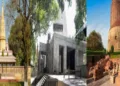
Indian civilisational influence has shaped Myanmar’s social and cultural landscape since antiquity through extensive networks of trade, religious exchange, and cultural interaction. Buddhism, transmitted from India and traditionally associated with the missionary efforts of Emperor Ashoka, became a foundational element of Burmese identity. The imprint of Indian civilisation is also evident in Burmese legal traditions, particularly “the Dhammasattha texts, as well as in art, architecture, temple practices, and literary culture”. These deep historical connections have endured into the contemporary era through religious pilgrimages, diaspora networks, and sustained cultural exchanges, reinforcing a longstanding civilisational bridge between India and Myanmar.
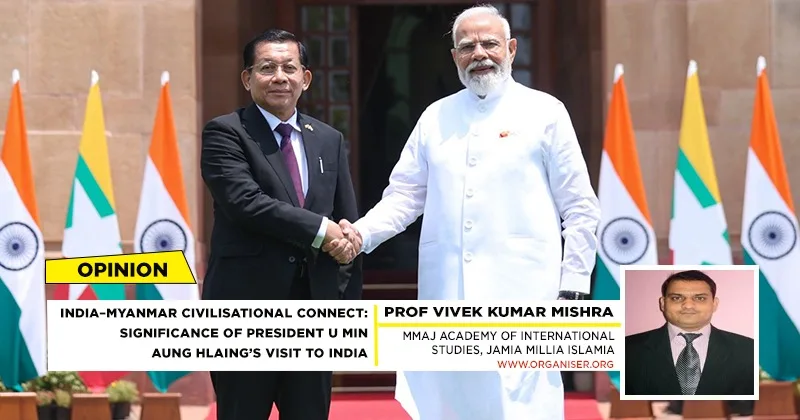
President U Min Aung Hlaing paid an official visit to India from May 30 to June 3, 2026. Notably, this was his first overseas visit since assuming office, underscoring the strategic importance Myanmar attaches to its partnership with India. As India’s immediate neighbour, sharing a 1,643-kilometre land border, Myanmar occupies a pivotal position at the intersection of India’s Neighbourhood First, Act East, MAHASAGAR (Mutual and Holistic Advancement for Security and Growth Across Regions), and Indo-Pacific policies. India and Myanmar share deep civilisational and cultural bonds rooted in Buddhism and centuries of religious and people-to-people exchanges. Reflecting this shared heritage, India has supported the restoration of the Ananda Temple in Bagan, undertaken the conservation of numerous damaged pagodas, and completed the renovation of two historic temples in Bodh Gaya built by Myanmar rulers King Mindon and King Bagyidaw.
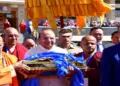
President U Min Aung Hlaing’s visit to the Mahabodhi Temple Complex, a UNESCO World Heritage Site associated with the Buddha’s enlightenment, as well as the Mahabodhi Ekta Dhamma Monastery and Sujata Temple, carried profound symbolic significance. By commencing his visit at Buddhism’s holiest pilgrimage site, the President underscored the enduring cultural and spiritual foundations of India–Myanmar relations. The visit reaffirmed the two countries’ shared Buddhist heritage, strengthened people-to-people ties, and highlighted the continuing importance of cultural diplomacy in complementing strategic and economic cooperation.
Cultural interactions between India and Myanmar are sustained through regular exchanges of cultural troupes, artists, and scholars, reflecting the deep civilisational and people-to-people links between the two countries. The Embassy of India in Yangon, through the Swami Vivekananda Cultural Centre, actively promotes cultural engagement by organising yoga programmes, cultural competitions, dance and music classes, seminars, lectures, and Hindi language courses. Although the COVID-19 pandemic disrupted physical connectivity and cultural exchanges, India and Myanmar continued to nurture their cultural ties through digital platforms. The Embassy leveraged communication technologies to organize online workshops and cultural programmes, including training in Indian classical dance forms, painting, yoga, and other areas of mutual interest, thereby ensuring continuity in cultural engagement during a period of restricted mobility.
On May 31, 2026, President Min Aung Hlaing’s visit focused on strengthening business diplomacy, technological cooperation, and strategic engagement. He delivered the keynote address at the India–Myanmar Business Conclave, jointly organised by UMFCCI and CII, where business leaders from agriculture, energy, banking, logistics, pharmaceuticals, infrastructure, and manufacturing explored avenues for enhanced trade and investment. The President also visited the NTPC Energy Technology Research Alliance (NETRA) in Greater Noida and was briefed on India’s advancements in clean energy, renewable integration, energy efficiency, and grid resilience. The day further featured high-level consultations with External Affairs Minister Dr S Jaishankar and National Security Adviser Ajit Doval, focusing on connectivity, regional security, border management, counter-insurgency cooperation, narcotics trafficking, and transnational crime.
On June 1, 2026, the Prime Minister of India and the President of Myanmar held wide-ranging talks, reviewing bilateral, regional and global developments and charting a forward-looking agenda for the partnership. Prime Minister Narendra Modi emphasised Myanmar’s unique strategic significance at the convergence of India’s Neighbourhood First, Act East and MAHASAGAR policies. The two leaders reviewed the full spectrum of bilateral cooperation and identified key priority areas for future engagement.
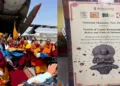
During the visit, President Min Aung Hlaing also viewed the exhibition “Light and the Lotus: Relics of the Awakened One,” highlighting the shared Buddhist and civilisational heritage between the two countries. The leaders reaffirmed the centrality of connectivity in strengthening people-to-people ties, trade and regional integration. They reviewed progress on the Kaladan Multi-Modal Transit Transport Project and the India–Myanmar–Thailand Trilateral Highway, including the Kalewa–Yagyi road segment, and agreed to expedite their completion. Both sides reaffirmed their commitment to preventing the misuse of their territories against each other’s security interests. Myanmar reiterated its assurance that its territory would not be used for activities harmful to India’s security. Prime Minister Modi announced an increase in Mekong-Ganga ICCR Scholarships for Myanmar students from 36 to 100 annually beginning in 2026.
Conclusion
President U Min Aung Hlaing’s visit to India marked a significant milestone in the evolution of India–Myanmar relations, reflecting the growing strategic convergence between the two neighbours. The visit reaffirmed Myanmar’s centrality to India’s Neighbourhood First, Act East, and MAHASAGAR policies, while advancing cooperation in connectivity, trade, security, critical minerals, energy, and cultural diplomacy.