In an age where cultural memory is increasingly diluted by spectacle and noise, certain gatherings emerge not merely as events, but as acts of civilisational remembrance. “Rama Rama Pahimam,” a three-day spiritual and cultural congregation organised at Guruvayur from May 15 to 17, 2026, stood as one such luminous effort, a confluence of bhakti, scholarship, temple arts, music, and national consciousness rooted in the timeless ideals of Bhagavan Sri Rama.
Held under the guidance of revered spiritual leaders and cultural thinkers, the programme transformed Guruvayur into a living mandala of devotion. The event drew together artists, scholars, devotees, students, and seekers from across Keralam and beyond, reaffirming that Sri Rama remains not merely a deity of worship but the moral axis of Bharatiya civilisation. The organisers described the gathering not as a conventional festival, but as a humble offering at the lotus feet of Sri Rama, an attempt to reconnect society with the ethical and spiritual foundations embodied by the Maryada Purushottam. The programme is being organised by Sai Sanjeevani Trust, Guruvayur and the Maulana Abul Kalam Azad Institute of Asian Studies, an autonomous institution under the Ministry of Culture, Government of Bharat, under the leadership of Kaipram Damodaran Namboothiri as Chairman and Manayogi Swami Harinarayanan as Chief Coordinator.
Rama Beyond Ritual
The central vision behind the festival was clear: Sri Rama is not confined to temples or epics. Rama is discipline, compassion, restraint, sacrifice, courage, kingship, family values, social harmony, and unwavering adherence to dharma. In the Indian civilisational imagination, Rama is simultaneously divine and deeply human. He is the ideal son who accepts exile without bitterness, the ideal ruler who places rajadharma above personal comfort, the ideal husband whose life reflects sacrifice and duty, and the ideal warrior who destroys evil without hatred.
The organisers emphasised that modern India, particularly its younger generation, must encounter Rama not merely as mythology, but as a living ethical framework. Through cultural performances, lectures, devotional music, and traditional arts, the festival sought to bring these values alive in contemporary public consciousness.
A Festival Rooted in Bharatiya Aesthetics
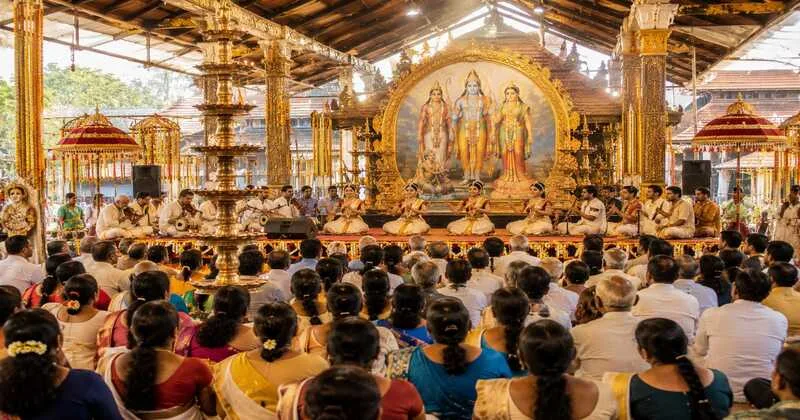
The three-day programme blended spiritual depth with Keralam’s rich artistic traditions. Classical performances, devotional singing, temple arts, dance presentations, and public lectures unfolded in an atmosphere steeped in reverence.
The opening day began with ceremonial rituals and devotional observances, followed by cultural programmes that reflected the diversity of Bharatiya artistic heritage. Traditional percussion, devotional music, classical dance forms, and dramatic temple arts created a sacred atmosphere reminiscent of Keralam’s old temple festivals.
One of the visual highlights of the event was the inclusion of traditional performance forms that embody the spirit of the Ramayana in living practice. The presence of classical dancers, percussion artists, and ritual performers underscored the continuity of India’s sacred artistic lineage.
A special devotional session titled “Rama Rama Pahimam” became the emotional centrepiece of the gathering. The phrase itself, a heartfelt plea seeking refuge in Sri Rama, resonated deeply among attendees.
Scholars Speak on Dharma and Civilisation
The event also featured an extensive lecture series by noted speakers, scholars, spiritual thinkers, and public intellectuals. Their talks explored themes such as:
§ The relevance of Ramayana in modern society
§ Dharma as the foundation of national life
§ Temple culture and civilisational continuity
§ The role of the arts in preserving spiritual consciousness
§ The importance of cultural rootedness among youth
§ Sri Rama as a unifying force in Bharat
The sessions attracted significant public participation, especially among young attendees eager to reconnect with Indic thought outside academic reductionism. Speakers repeatedly highlighted that Rama belongs to all sections of society. Across languages, regions, castes, and traditions, the Ramayana has served for centuries as India’s shared moral vocabulary. From Kamban Ramayanam in Tamil Nadu to Ezhuthachan’s Adhyatma Ramayanam in Keralam, the story of Rama has shaped collective ethics and cultural imagination.
Guruvayur as Sacred Setting
The choice of Guruvayur as the venue carried deep symbolic significance. Known primarily as the abode of Guruvayurappan, the sacred town has historically served as a vibrant centre of devotion, Sanskrit learning, temple arts, and spiritual continuity. Against this sacred backdrop, the invocation of Sri Rama acquired added emotional depth. Devotees described the atmosphere as one of serenity and collective spiritual energy.
The organisers noted that Keralam possesses a profound yet often underrepresented Ramayana tradition. During the Malayalam month of Karkidakam, homes across the state reverberate with readings of the Adhyatma Ramayanam. Through this festival, organisers sought to extend that devotional culture into a larger public and cultural space.
Cultural Resistance Through Sacred Memory
Beyond its devotional dimension, “ Rama Rama Pahimam” also reflected a broader cultural assertion. At a time when traditional values are increasingly caricatured or dismissed in elite discourse, such gatherings serve as spaces of cultural confidence. The festival demonstrated that Bharatiya traditions continue to possess extraordinary emotional and philosophical vitality.
Rather than presenting Hindu civilisation as something frozen in the past, the event projected it as a living continuum capable of inspiring modern society.
The participation of artists, youth, families, scholars, and devotees reflected a growing cultural awakening across Keralam, one rooted not in aggression, but in civilisational self-awareness.
Sri Rama and the Idea of Bharat
No figure in Indian civilisation has travelled through the collective heart of the nation as deeply as Sri Rama. From village bhajans to temple murals, from classical literature to folk theatre, Rama remains woven into the consciousness of Bharat. The chant of “Jai Shri Ram” is not merely a slogan; it is an invocation of righteousness, courage, and spiritual sovereignty.
The organisers stressed that remembering Rama also means remembering the ethical foundations of nationhood. Rama Rajya, in the Bharatiya imagination, represents governance anchored in justice, compassion, accountability, and moral restraint. In this sense, the festival became more than a cultural programme. It evolved into a reaffirmation of civilisational values in an era searching for moral clarity.
A Concluding Invocation
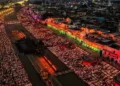
The concluding sessions of the festival carried an atmosphere of collective gratitude and devotion. Musical offerings, prayers, and spiritual reflections brought the three-day gathering to a deeply emotional close. As lamps flickered and chants filled the venue, one sentiment echoed repeatedly among participants: Sri Rama continues to guide Bharat through its civilisational journey. “Rama Rama Pahimam” was ultimately not just a prayer seeking divine protection. It was also a call to protect and preserve the spiritual and cultural inheritance of Bharat itself. And in that sacred invocation lay the true spirit of the festival.