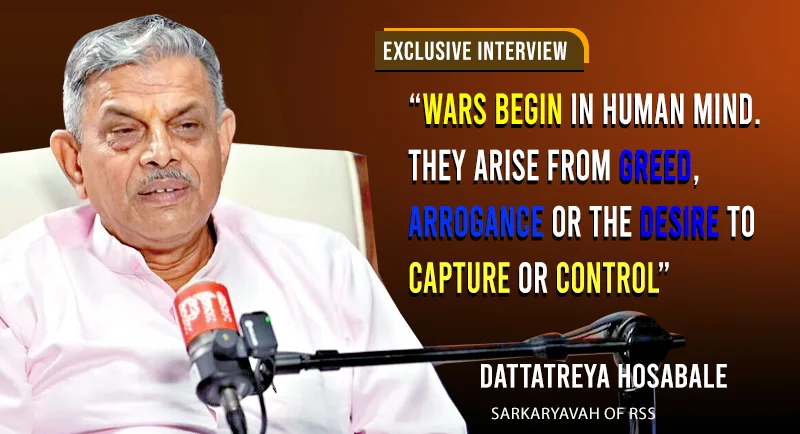
RSS Sarkaryavah Dattatreya Hosabale, in a wide-ranging conversation with PTI at the RSS Delhi office on May 12, spoke on Hindutva, Sanatan Dharma, Bharat’s global role, the organisation’s outreach in the West, relations with Pakistan, the Bharatiya diaspora, science and spirituality, and the civilisational challenges confronting the modern world. Here are the excerpts from the interview:
One intention of your trip was to address misconceptions in the Western world about the RSS. Are you satisfied with the outcome?
I have visited Western countries earlier as well, mainly to meet the Hindu community and address Hindu Swayamsevak Sangh gatherings. Except on one or two occasions, most of those interactions were with people of Bharatiya origin and members of the Hindu community.
This time, in the backdrop of the RSS centenary year and as part of our global outreach efforts, we decided to engage more with local and influential people from different sectors of society, including academics, policymakers and thought leaders.
I received invitations from the Global Scientific Innovation Forum at Stanford University and from the Hudson Institute in Washington, D.C. These engagements also gave me opportunities to visit other places and interact with academicians, think tank members, Nobel laureates and even some members associated with the US Congress.
The visit allowed me to explain what RSS is, its philosophy, and how it is inspired by Bharat’s ancient civilisational culture and spiritual message to the world.
Since you interacted with many non-Indians, what concerns from the Western world stood out during your discussions?
One major concern I noticed was about the rapid growth of technology. While there is excitement about developments such as artificial intelligence, there is also anxiety about how societies will deal with cultural challenges, what will happen to human relationships and how human society itself will evolve. Another important concern was the environment. I felt these are issues Bharat is especially capable of addressing because of its long civilisational experience and worldview.
What kinds of questions did people ask you about RSS and the misconceptions surrounding it?
In many cases, it was not only misconception but also simple ignorance. Many people had no real idea about what RSS does. Whatever they had heard was mostly through media reports or second-hand narratives. Some people viewed RSS as anti-Muslim, anti-minority or even supremacist.
I explained that RSS is a voluntary organisation working to build human and social capital through community service and national service. I also spoke about our hundred-year track record and how Swayamsevaks have contributed to public life and established many civil institutions dedicated to nation-building activities. People listened with interest, asked follow-up questions and engaged seriously with the explanations.
The Indian diaspora in the US has grown tremendously in wealth and influence. But do you also feel that the diaspora remains divided along regional, linguistic and caste lines?
You are right on both counts. The Bharatiya diaspora has definitely made a mark in the United States. One important thing about Bharatiya or Hindu community is that they have not become a problem for any country where they live. Their conduct as a community has generally been positive, and I believe this comes from their cultural and civilisational background.
So are you disappointed that instead of emerging as one larger community, Indians abroad sometimes recreate mini versions of Telangana, Tamil Nadu or Andhra Pradesh?
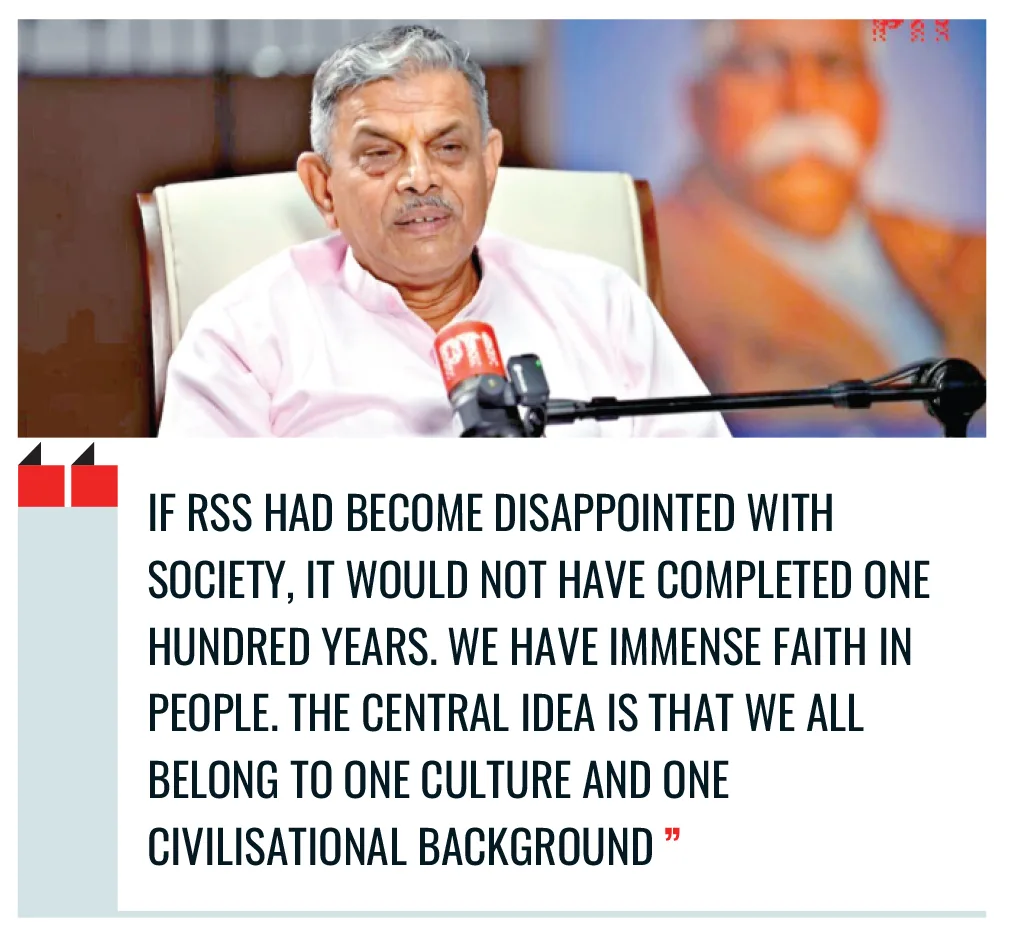
If RSS had become disappointed with society, it would not have completed one hundred years. We have immense faith in people. The central idea is that we all belong to one culture and one civilisational background. Another point I stressed everywhere was that people should learn the art of “working together separately.” Different organisations can continue to work autonomously for the causes they have chosen. But at the same time, they should also find ways to come together occasionally, organise joint events and extend mutual support. Not everyone can come under HSS or any one organisation. That is impractical. What is important is the influence of shared cultural values and the idea of “working together separately.”
Do you worry that future generations living in America on Britain may completely lose their Indian identity? How should Indians balance pride in their culture with respect for local communities?
We are also becoming more westernised in many ways. The real question is not whether someone becomes American or British, but what values they live by. Human behaviour towards family, community and nature is what ultimately matters. Bharat’s worldview has always focused on these enduring values.
External aspects such as dress or lifestyle naturally adapt to the society one lives in. “When in Rome, be a Roman” is acceptable in that sense. But values like respect for elders, family cohesion, responsibility towards society and nurturing the next generation remain fundamental and permanent values of human life.
The overwhelming majority of Bharatiya abroad are law-abiding and not involved in illegal activities. Sometimes friction emerges because Indians are economically successful through hard work and talent. There can be fears among sections of local society that jobs or opportunities are being taken away. This is where civilisational values become important. Indians living abroad should always remember their responsibility towards the host society and host nation where they live and earn their livelihood. Their loyalty should never come into question. Maintaining a connection with India is natural, but at the same time they should also actively serve and engage with the local community around them.
What did you tell your hosts about how India could offer guidance in areas such as their modern social problems like drug addiction, broken families, excessive individualism, etc?
I spoke about the worldview rooted in Indian philosophy. More than a hundred years ago, Swami Vivekananda had spoken about similar issues. Religious bigotry cannot provide solutions. The Indian worldview teaches seeing the same divinity in all beings, living and non-living. These values must be inculcated through education, family life and moral training. Human relationships, social harmony and harmony with nature are all important.
Many of our festivals and traditions are not merely religious practices; they are cultural mechanisms such as Raksha Bandhan and Guru Vandana designed to strengthen human bonds and values.
About the ongoing conflicts in the world, many people describe the present situation as a civilisational crisis. How do you see these wars?
If we look at world history over the last thirty years, there has hardly been a period completely free of war or conflict. At any given time, some part of the world has experienced war, tension or confrontation. There was the Cold War, the Vietnam War, the Gulf War, the Iraq conflict and continuing tensions in West Asia.
Wars begin in the human mind. They arise from greed, arrogance or the desire to capture or control what does not belong to oneself. This can happen at the level of individuals, societies or nations.
Many modern conflicts are shaped by commercial interests and geopolitics. Decades ago, some thinkers predicted wars over oil, and now there are predictions about future wars over water. This means that humanity is unlikely to become completely free from conflict. The present conflicts will also influence human life and alter the global scenario in significant ways.
In the short term, however, countries like India are also suffering because of these wars. The Prime Minister has recently called for austerity measures.
Calls for austerity during difficult times are not new in India. Lal Bahadur Shastri, during a period of crisis, appealed to people to voluntarily skip one meal a week. Many citizens followed it sincerely. Indira Gandhi also made appeals for austerity during difficult periods. When national leaders call for restraint and simplicity, it should be viewed in the context of the country’s welfare. The present Prime Minister’s appeal should also be understood in that spirit.
In fact, even beyond times of war, simplicity and austerity are values deeply connected with India’s traditional way of life. During periods of crisis, these values become even more necessary.
Do you think India can play a larger role internationally during such crises?
Bharat’s standing in the world has changed significantly over the last decade or more. Today, Bharat is heard, recognised and respected internationally. Because of this position, Bharat can play a constructive role by appealing to the wisdom and good sense of nations and global leaders.
Over the last year, India has faced several foreign policy challenges. Has RSS provided any inputs to the Government on how to handle these issues?
We do have informal discussions, but RSS does not have a formal foreign policy think tank. However, many of the principles visible in the Prime Minister’s foreign policy approach reflect broader civilisational ideas and worldviews that RSS has long emphasised and which are rooted in this country’s traditions.
How do you think India should deal with Pakistan? Should engagement continue?
India has tried every possible method of engagement with Pakistan over the years. Atal Bihari Vajpayee travelled to Lahore by bus in an effort to improve relations. The present Prime Minister invited Pakistan’s leadership during his swearing-in ceremony and even made personal outreach efforts on certain occasions.
At the same time, whenever Pakistan engages in actions such as terror attacks or provocations like Pulwama, India must respond appropriately and firmly. The security and self-respect of the nation must always be protected, and the government of the day has a responsibility to ensure that.
However, even while responding firmly, the doors for dialogue should not be completely closed. Diplomatic relations continue, trade and commerce continue to some extent, and visas are still issued. At present, many exchanges have stopped because of Pakistan’s own rigidity and the tensions created by repeated incidents. Since the 26/11 Mumbai attacks, mutual trust has weakened considerably, and peace efforts have faced repeated setbacks. Still, other forms of engagement have continued in limited ways. I believe greater involvement from Pakistan’s civic society can help improve relations. Political and military leaderships may develop strong disagreements or distrust, but civic society relations should continue wherever possible.
One question often raised, including in the United States, is about Hindutva and the idea of a Hindu nation. How do you assure minorities that they are safe in India?
This question has been raised repeatedly for decades. But we should look at the reality and the facts. Has the Muslim population in India declined? Have Muslims or Christians been forced to flee India? Are they treated as second-class citizens in states governed by the BJP or in places where Swayamsevaks are active? These are questions that should be examined honestly.
Fear is often unnecessarily created by repeatedly projecting such concerns in sections of the media and public discourse. RSS maintains continuous dialogue with leaders from minority communities, including Christians and Muslims. In fact, RSS believes that the very framework of “religious minorities” in India is not entirely sound because, fundamentally, we see all Indians as one people with shared ancestry and a shared civilisational heritage. Changing one’s mode of worship does not change one’s nationality.
RSS is not trying to create a Hindu nation. This nation already has a Hindu civilisational character. There is often confusion between the concepts of nation and state. In India, nationhood is understood in a broader civilisational and cultural sense rather than only as a political arrangement.
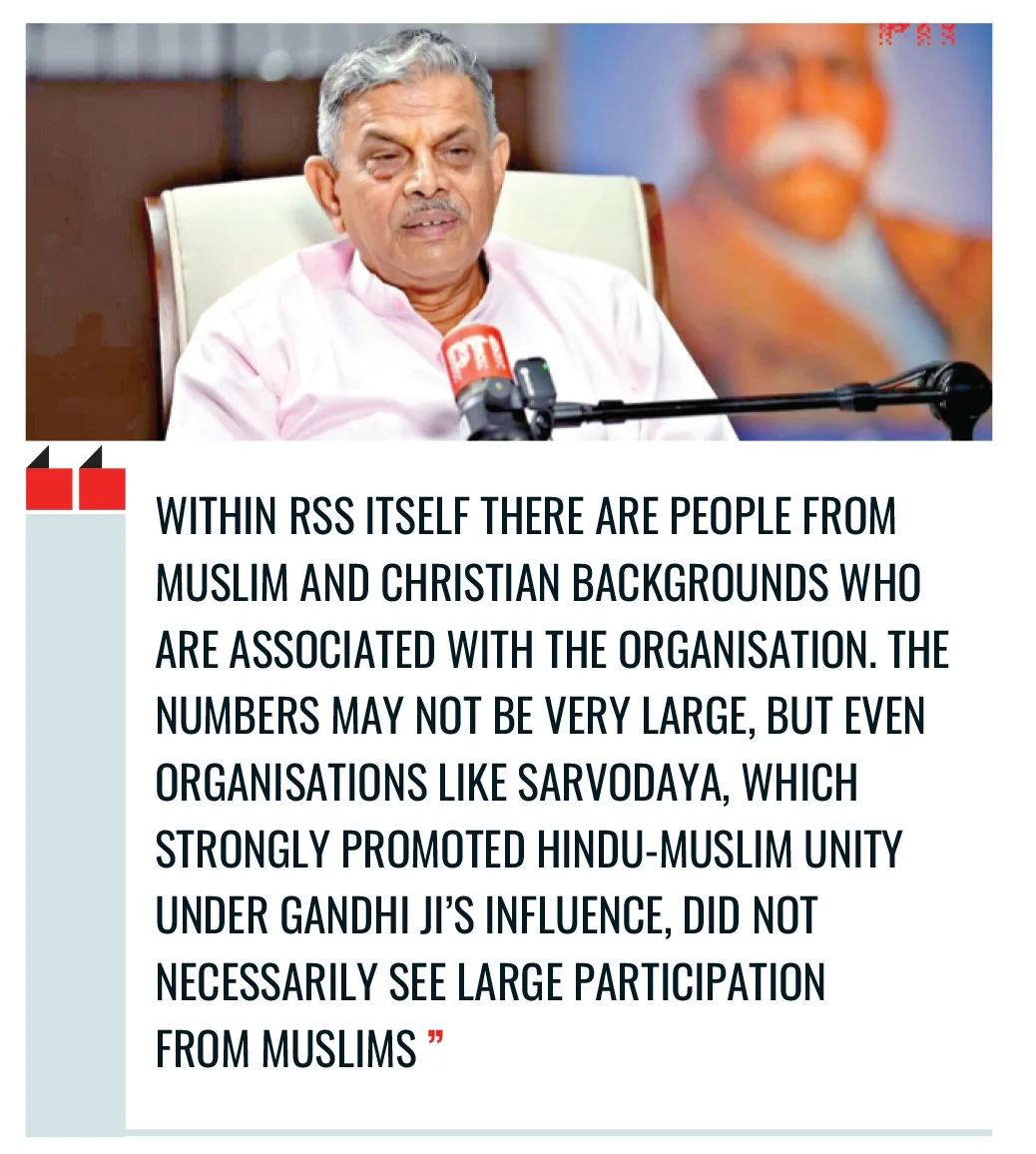
Within RSS itself there are people from Muslim and Christian backgrounds who are associated with the organisation. The numbers may not be very large, but even organisations like Sarvodaya, which strongly promoted Hindu-Muslim unity under Gandhi ji’s influence, did not necessarily see large participation from Muslims. That alone cannot be used to conclude hostility or exclusion.
Therefore, I believe the discussion should go deeper into the roots of these issues. The question should not be directed at RSS. It should be posed to the Muslim leadership.
Udhayanidhi Stalin again said that Sanatan Dharma should be eradicated. How do you respond to such statements?
That is his opinion, and people have responded to such views through elections as well. But Sanatan cannot disappear simply because someone says so.
Sanatan is not merely a religious practice. It is the spirit and soul of this nation. It is a value system and a worldview. The very meaning of “Sanatan” is something eternal — that which continues to exist permanently.
Sri Aurobindo had also described Sanatan as the basis of the nationality of this country. In that sense, eternal values such as truth and enduring principles are expressed through what we call Hindu values and the civilisational ethos of Bharat.