





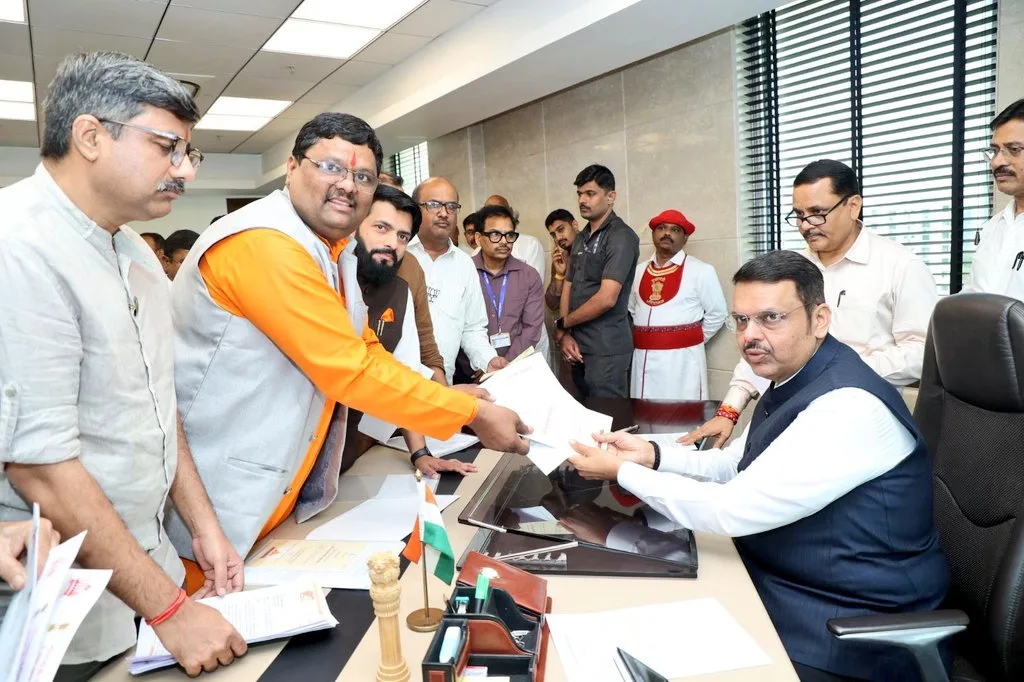
The proposed Maharashtra Devasthan Inams Abolition (Draft) Act, 2026 has sparked intense opposition from Hindu organisations across Maharashtra, with temple bodies accusing the state government of attempting to weaken temple ownership rights and facilitate the transfer of historic temple lands to tenants, encroachers and private holders. The controversy escalated after a delegation of Hindu activists submitted a memorandum to Maharashtra Chief Minister Devendra Fadnavis demanding immediate withdrawal of the draft legislation.
At the centre of the dispute is the Maharashtra government’s proposal to abolish Devsthan Inams, lands historically granted to Hindu temples, religious institutions and charitable establishments by erstwhile rulers, often with exemptions from land revenue. Temple organisations claim the proposed law could permanently strip temples of lands that have sustained religious rituals, charitable work and temple administration for centuries.
What are Devsthan Inam lands?
The draft legislation defines Devsthan Inams as grants of villages, portions of villages, land revenue assignments or tax-exempt lands historically given to temples and religious institutions. Such lands were traditionally meant to financially sustain temples, priests, festivals, rituals and welfare activities associated with religious institutions.
The proposed Act seeks to abolish existing Devsthan Inams and establish a new legal framework governing ownership rights, occupancy claims, tenancy issues, transfers and encroachments. However, one provision has become particularly controversial: the law explicitly excludes properties governed under the Waqf Act, 1995, along with certain Hyderabad-era laws. Hindu organisations argue that while Waqf lands continue receiving legal protection, Hindu temple lands are being opened for restructuring and transfer.
Temple organisations fear permanent transfer of temple lands
The strongest objections have come from the Maharashtra Mandir Mahasangh, which has alleged that the law could effectively hand over temple lands to tenants, leaseholders, private occupants and encroachers. The organisation argues that temple properties legally belong to the deity and cannot be alienated either by trustees or by the state government.
Speaking on the issue, Maharashtra Mandir Mahasangh national organiser Sunil Ghanwat reportedly raised three major objections to the proposed legislation. First, he argued that the Maharashtra government itself has no ownership rights over Devsthan lands and therefore lacks authority to enact legislation enabling transfer of temple-owned properties. According to him, earlier legal frameworks were designed specifically to prevent transfer of temple lands into private hands.
Second, Ghanwat stressed the historical and civilisational importance of these lands. He stated that many temple land parcels have remained with religious institutions for centuries and, in several cases, may have originally been granted by Hindu rulers including Chhatrapati Shivaji Maharaj and other dynasties. Temple bodies fear that enactment of the law could result in historically protected lands being permanently diverted away from temples.
Third, the Mahasangh strongly objected to the exemption granted to Waqf properties under the draft law. Leaders argued that the state was selectively targeting Hindu temple lands while excluding Waqf properties from similar restructuring provisions, making the issue a larger political controversy involving alleged unequal treatment of religious institutions.
Occupancy rights for tenants and holders
One of the most debated sections in the draft law is Section 4, which grants occupancy rights to authorised holders, Mirasdars, tenants and inferior holders cultivating the land personally. Under the proposal, such lands could receive “Occupant Class-I” status, effectively creating ownership-like rights for occupants.
Temple organisations fear that this provision could permanently transfer large portions of temple property away from religious institutions. Many argue the law legitimises occupation claims over lands that historically belonged to temples and were meant for religious purposes.
The controversy deepened further because the draft law also permits regularisation of certain “unauthorised holders” if they have remained in possession since before 1 January 2011, fulfil economic holding limits and pay market value. Additionally, residential occupants in Gaothan areas before the cut-off date may receive occupancy rights without paying occupancy price or Nazarana. Hindu groups claim this effectively legalises decades-old encroachments on temple lands.
Government introduces anti-land grabbing clauses
Even as the law allows regularisation of some occupations, it also introduces stringent anti-land-grabbing provisions. Sections 7 and 8 criminalise illegal occupation of Devsthan lands and provide for imprisonment ranging from two to five years along with fines that may extend up to the market value of the land. The law also empowers collectors to carry out summary eviction proceedings.
The Maharashtra government appears to be attempting a dual strategy: regularising older occupations while discouraging future encroachments. However, temple organisations maintain that introducing a cut-off date mechanism itself rewards earlier illegal occupations and weakens temple ownership claims.
Constitutional concerns raised By Hindu organisations
The Maharashtra Mandir Mahasangh has argued that the proposed law violates constitutional protections relating to religious freedom and management of religious affairs. According to the organisation, temple lands are essential for sustaining rituals, temple administration, charitable activities, staff salaries, festivals and community welfare initiatives.
Temple leaders have also demanded explicit non-transferable status for Devsthan lands in revenue records, a dedicated anti-land-grabbing law for temple properties, an SIT investigation into alleged past encroachments and forged land records, and fast-track courts to resolve temple land disputes within six months.
Memorandum submitted to CM Devendra Fadnavis
A delegation led by Sunil Ghanwat met Chief Minister Devendra Fadnavis along with MLAs Pratap Adsad and Pratap Pachpute to submit a memorandum against the proposed legislation. According to Mahasangh leaders, the Chief Minister acknowledged the seriousness of the issue and instructed officials to hold discussions with the concerned departments and ministers.
The draft Act has currently been placed in the public domain for objections and suggestions, with stakeholders asked to submit responses before June 5, 2026. The Maharashtra government may now choose to amend the draft, delay implementation or proceed with the legislation in the Assembly.
However, given the growing mobilisation by temple organisations and the politically sensitive comparison with Waqf protections, the issue is rapidly emerging as one of Maharashtra’s biggest religious and political flashpoints. Hindu organisations have already warned that if the law proceeds in its current form, a statewide agitation involving devotees, temple trusts and Hindu groups could soon follow.









