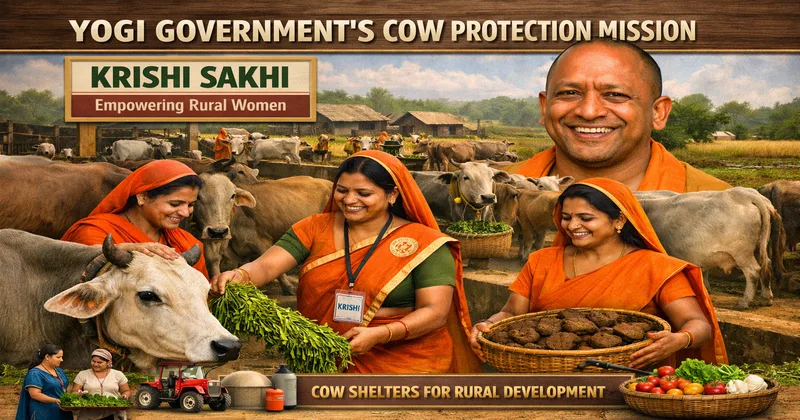
LUCKNOW: In recent years, governance in India has moved more towards models that attempt to merge welfare, employment, sustainability, and grassroots participation into a single framework. Uttar Pradesh’s latest initiative on cow protection is on the same lines. For the first time, under the leadership of Chief Minister Yogi Adityanath, the state government is preparing such a large-scale plan that will transform cow shelters from welfare centers into engines of rural development, women’s empowerment, and organic agriculture/ farming.
The importance of this large-scale initiative lies not only in the scale of implementation, but in the way it attempts to connect multiple rural challenges through a single integrated model. As per the proposed plan, more than 7,500 cow shelters across all 75 districts of Uttar Pradesh will see the deployment of “Krishi Sakhis” i.e., women who are associated with the Uttar Pradesh Livelihood Mission. These women will not only participate in cattle care and shelter management but will also become central figures in the promotion of organic farming and rural entrepreneurship in UP.
For years, cow shelters in many parts of India have been viewed largely as welfare-driven institutions which are most likely dependent on government support. Cow protection has always been an important cultural and religious issue but managing it in a sustainable way has been a major challenge. Taking care of stray cattle, building proper facilities, arranging fodder, and making cow shelters economically useful have been difficult tasks. Uttar Pradesh’s new plan is trying to solve these problems by linking cow protection with multiple economic activities.
The most important aspect of the plan is the emphasis on converting cow dung into organic manure on a large scale. This may appear simple at first glance, but its implications are substantial. India’s agricultural sector has long struggled with rising fertilizer costs, declining soil fertility, and excessive dependence on chemical fertilizers or inputs. Making organic manure in cow shelters can help solve some of these problems. If this is done properly, it can lower farming costs, improve soil health, and encourage safer and more natural farming methods. This will indirectly boost farmers’ income and ensure that people in Uttar Pradesh will get safer and better-quality food.
At the same time, the policy also acknowledges that rural development cannot succeed without women’s participation. The decision to involve women from self-help groups and livelihood missions gives the initiative a social foundation beyond administrative execution. Rural women in India remain underrepresented in formal economic activities despite playing a crucial role in agriculture and household management. By training them as master trainers and placing them in leadership roles, the Yogi government is trying to create a decentralized network of local women entrepreneurs and community mobilizers. A women-led structure can potentially ensure continuity, accountability, and stronger community participation.
Another notable dimension of the initiative is its focus on creating a “cow-based rural economy.” This concept has been discussed earlier, but it has rarely been implemented on the ground in a proper way. Now, Uttar Pradesh under CM Yogi’s leadership is trying to make it a reality through proper training, job creation, and linking it with farming systems. If successful, it could give the state a new identity in organic farming, rural development, and livestock-based economic activities.
Rural India today requires models that combine tradition with economic practicality. Thus the success of this ambitious plan will ultimately depend on execution. Large rural projects often face problems like proper training, monitoring, financial transparency, and long-term success. To make cow shelters truly useful and productive, regular supervision and clear results will be needed. The Yogi government will also have to build strong market connections for organic manure and other products so that income keeps coming regularly.