In the domain of national defence and security, national interest remains constant. Philosophy and values that the people hold close to their heart are given due weightage in a democracy. Strategy is guided by the aforementioned factors and by the ideology of the political party running the government.
Over the past decade, India has witnessed a marked transformation in the interpretation of its defence and security paradigm which, in turn, has led to a visible strategic shift. The earlier largely reactive and Pakistan-centric paradigm has given way to an India-centric approach anchored in national interests, strategic autonomy, and comprehensive power-building.
Militarily Inexperienced Political Leadership
Indian defence remained in the imperial hands of foreign rulers for the best part of a millennium. The British created in the sub-continent a well-oiled and professional military machine that maintained their hold internally and saved their skin in the two world wars of the nineteenth century.
Post-Independence and partition, while the military leadership was well trained, experienced and professional, the Indian political leadership was deficient in military thought.
The lack of military experience of the Indian political leadership in 1947 can be gauged from the fact that despite being geographically four times larger it agreed to divide the British Indian Army in a roughly 64:36 ratio between India and Pakistan. Pakistan walked away with an army that was too large for its needs.
The Pakistan Army built upon this massive force and took over political control of the nation. The country carried out modernisation of its forces at a pace much faster than India. Its military leadership held the belief, for the first two decades, of being militarily superior to the Indian Army. Consequently, Pakistan triggered wars against India in 1947 and 1965 on the basis of a conviction that it would easily beat the Indian forces.
Indian Doctrine of Peace and Non-alignment
The first prime minister of India, Pandit Jawahar Lal Nehru, declared peaceful coexistence, non-alignment and belief in the United Nations as the guiding principles of the Indian defence policy. The end result was a humiliating defeat in the hands of the Chinese in 1962.
Prime Minister Lal Bahadur Shastri did not get enough time to set right the mistakes of Pandit Nehru. Pakistan initiated the Indo-Pakistan War, 1965 because it had received new and state-of-the-art military equipment from the United States, especially the vastly superior Patton tanks. The field was saved by the superior training and courage of the Indian soldier and the experience and professionalism of the military leadership.
The political leadership of India, once again, failed to leverage the victory in the war to strategic advantage. All areas of Pakistan occupied by our forces were returned back without taking any military advantage or guarantee in return.
Strategic Realignment
Post the Indo-Pakistan War, 1965, the Soviet Union, on the basis of a strategic partnership laid by PM Shastri, started providing military equipment to India. This was a pivotal strategic realignment that transformed India into the dominant military power in South Asia. In 1974, India, carried out its first nuclear weapon test codenamed Operation Smiling Buddha.
The rapid modernization enabled the Indian Armed Forces to achieve an overwhelming victory in the Indo-Pakistan War, 1971 which resulted in the creation of Bangladesh. Yet, Indira Gandhi failed to leverage the massive victory against Pakistan in 1971 to strategic advantage for India. What followed was adoption of the proxy war paradigm by Pakistan termed as the policy of a thousand cuts.
Indian Strategic Dormancy
Post 1971, India continued to hesitate from leveraging her military might to completely neutralise the Pakistani threat. Even the nuclear blast was labelled a “peaceful nuclear explosion” (PNE) rather than a weapons test and the government opted against weaponisation at the time.
The end result was that for the next two decades plus, Pakistan, in pursuit of its proxy war policy, caused untold damage in selected areas of Punjab and Jammu and Kashmir through sponsored terrorism. The post 1971 period is characterized by a “no war, no peace” scenario between India and Pakistan, marked by limited military engagement rather than full-scale war. No effort was made to find a permanent solution to the Pakistan problem.
The conduct of the five nuclear weapons tests by the Shri Atal Bihari Vajpayee led Government of India 1998 code named Operation Shakti established India as a declared nuclear-weapon state and marked a transition from undefined and covert nuclear posturing to explicit, overt nuclearization in 1998. Pakistan also conducted nuclear weapons tests the next day. India finally learned to shed fear in military matters and stand up on its own.
Indian Obsession with Pakistan
Numerous military set-backs, an internal economic crisis, frail democracy and gun culture did not deter Pakistan from retaining momentum in asymmetric warfare against India in the new millennium. It continued to leverage the nuclear overhang to constrain India’s options.
Despite being a military superpower and a nuclear state, India exhibited a military passivity that would be inexplicable in the eyes of any expert on national security. Where did this fear come from? Apparently, the weak political will prevailed over a disciplined and professional military structure.
India’s security responses were shaped by immediate provocations from Pakistan. Her security forces went into a state of siege even as the enemy set a debilitating agenda. Turning a blind eye to terror attacks, ceasefire violations, and diplomatic brinkmanship often dictated India’s strategic posture.
Strategy revolved around managing Pakistan diplomatically with the military option remaining defensive and symbolic. The emphasis was totally on de-escalation, maintenance of a moral high ground, and international opinion forming. The reason given was the nuclear risk.
Ideological and Strategic Shift
The change in government in 2014 brought NDA under Prime Minister Narendra Modi to the helm. The change heralded an ideological as well as strategic shift in the security paradigm of the nation. The Nehruvian mind-set of restraint and the fear of a nuclear backlash were replaced with a proactive policy wherein a deterrent intent was exhibited with firm responses such as surgical strikes and air operations. The emphasis has moved from signalling outrage to shaping the strategic environment. A big element of the strategic shift was acceptance of China as a bigger security threat to India.
In other words, India has decoupled its national planning from Pakistan’s actions and she no longer allows imbecile type provocations from the neighbouring country to dominate her strategic bandwidth. The emphasis is on preparedness for a full spectrum of conflict.
National security is now being increasingly linked to growth, infrastructure, and technological self-reliance. Long-term initiatives in manufacturing, defence production, digital infrastructure, and critical technologies underscore the recognition that sustained power flows from economic resilience.
The Indian psyche is also witnessing a drastic change. Gone are the days of self-doubt and overawe of the west or Pakistan. The narrative now exudes confidence in cultural superiority that brings with it articulation with authority on the basis of justice and righteousness.
The New Approach
The new approach keeps national interest paramount and does not believe in bending to blackmail. Internal resilience and comprehensive national power is exhibited to deal with pressure. Indian first is the defining ideology. Decisions are being taken in national interest without looking over the shoulder. Panic reactions are now a thing of the past. Responses are well thought out and calibrated in time and space.
The foregoing signals the emergence of a more confident and self-directed state that is poised to make a serious bid for a place on the big table globally.
The primary focus of the nation is now on capacity building as a part of defence preparedness. The thrust to self-reliance through Aatmanirbhar Bharat and Make in India is finding maximum resonance in the defence sector. New military doctrines involving jointness and theatre commands are being talked about in open debates and implemented with clarity.
Foreign policy too has evolved in concert with national aspirations. As PM Indira Gandhi moved on from non-alignment and PM Vajpayee demolished strategic ambiguity, the present dispensation is building on strategic autonomy and issue-based partnerships. India is comfortable working with the Quad, engaging the Middle East, pushing Act East, staying active in BRICS, and projecting itself as a net security provider. From avoiding choices, India is increasingly shaping them.
Ramifications of the Strategic Shift
To all future provocations from any adversarial entity be it Pakistan, China or anybody else, India will respond with strength and resolve. In the response multiple instruments – diplomatic, financial, legal, covert and overt will be put to use. She will not be pulled into adversary-defined timelines and provocations.
The political leadership of Pakistan has, for long, used the proxy war card to maintain its relevance in the eyes of domestic as well as international audiences. As India moves on from the Pakistan obsession, the neighbouring country’s ability to command attention through India bashing has been severely jeopardised. Domestic and international circles are clearly exhibiting fatigue over its counter-productive policy.
Consequences of the Strategic Shift
The new paradigm will find feet with time. India will fine-tune its multi-domain and two-front contingency planning. She will improve upon economic resilience with self-sufficiency in defence becoming a seamless offshoot to create a new strategic shield. Growth, manufacturing depth, and technological leadership will underpin deterrence.
Once the elements are in place, India’s adversaries will not be to gain leverage from either economic or security coercion as has been happening for many decades since independence. Pakistan will find it increasingly difficult to find allies as more and more states understand the necessity of aligning with the more powerful India.
A strong India will emerge as a security provider which will greatly limit the space for inimical global powers to exploit regional anxieties. To achieve this India will have to create a posture of trust rather than domination.
Conclusion
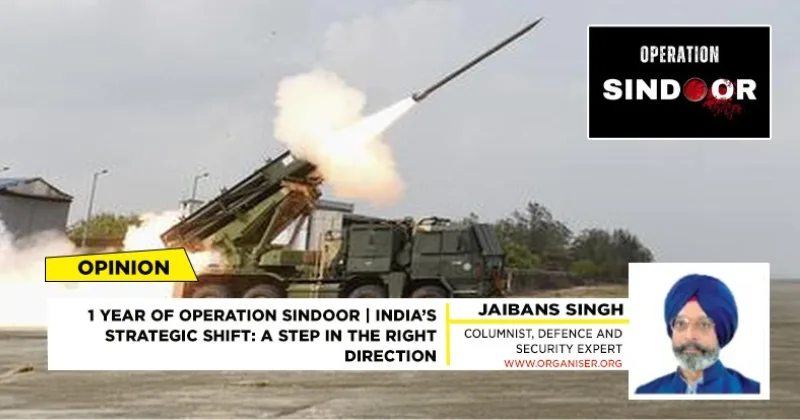
Operation Sindoor, as a response to the terrorist attack in Pahalgam, is the most significant outcome of the strategic shift. It has left no doubt about the Indian policy towards national security.
Terrorism and asymmetric threats remain, but they are only one part of a much wider security picture. Deterrence is more punitive, and there’s no dialogue for the sake of dialogue. Defence in India is no longer seen as the sole responsibility of the armed forces. In place now is a “whole-of-nation” approach with seamless integration of defence, economy and diplomacy. There is higher trust between the political leadership, the military and bureaucracy, especially external affairs.
The change has come about because of the political ideology of the incumbent NDA government under the leadership of Prime Minister Narendra Modi being different from the previous regime. The new approach reflects the mood of the nation as more confident and upwardly mobile.