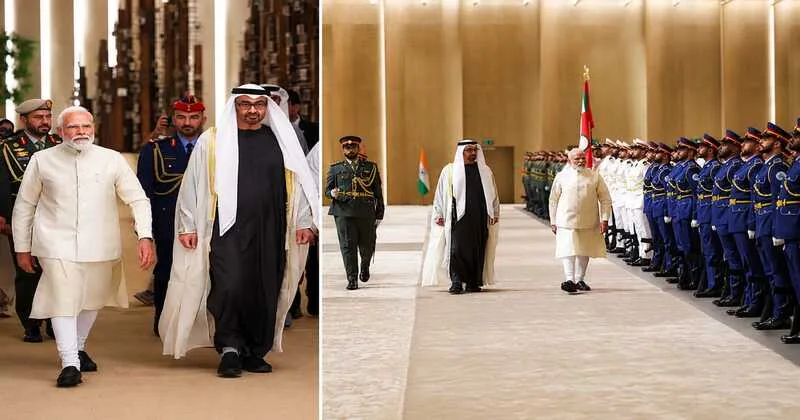
Abu Dhabi: Prime Minister Narendra Modi landed in Abu Dhabi on May 15 as part of his five-nation diplomatic tour, with the visit taking place against the backdrop of escalating conflict in West Asia, rising global energy and economic uncertainty linked to the ongoing war involving Iran, the United States and Israel. The UAE leg of the visit focused heavily on energy security, strategic cooperation and regional stability as New Delhi sought to deepen ties with one of its most important partners in the Gulf amid mounting geopolitical tensions.
PM Modi held talks with UAE President
Mohamed bin Zayed Al Nahyan in Abu Dhabi on a wide range of issues, including trade, investment, defence cooperation, energy security and the welfare of the Indian diaspora living in the Gulf nation. The visit also focused on strengthening the Comprehensive Strategic Partnership between India and the UAE, which has emerged as one of India’s most important relationships in the Gulf region.
India-UAE sign key energy and defence agreements
During the visit, India and the UAE concluded two important memorandums of understanding in the sectors of Liquefied Petroleum Gas (LPG) and Strategic Petroleum Reserves, aimed at strengthening India’s long-term energy security amid global volatility in oil markets. Both countries also agreed on a framework for strategic defence cooperation, reflecting the growing security partnership between New Delhi and Abu Dhabi. In another significant development, the two sides signed an MoU for setting up a ship repair cluster at Vadinar in Gujarat’s Dwarka district.
The visit additionally saw investment announcements worth nearly USD 5 billion in Indian infrastructure projects as well as investments in RBL Bank and Samman Capital.
Officials said the agreements would further deepen economic and strategic engagement between the two countries at a time when regional instability has increased the importance of reliable energy and trade partnerships.
The UAE remains India’s third-largest trading partner and the seventh-largest source of cumulative foreign investment into India over the last 25 years. With long-term supply agreements already in place, the Gulf nation continues to remain one of India’s most dependable energy partners despite the ongoing turmoil in West Asia.
PM Modi condemns attacks on UAE
A major focus of the visit was the worsening conflict in the region following Iranian attacks on the UAE during the broader confrontation involving the United States and Israel. During bilateral talks, PM Modi strongly condemned the attacks on the UAE and expressed solidarity with Abu Dhabi.
“We strongly condemn the attacks launched on the UAE. The manner in which the UAE has been targeted is not acceptable in any form. We welcome the steps taken by you to uphold national unity, security and regional integrity,” the Prime Minister said during his meeting with Sheikh Mohamed bin Zayed Al Nahyan.
The friendship between India and UAE is very strong! Our nations will keep working together with the aim of building a better future for our planet.@MohamedBinZayed pic.twitter.com/TzjU63GFll
— Narendra Modi (@narendramodi) May 15, 2026
PM Modi also thanked the UAE leadership for ensuring the safety and welfare of the Indian community living in the country during the attacks and tensions. “For the care provided to the Indian diaspora residing in the UAE in these difficult times, the manner in which they were considered as members of one’s own family by the UAE Government, you and the Royal Family, I express my heartfelt gratitude,” he said.
The Prime Minister reiterated India’s position that dialogue and diplomacy remain the only sustainable path for resolving regional conflicts. “The impact of war in the West Asia region is seen across the world today. India has always given importance to dialogue and diplomacy for resolving issues. It is our biggest concern that Hormuz remains free and open. In this regard, it is essential to abide by international laws,” PM Modi said. He further asserted that India would continue to stand firmly with the UAE. “India stands shoulder-to-shoulder with the UAE in every situation, and it will continue to do so. For the restoration of peace and stability, India will extend all possible cooperation,” the Prime Minister added.
Fuel price hike, energy discussions and Indian diaspora
PM Modi’s visit comes at a time when India is dealing with the economic fallout of rising energy prices linked to the conflict in West Asia. After months of absorbing the impact of the global fuel shock caused by the US-Iran conflict, India has increased the retail prices of petrol and diesel for consumers for the first time in four years. The revised fuel prices came into effect on Friday, while the price of CNG was also raised by Rs 2.
Against this backdrop, securing stable long-term energy supplies and strengthening strategic petroleum reserves emerged as a key priority during discussions between the two sides.
The UAE hosts more than 4.5 million Indians, making the Indian diaspora one of the largest expatriate communities in the Gulf region. Their welfare and safety also formed an important component of the bilateral talks. PM Modi expressed satisfaction over his close engagement with the UAE President and said the two leaders had remained in regular contact over the phone in recent months.
“For the past some time, we had been talking over the phone regularly. I used to keep speaking to you over the phone, but I was very eager to meet you in person,” he said. The Prime Minister also thanked the UAE President for elevating bilateral ties to new levels and noted that significant progress had been achieved since the UAE leader’s visit to India in January. “In the kind of situation we have at hand today, the importance of India-UAE strategic cooperation has vastly increased. In the time to come, we will go ahead together in every area,” he said.
Tour to continue across Europe
Following the UAE leg of the visit, PM Modi will travel to several European nations as part of his broader five-country diplomatic outreach.
According to Secretary (West) in the Ministry of External Affairs, Sibi George, the Prime Minister will next visit the Netherlands before travelling to Sweden, where he will hold bilateral talks with Swedish Prime Minister Ulf Kristersson in Gothenburg. The two leaders will also jointly address the European Round Table for Industry along with Ursula von der Leyen. The Prime Minister will then visit Norway for the 3rd India-Nordic Summit and related bilateral engagements before concluding the final leg of his tour in Italy. During the Italy visit, PM Modi is scheduled to meet President Sergio Mattarella and hold talks with Prime Minister Giorgia Meloni as India seeks to deepen strategic, economic and technological cooperation with key European partners.