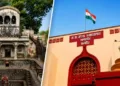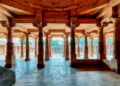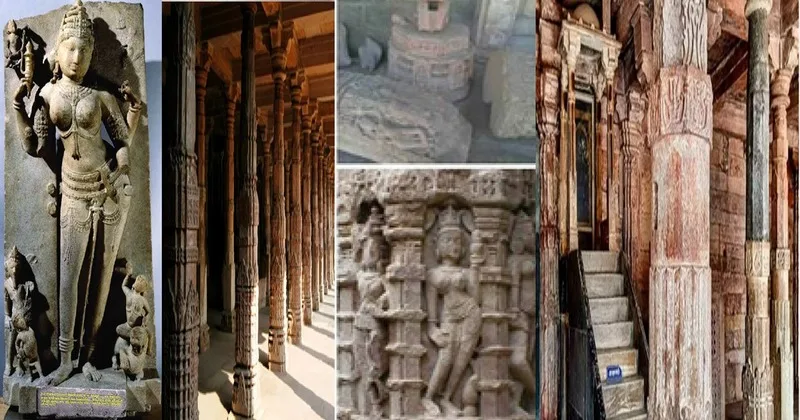
A division bench of the Madhya Pradesh High Court delivered the crucial verdict on May 15, holding that the Bhojshala complex in Dhar is a temple of Maa Vagdevi and not a mosque structure for offering namaz.
The court specifically quashed the earlier ASI circular that had permitted Muslims to offer Friday namaz at the disputed complex between 1 pm and 3 pm under a 2003 arrangement. With the latest ruling, no namaz will now be permitted inside the Bhojshala premises.
The court passed several directions in its order:
1. Bhojshala shall remain a protected monument.
2. Bhojshala has been recognised as the temple of Maa Vagdevi.
3. Hindus have been granted the right to worship at the site.
4. Permission granted to the Muslim community to offer namaz stands quashed.
5. The ASI will continue to manage and control the monument.
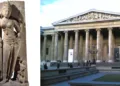
6. The Union Government has been directed to consider representations seeking the return of the Vagdevi idol reportedly kept in a museum in the United Kingdom.
7. The Muslim side may approach the government seeking allotment of alternate suitable land for a mosque.
The bench also observed that the Muslim side is free to approach the Supreme Court against the judgment if it wishes to challenge the order.
MP High Court declares Bhojshala a mandir
A division bench of Justices Vijay Kumar Shukla and Alok Awasthi delivered the significant verdict in the long-running Bhojshala dispute, holding that the religious character of the disputed structure is that of a temple dedicated to Goddess Vagdevi (Saraswati).
“The disputed area of Bhojshala complex and Kamal Maula Mosque is held to be a protected monument. The religious character of the disputed area of the Bhojshala complex and Kamal Maula Mosque is held to be Bhojshala with a temple of Goddess Saraswati,” the court ruled.
The High Court also quashed the 2003 ASI order under which Muslims had been permitted to offer Friday namaz at the site for two hours every week.
“2003 ASI order to the extent restricting the right of Hindus to worship within the Bhojshala complex and also the order permitting prayer by Muslim community are quashed,” the bench observed.
In a landmark verdict in the decades-old Bhojshala dispute, the High Court has declared Dhar Bhojshala to be a temple of Goddess Vagdevi, based on the detailed findings submitted by the ASI.
Key directions in the judgment:
– Installation of the Saraswati idol
– Full control of… https://t.co/tQalteycL9— Amit Malviya (@amitmalviya) May 15, 2026
With this, the decades-old arrangement allowing Muslims to offer namaz at the complex on Fridays between 1 pm and 3 pm stands cancelled, while Hindus retain worship rights at the site.
While ending the namaz arrangement inside the Bhojshala complex, the court said the State government may consider allotting alternative land to the Muslim side for construction of a mosque or prayer site elsewhere in Dhar district.
“In order to secure the religious rights of the Muslim community and to ensure complete justice between the parties, in case the Muslim side submits an application for allotment of suitable land within Dhar district for construction of mosque or place for prayer, the State government may consider the said application in accordance with law,” the judgment directed.
The bench also noted that the Muslim side is free to challenge the ruling before the Supreme Court.
ASI survey played crucial role in verdict
The verdict comes after the ASI submitted an extensive scientific survey report before the High Court on July 15, 2024. The report was prepared after a 98-day court-monitored survey of the disputed structure.
According to submissions made before the court, the ASI report stated that archaeological remains, sculptural fragments, inscriptions, literary slabs, and temple-style architectural remains found at the site indicated the existence of a large pre-existing Hindu religious and educational structure dating back to the Paramara period.
The report noted that scientific investigations and excavations revealed that the “existing structure was made from parts of earlier temples.”
Big win for Hindus in #Bhojshala:
Complex that is a Mandir on Tuesdays & Masjid on Friday will undergo ASI survey in coming weeks.
Attempts have been made by Islamic invaders to convert the structure into a Mosque by grinding carved murtis and inscriptions. My ground report: pic.twitter.com/aOqs0Dhb6x
— Subhi Vishwakarma (@subhi_karma) March 12, 2024
Advocate Vinay Joshi, representing petitioner organisation Hindu Front for Justice, stated that the ASI prepared a massive report spanning over 2,000 pages across 10 volumes. During the survey, officials reportedly recovered 1,710 artefacts, including 39 broken idols, temple remains, inscriptions, coins, and symbols associated with Sanatan traditions.
“We have considered the archaeological and historical facts, ASI notifications and survey report. On the basis of the precedent laid down in the Ayodhya case, and considering the nature of archaeological evidence, the court can safely rely on conclusions of such multidisciplinary studies by the ASI,” the bench stated.
“There is a constitutional duty even to provide basic amenities to pilgrims, proper maintenance of law and order, and preservation of the pristine character of the deity. We have noted that continuity of Hindu worship at the site has over time never been extinguished,” the bench ruled.
According to the petitioners, the findings strongly indicated that the site originally functioned as a centre of learning and worship associated with Maa Saraswati.
Long-running Bhojshala dispute
The Bhojshala complex has remained at the centre of a decades-long religious and legal dispute in Madhya Pradesh.
For Hindus, Bhojshala is revered as an ancient temple of Goddess Vagdevi, the deity of knowledge and wisdom. Muslims, however, have claimed the structure as the Kamal Maula mosque.
Under a 2003 administrative arrangement, Hindus were allowed to perform puja every Tuesday from sunrise to sunset, while Muslims were permitted to offer namaz on Fridays for a limited duration.
The High Court’s latest order effectively ends the Friday namaz arrangement and formally recognises the site’s temple character based on the ASI’s scientific findings and archaeological evidence placed before the bench.
Before pronouncing the verdict, Justice Vijay Kumar Shukla had personally visited the Bhojshala complex on March 24 to inspect the disputed structure and understand its layout.
The verdict is expected to reignite national debate surrounding disputed historical religious structures and archaeological evidence in India. Hindu organisations welcomed the ruling as a restoration of historical truth and religious rights, while the Muslim side is expected to explore legal remedies, including approaching the Supreme Court.
The direction to the Union Government to consider bringing back the idol of Maa Vagdevi from a museum in the United Kingdom has also added a significant cultural dimension to the case.
The Bhojshala dispute has often drawn comparisons with other high-profile religious litigations in India, including the Ram Janmabhoomi case in Ayodhya, with many Hindu groups referring to Bhojshala as a “Mini Ayodhya” due to the long legal battle over worship rights and claims surrounding the site’s original religious character.
In such cases, courts have examined historical records, archaeological findings, inscriptions, and documentary evidence to determine the original nature of disputed structures.