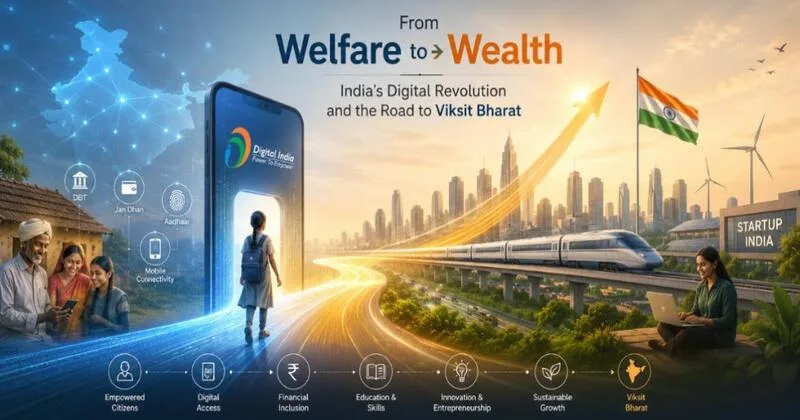
In 1947, India inherited a broken economy, a fractured society and a colonial administrative machinery designed not to serve its people but to extract from them. Seventy-seven years later, the same nation processes over 12.5 billion digital payment transactions every single month, more than any country on earth. A farmer in Vidarbha receives crop advisory in Marathi on his phone without visiting a single government office. India is at an inflexion point. And the direction it chooses in the next decade will determine whether 2047 becomes a moment of genuine civilisational renaissance or just another statistical milestone.
What DPI Actually Is And Why It Matters
Digital Public Infrastructure, or DPI, is not a government app or a website. It is a design philosophy. It means building shared digital foundations like roads or electricity grids on which both government and private innovators can build services for citizens at a population scale.
India’s first generation of DPI, the report consisted of three pillars: Aadhaar (digital identity), UPI (digital payments) and Jan Dhan bank accounts. Together, they formed the JAM Trinity: Jan Dhan, Aadhaar, and Mobile, which became the backbone of India’s digital transformation. The results have been extraordinary by any global standard.
In 2011, a staggering 65 per cent of Indian adults had no access to a formal bank account. Within eight years, India achieved 80 per cent bank account penetration. The Bank for International Settlements had estimated this would take 47 years using conventional methods. India did it in eight through Aadhaar-enabled e-KYC that eliminated paperwork and made account opening a matter of minutes.
Welfare leakages, the chronic disease of India’s social spending since independence, stood at 35 per cent to 40 per cent before Aadhaar-linked Direct Benefit Transfer. Since then, over Rs 43.95 lakh crore has been transferred directly to beneficiaries’ accounts, with Rs 3.48 lakh crore saved through leakage prevention. During the COVID-19 pandemic, $4.5 billion was transferred directly into bank accounts, reaching the poor when they needed it most, without middlemen or any delay.
UPI, launched in 2016, has transformed India from a cash-dominated economy into the global leader in real-time digital payments within six years. The humble QR code at the neighbourhood tea stall became the symbol of a quiet revolution by bringing millions of micro-entrepreneurs into the formal economy, creating transaction histories that could substitute for the collateral they never had.
DPI-enabled startups have created over $100 billion in market value. From 5 lakh MSMEs registered under GST in FY 2017-18, the number grew to 1.5 crore by December 2024, a thirty-fold increase driven by digital formalisation.
The Honest Assessment: Foundation Laid, Destination Far
The NITI Aayog report presented honest data. DPI 1.0 delivered welfare and financial inclusion at scale, also reflecting that welfare is not prosperity. Inclusion is not an opportunity. A bank account is not a livelihood. The Indian agricultural sector employs over 45 per cent of the workforce, yet contributes only 18 per cent to GDP. Over 85 per cent of smallholder farmers continue to operate at subsistence levels, with an average monthly agricultural income of just Rs 4,476. India’s vast MSME sector, 6.3 crore enterprises employing 110 million people, faces complex compliance burdens, limited market access, and a formal credit penetration of merely 20 per cent.
This is the ambition of DPI 2.0, covering the period 2025 to 2035, described as Realising Aspirations. The shift is fundamental from welfare delivery to livelihood empowerment, from financial inclusion to productive participation and from services reaching citizens to citizens becoming active economic agents.
Eight Transformations, One Direction
DPI 2.0 identifies eight specific sectoral transformations, not aspirational goals but targeted interventions with identified structural bottlenecks. For MSMEs, the focus is on market expansion through digital networks, AI-driven market intelligence and simplified compliance enabling at least 10 million enterprises to grow beyond survival-driven local trade into regional and global value chains.
For farmers, the vision is AI-powered advisory in local languages, digital agriculture registries linking land records and crop cycles to credit access and direct market linkages that eliminate exploitative middlemen.
For education, the roadmap addresses the crisis hiding in plain sight, the 2022 ASER survey finding that only 42 per cent of Class V students can read a Class II text. Multilingual AI learning assistants, safe judgment-free learning spaces, and verifiable digital credentials are proposed to realise the National Education Policy’s vision that policy documents alone have not achieved.
For healthcare, the Ayushman Bharat Digital Mission is to be strengthened and fast-tracked. Nearly 30% of India’s population, the so-called missing middle, remains uninsured. Out-of-pocket expenditure accounts for 39.4 per cent of total health spending, meaning a single illness can erase years of a family’s economic progress.
For credit access, the focus is on unlocking the vast pool of individually owned assets like land records, invoices, and receivables that remain illiquid because the transaction cost of formal lending is too high. Tokenisation of these assets, combined with open ledger protocols, can democratise credit for small enterprises, farmers and low-income households.
Two more transformations address decentralised energy markets, allowing households to produce and sell surplus solar power and benefits reaching beneficiaries proactively, rather than beneficiaries navigating bureaucratic labyrinths to claim what is rightfully theirs.
Why This Is Distinctly Indian by Soul
What makes the India DPI model remarkable and worth examining beyond its economic metrics is that it is philosophically Indian in its architecture. It is not the Chinese model of state-controlled digital infrastructure where citizen data flows through centralised government servers. Also, it is different from the American model of Big Tech platforms extracting private value from public behaviour. India DPI is built on open standards, interoperability and consent-based data sharing. The citizen owns their data. The state creates the rails. The market builds the services.
The Account Aggregator framework, which was enabled by the Reserve Bank of India in 2021, is a precise example. It allows individuals to share their financial data with lenders through a consent-based mechanism, with data flowing directly between regulated entities, never stored by the intermediary. By late 2025, over 223 million users will have linked their accounts to this ecosystem and loan approvals that took weeks will now take minutes.
It is an approach that emerged from India’s specific challenges in its vast linguistic diversity, federal structure, billion-plus population and designed solutions around them. Voice interfaces in regional languages, QR codes accessible to feature phone users, biometric authentication for those without documents and every design choice was shaped by the reality of Bharat.
From Blueprint to Reality
The report mentions that the action plan is specific and time-bound. The first cycle of DPI 2.0 runs from 2026 to 2027, focusing on MSME and agriculture transformations. Six champion States and Union Territories representing all five geographic regions will implement lighthouse pilots. MeitY and NITI Aayog will provide institutional support, expert advisory and global partnerships. By 2027, India is proposed to establish a globally focused initiative to export its DPI model not as foreign aid, but as a replicable template that low and middle-income countries worldwide are already seeking.
This is India as Vishwaguru, in the most grounded, practical sense a demonstrated capability is presented. Nations across Africa, Southeast Asia and Latin America are studying India’s Aadhaar, UPI and data governance frameworks. The DPI@2047 roadmap, if executed properly, will give them more to learn from.
The Civilisational Moment
India has always been more than an economy. It has been a civilisation with a coherent understanding of the relationship between the individual, the community and the state, where prosperity is not merely personal accumulation but collective flourishing.
The Viksit Bharat target of becoming a $30 trillion economy with a per capita income of $18,000 by 2047 is a number. But the roadmap behind it is moving from welfare to wealth creation, charity to capability, and leakage-ridden transfers to dignified livelihoods, which reflects something deeper.It reflects a nation that has decided it will not wait another century to take its rightful place in the world. The tools built in the last fifteen years, Aadhaar, UPI, GSTN, and Account Aggregator, were not endpoints but foundations. That the next twenty years belong not to those who receive benefits, but to those who create them.
India is not building digital infrastructure. It is building the architecture of a confident, self-reliant and inclusive civilisation. The responsibility now belongs to every stakeholder, government, entrepreneur, educator and citizen to build upon it. Bharat is not catching up. Bharat is leading the world slowly and steadily.