India is undertaking the transformations in its modern military, shifting from a traditional manpower intensive defence posture to a technology-led, drone-centric battlefield strategy. Driven by hard lessons learned from Operation Sindoor in May 2025 and reinforced by careful study of drone warfare in other theatres, the Indian armed forces are restructuring around the principle of mass, affordability and networked intelligence.
Operation Sindoor
Operation Sindoor, conducted on 7 and 8 May 2025 in direct response to the Pahalgam terror attack, marked India’s first large-scale non-contact war. For four days along the western frontier, Pakistani forces deployed multiple waves of drones from Leh to Sir Creek, many of them relatively simple platforms designed to exhaust Indian air-defence systems by drawing fire away from more sophisticated assets. Indian forces successfully neutralised hundreds of enemy drones and missiles through an integrated air defence shield, and loitering munitions were used to destroy high-value targets, including enemy radar and missile systems. The Indian Air Force bypassed and jammed Pakistan’s Chinese-supplied air defence systems, completing its missions in as little as 23 minutes in certain sorties.
According to a report by the Indian Defence Research Wing, Pakistani swarms overwhelmed Indian air defences in certain sectors, jamming GPS signals across a 150-kilometre radius. An estimated 60% to 70% of the critical components in India-owned drones, including motors, sensors and batteries, were sourced from China, highlighting a dangerous strategic dependency. The operation confirmed a global trend that cheap, attainable drones fielded in mass can create disproportionate pressure on expensive, limited-inventory defence systems.
The Army Blueprint: 8,000 to 10,000 Drones per Corps
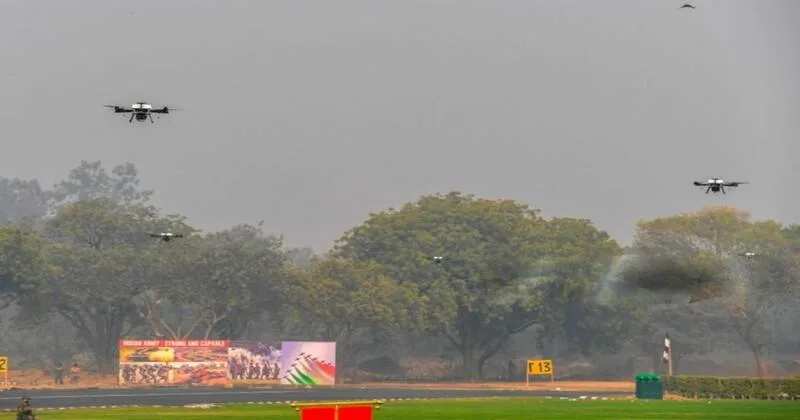
In direct response, Chief of Army Staff General Upendra Dwivedi unveiled an ambitious restructuring blueprint targeting 8,000 to 10,000 drones per corps across the Indian Army. The plan fundamentally reimagines military formations from the battalion level upward. Traditional infantry units will now embed dedicated drone platoons of 30 to 70 personnel trained in swarm operations and loitering munitions. The Corps of Electronics and Mechanical Engineers will gain drone repair sections capable of on-site fixes and terrain mapping, while utility UAVs will enable resupply drops to forward posts in high-altitude theatres like Ladakh.
Several new specialised formations are being raised alongside this restructuring. Bhairav Light Commando Battalions, each 250-strong, will blend elite raiding capacity with drone overwatch. Rudra Brigades will fuse mechanised infantry, special forces, artillery and UAVs for multi-domain operations. Divyastra Batteries in artillery regiments will pair kamikaze drone swarms with conventional howitzers for deep strikes, while Shaktibaan units will function as dedicated drone strike outfits. The target for achieving near-universal soldier training in drone operations has been set for 2027, according to reporting by Indian Masterminds and Indian Defence News.
The IAF Mehar Baba Competition: Towards Distributed Aerial Radar
The Indian Air Force is pursuing a complementary but distinct vision for drone swarms. In April 2026, the IAF launched the third edition of the Mehar Baba Competition (MBC-3), with the theme of Collaborative Drone-Based Surveillance Radars. The aim is to develop a proof-of-concept for a swarm of unmanned aerial systems functioning collectively as an airborne radar network capable of detecting, tracking and reporting aerial targets in contested environments.
The concept draws on swarm intelligence: instead of relying on a single high-value Airborne Warning and Control System (AWACS) aircraft, sensing and surveillance functions would be distributed across many smaller, expendable drone nodes. Each drone acts as a sensing node, sharing data with a centralised monitoring station for real-time tracking and target localisation. The inherent redundancy means the loss of individual nodes does not collapse the network. The first two editions of the competition have already generated approximately Rs. 2,000 crore worth of orders for India’s unmanned systems industry.
Make in India: Policy Foundations
India’s drone ambitions rest on a set of interlocking domestic policies. Since 2021, the government has banned the import of fully assembled drones in CBU, SKD and CKD forms to protect and cultivate indigenous manufacturers. The Production Linked Incentive (PLI) scheme for drones and drone components, notified in September 2021 with an approved outlay of Rs. 120 crores spread over three financial years, has seen rapid expansion in domestic manufacturing capacity.
In September 2025, the 56th GST Council meeting approved a reduction in the goods and services tax on drones from the earlier fragmented rates of 18% and 28% to a uniform 5%, effective from 22 September 2025. Military-grade drones, high-performance batteries and flight simulators were made entirely tax-exempt. These reforms create a powerful policy alongside the PLI scheme and the import ban. PLI provides manufacturing incentives, and the GST cut makes the final product more affordable for end-users, including the armed forces. India is now home to over 600 drone start-ups that have collectively raised more than 500 million dollars in funding, according to Businessworld.
The Threat Environment: Two Fronts, One Answer
India’s drone build-up is shaped by the distinct but simultaneous pressures it faces on two fronts. Along the Line of Actual Control (LAC) with China, the People’s Liberation Army has invested heavily in drone technology and swarm concepts over many years. Along the Line of Control (LoC) with Pakistan, Operation Sindoor demonstrated that adversaries can field hundreds of drones per day at relatively modest cost. India has a defence posture that functions smart, rather than an expensive shield, a system that absorbs, identifies and neutralises threats across a wide front rather than depending on a small number of costly interceptor missiles.
On the counter-drone side, the Army is inducting layered indigenous systems. These include the D4 anti-drone platform, the SAKSHAM counter-UAS grid approved in 2025, the Bhargavastra multi-layer micro-missile and micro-rocket system and DRDO laser-based directed-energy weapons capable of engaging targets at ranges up to two kilometres. The combination of offensive swarm capacity and indigenous counter-drone defence is what planners describe as the integrated swarm architecture.
Challenges That Remain
The drone ambitions face genuine technical and industrial challenges that official sources and industry analysts openly acknowledge. Supply chain dependency on imported components remains acute, particularly for batteries, motors, sensors and silicon chips, as the CEO of drone firm Unmanned noted at the Bengaluru Tech Summit. Spectrum management for controlling multiple simultaneous drone swarms and building electronic warfare resilience against jamming and spoofing are complex engineering problems that require sustained R&D investment. Defence exports crossed Rs. 24,000 crores in the financial year of 2024-25, with an ambitious target of Rs. 50,000 crores by 2029, but indigenous component manufacturing procurements will take time.
India’s swarm strategy is a multi-year programme of restructuring, indigenisation and capability development whose foundations are now clearly laid. Operation Sindoor compressed timelines and focused minds on 8,000 to 10,000 drones per corps as a target. The IAF distributed surveillance radar concept, a supportive GST and PLI policy framework will support the pace of indigenous component production, training and systems integration.