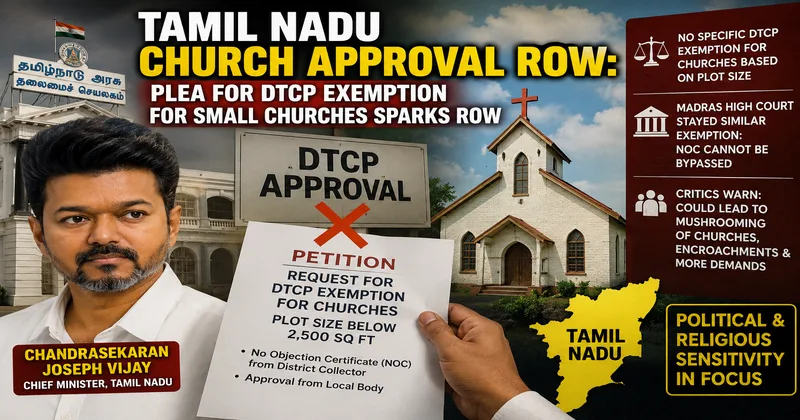
CHENNAI: According to reports circulating on social media, Jebasingh, General Secretary of the Church Workers Welfare Trade Union, has submitted a formal petition to Chief Minister C. Joseph Vijay requesting relaxation in approval procedures for smaller churches.
The petition reportedly argues that obtaining approvals from the Directorate of Town and Country Planning (DTCP) involves lengthy bureaucratic procedures, especially for small religious structures.
Jebasingh has sought an official Government Order exempting churches built on plots below 2,500 square feet from mandatory DTCP approval. Instead, he has requested that such structures be permitted through a simplified process requiring only:
- A No Objection Certificate (NOC) from the District Collector
- Approval from the concerned local body
A formal petition was submitted to the Chief Minister of Tamil Nadu regarding building regulations for smaller churches.
The petition was submitted by Bro. Jebasingh who is the General Secretary of the Church Workers Welfare Trade Union. Currently, constructing religious… pic.twitter.com/4gFIVrOjGG— karupaiah Thevar (@karupaiahthevar) May 21, 2026
Madras High Court Had Earlier Stayed Similar Exemption
The controversy has revived memories of a similar exemption attempt made during the DMK regime.
Ahead of Christmas celebrations last year, Chief Minister M.K. Stalin had announced that religious structures functioning between 2019 and 2024 in compliance with Tamil Nadu Combined Development and Building Rules, 2019, would be exempted from requiring a District Collector’s NOC for planning permission.
However, the move soon landed in legal trouble.
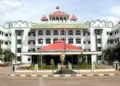
On January 24, 2026, the Madurai Bench of the Madras High Court stayed the operation of a Government Order issued by the Tamil Nadu Housing and Urban Development Department on January 8, 2026.
The PIL challenging the order had been filed by Madurai-based real estate businessman Kalanithi.
A division bench comprising Justices G Jayachandran and N Senthilkumar observed that retrospective exemptions bypassing statutory NOC requirements under the Town and Country Planning Act could not be granted through executive orders.
Critics now argue that the Vijay government may avoid taking any formal decision on Jebasingh’s petition because of the legal complications already highlighted by the High Court.
Political and Religious Sensitivities
Political observers believe the issue could become a major flashpoint if the government attempts any religion-specific relaxation.
Critics argue that granting exemptions exclusively for churches may lead to demands from other religious groups for similar concessions, potentially placing the government in an uncomfortable position.
Some analysts suggest the TVK government is likely to adopt a cautious “no-comment” approach rather than publicly accepting or rejecting the petition.
Observers also point out that the Vijay government, still in its early days and dependent on delicate coalition management, may avoid any move capable of triggering wider communal or political controversy.
Govt Yet to Respond
As of now, neither the Tamil Nadu government nor the Chief Minister’s Office has issued any official response regarding the petition.
With the matter touching upon religion, planning regulations, court rulings and political optics simultaneously, the issue is expected to remain sensitive in the coming weeks.