
Pokhran-II: How India Outsmarted the CIA
August 31, 2026
  • Read Ecopy
  • Circulation
  • Advertise
  • Careers
  • About Us
  • Contact Us
Android AppiPhone AppArattai
Organiser
  • ‌
  • Bharat
    • Assam
    • Bihar
    • Chhattisgarh
    • Jharkhand
    • Maharashtra
    • View All States
  • World
    • Asia
    • Europe
    • North America
    • South America
    • Africa
    • Australia
  • Editorial
  • International
  • Opinion
  • RSS @ 100
  • More
    • Op Sindoor
    • Analysis
    • Sports
    • Defence
    • Politics
    • Business
    • Economy
    • Culture
    • Special Report
    • Sci & Tech
    • Entertainment
    • G20
    • Azadi Ka Amrit Mahotsav
    • Vocal4Local
    • Web Stories
    • Education
    • Employment
    • Books
    • Interviews
    • Travel
    • Law
    • Health
    • Obituary
  • Subscribe
    • Subscribe Print Edition
    • Subscribe Ecopy
    • Read Ecopy
  • ‌
  • Bharat
    • Assam
    • Bihar
    • Chhattisgarh
    • Jharkhand
    • Maharashtra
    • View All States
  • World
    • Asia
    • Europe
    • North America
    • South America
    • Africa
    • Australia
  • Editorial
  • International
  • Opinion
  • RSS @ 100
  • More
    • Op Sindoor
    • Analysis
    • Sports
    • Defence
    • Politics
    • Business
    • Economy
    • Culture
    • Special Report
    • Sci & Tech
    • Entertainment
    • G20
    • Azadi Ka Amrit Mahotsav
    • Vocal4Local
    • Web Stories
    • Education
    • Employment
    • Books
    • Interviews
    • Travel
    • Law
    • Health
    • Obituary
  • Subscribe
    • Subscribe Print Edition
    • Subscribe Ecopy
    • Read Ecopy
Organiser
  • Home
  • Bharat
  • World
  • Operation Sindoor
  • Editorial
  • Analysis
  • Opinion
  • Culture
  • Defence
  • International Edition
  • RSS @ 100
  • Magazine
  • Read Ecopy
Home Bharat

National Technology Day: Pokhran 2 at 28 – India’s silent nuclear triumph that rewrote history

As we celebrate the National Technology Day, we need to remember that in May 1998, India executed one of the most daring and secretive strategic operations in modern history. Deep beneath the sands of Rajasthan’s Pokhran desert, Indian scientists and military planners carried out a series of underground nuclear tests that stunned the world and transformed India into a declared nuclear weapons state

Nandini NairNandini Nair
May 11, 2026, 08:30 am IST
inBharat, World, Defence, Sci & Tech
Follow on Google News
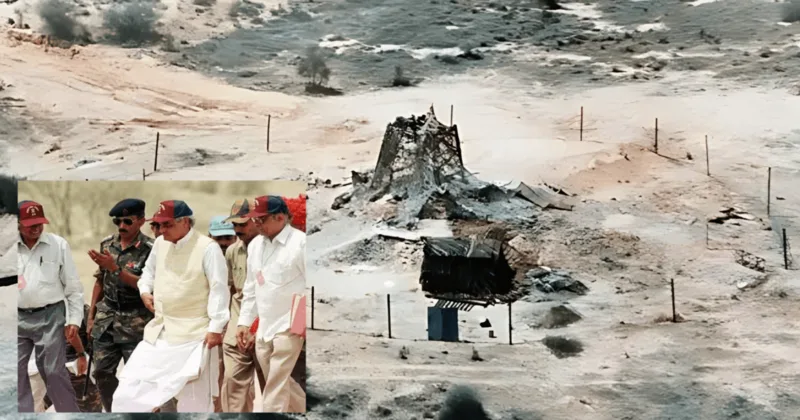
The then PM of India Atal Bihari Vajpayee at the site where Pokhran Nuclear Tests were conducted

The then PM of India Atal Bihari Vajpayee at the site where Pokhran Nuclear Tests were conducted

Facebook
Twitter
WhatsAppTelegramEmail

In May 1998, India quietly altered the global balance of power. Without prior warning, without satellite alerts, and without intelligence leaks, India conducted a series of underground nuclear tests at Pokhran in Rajasthan. Known as Pokhran-II, these tests stunned the world, and exposed one of the most significant intelligence failures in modern history. Even the CIA, widely regarded as the world’s most sophisticated intelligence agency, failed to detect them.

How India Outsmarted the CIA… And Made History in 1998 🇮🇳🔥

> In his book, former CIA Director George Tenet admitted a rare failure.
> The US intelligence completely missed India’s nuclear tests… a mistake he says still haunts him.

📌 How Pokhran-II fooled the world’s best… pic.twitter.com/5aWm8G5mrd

— The Tathya (@_TheTathya) January 6, 2026

Years later, former CIA Director George Tenet admitted this lapse in his memoir, describing it as a mistake that continued to haunt him. For India, however, Pokhran-II was far more than a scientific breakthrough. It was a triumph of planning, secrecy, and national resolve.

A masterclass in strategic deception

The success of Pokhran-II lay not only in nuclear physics but also in operational discipline. Indian scientists and military planners understood that satellite surveillance posed the greatest risk. Every step was therefore designed to appear ordinary, routine, and unremarkable from space.

Work at the test site was carried out exclusively at night or in the early hours before dawn, when spy satellites were least effective. Heavy equipment was moved carefully and then returned to its original position before sunrise. Disturbed sand was reshaped to match natural wind patterns, erasing signs of human activity. Even sand heaps were aligned with prevailing wind directions to avoid drawing attention.

Advanced camouflaging techniques blended the site seamlessly into the desert landscape. From above, Pokhran looked unchanged, deceptively calm. The hydrogen bomb test shaft itself was code-named “White House” (Whisky), a quiet irony that underscored India’s confidence and discretion.

Five tests, zero warnings

On May 11 and 13, 1998, India conducted five underground nuclear tests, including a thermonuclear device. The world only learned of them after Prime Minister Atal Bihari Vajpayee announced the achievement. There had been:

  • No satellite warnings
  • No intelligence alerts
  • No diplomatic leaks

For global intelligence agencies, especially the CIA, it was a complete surprise. Pokhran-II was possible because of political courage at the highest level. Atal Bihari Vajpayee ji demonstrated rare resolve, fully aware that sanctions, pressure, and international criticism would follow. Yet he chose long-term national security over short-term approval. That decision fundamentally transformed India’s strategic position. India declared itself a nuclear weapons state, not through rhetoric, but through capability. The tests established credible deterrence and ensured that India could never again be coerced or threatened with impunity.

A silent victory beyond science

While Pokhran-II is often remembered as a nuclear milestone, it was equally an intelligence victory, a moment when meticulous planning and national unity outwitted the world’s most powerful surveillance systems. It demonstrated that discipline, secrecy, and determination can rival even the most advanced technology. Above all, it reaffirmed India’s sovereignty and strategic independence.

More than two decades later, the legacy of Pokhran-II endures. India stands stronger, more confident, and secure in the knowledge that its leadership once made a choice that forever safeguarded the nation.


Topics: National Technology DayPM Narendra ModiCIA1998 Pokhran tests
Nandini Nair
Nandini Nair
Nandini Nair is a Subeditor-cum-Content Manager at Organiser Digital with more than 3.5 years of experience covering international, national, cultural and current affairs. Also tracks and develops impactful stories emerging from social media discourse, delivering engaging digital reporting [Read more]
Share
Tweet
SendShareSend
✮ Subscribe Organiser YouTube Channel. ✮
✮ Join Organiser's WhatsApp channel for Nationalist views beyond the news. ✮
Previous News

Foundation of my life’s vision was laid in Vidyarthi Parishad & then nurtured & enriched in Sangh: Dattatreya Hosabale

Next News

Andhra Pradesh: PM Modi meets Chandrababu Naidu, Pawan Kalyan amid push for development 

Related News

Uzbekistan President Shavkat Mirziyoyev

India’s Central Asia Outreach: PM Modi arrives in Uzbekistan, receives warm welcome from President Mirziyoyev

Prime Minister Narendra Modi

PM Modi begins four-day Central Asia visit with Uzbekistan trip and SCO summit in Kyrgyzstan

J-K’s Doda Unfurls 100-Ft Tricolour on Independence Day

J&K: 100-Ft Tiranga soars high at Doda stadium on Independence Day

New Delhi, Aug 15 (ANI): Prime Minister Narendra Modi addresses the nation from the ramparts of Red Fort on 80th Independence Day, in New Delhi on Saturday. (ANI Photo/Rahul Singh)

Independence Day 2026: PM Modi announces free online coaching, AI training for 1 crore youth

Vande Mataram Echoes at Red Fort for First Time Since Independence

Historic First on 80th Independence Day: Vande Mataram echoes from Red Fort; PM Modi hails the rendition

Partition Horrors Remembrance Day

Partition Horrors Remembrance Day: Know why it is important to remember those who became victims of mindless violence

Load More

Latest News

A representative image

Maharashtra Anti-Conversion Law: 20 organisations oppose freedom of religion act, seek halt to implementation

Operation Sindoor shows future of India’s warfare; 4th Tri-Services future warfare course concludes

Congress minister Basavaraj Rayareddy

Karnataka Congress Minister Basavaraj Rayareddy’s remark, “Islam is the best religion” sparks row

Representative Image

Pakistan’s Indus Waters gambit falls flat: No international experts at Washington ‘Dialogue’

Hindu Vishwa Bandhu: ‘If Hindus awaken, the world awakens’: Dr Mohan Bhagwat invokes unity in diversity in Canada

Goa: Muslim share rises from 1.95% to 8.33%, Christian count falls; Why opposition rejects anti-conversion Bill?

Jadavpur University

Jadavpur University: From nationalist educational emblem to leftist battleground & Maoist anarchy

BRICS Ahead, CJP Takes to Streets: Why Dipke’s September 5 March Raises National Security Questions

BRICS Summit ahead, CJP plans Delhi march: Is global optics driving the protest strategy before every big moment?

Students at the Gautam Buddha University, Greater Noida

Mann Ki Baat: PM Modi praises GBU’s mission ShakthiSAT, says dreams of daughters are now taking flight to space

Dutch TikTokker Angelo Bryson, known as Superhuman Unchained, at a pro-Palestine protest.

Dutch TikTokker recently converted to Islam livestreams stabbing three in Amsterdam; Watch video

Load More
  • Privacy
  • Terms
  • Cookie Policy
  • Refund and Cancellation
  • Delivery and Shipping

© Bharat Prakashan (Delhi) Limited.
Tech-enabled by Ananthapuri Technologies

  • Home
  • Search Organiser
  • Bharat
    • Assam
    • Bihar
    • Chhattisgarh
    • Jharkhand
    • Maharashtra
    • View All States
  • World
    • Asia
    • Africa
    • North America
    • South America
    • Europe
    • Australia
  • Editorial
  • Operation Sindoor
  • Opinion
  • Analysis
  • Defence
  • Culture
  • Sports
  • Business
  • RSS @ 100
  • Entertainment
  • More ..
    • Sci & Tech
    • Vocal4Local
    • Special Report
    • Education
    • Employment
    • Books
    • Interviews
    • Travel
    • Health
    • Politics
    • Law
    • Economy
    • Obituary
  • Subscribe Magazine
  • Read Ecopy
  • Advertise
  • Circulation
  • Careers
  • About Us
  • Contact Us
  • Policies & Terms
    • Privacy Policy
    • Cookie Policy
    • Refund and Cancellation
    • Terms of Use

© Bharat Prakashan (Delhi) Limited.
Tech-enabled by Ananthapuri Technologies