

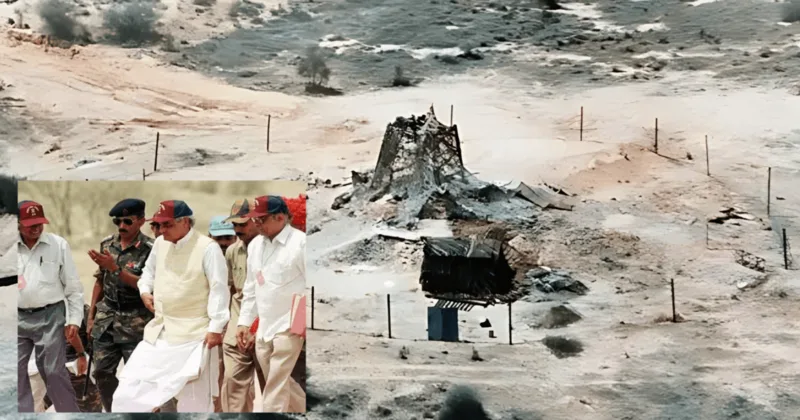
In May 1998, India quietly altered the global balance of power. Without prior warning, without satellite alerts, and without intelligence leaks, India conducted a series of underground nuclear tests at Pokhran in Rajasthan. Known as Pokhran-II, these tests stunned the world, and exposed one of the most significant intelligence failures in modern history. Even the CIA, widely regarded as the world’s most sophisticated intelligence agency, failed to detect them.
How India Outsmarted the CIA… And Made History in 1998 🇮🇳🔥
> In his book, former CIA Director George Tenet admitted a rare failure.
> The US intelligence completely missed India’s nuclear tests… a mistake he says still haunts him.📌 How Pokhran-II fooled the world’s best… pic.twitter.com/5aWm8G5mrd
— The Tathya (@_TheTathya) January 6, 2026
Years later, former CIA Director George Tenet admitted this lapse in his memoir, describing it as a mistake that continued to haunt him. For India, however, Pokhran-II was far more than a scientific breakthrough. It was a triumph of planning, secrecy, and national resolve.
A masterclass in strategic deception
The success of Pokhran-II lay not only in nuclear physics but also in operational discipline. Indian scientists and military planners understood that satellite surveillance posed the greatest risk. Every step was therefore designed to appear ordinary, routine, and unremarkable from space.
Work at the test site was carried out exclusively at night or in the early hours before dawn, when spy satellites were least effective. Heavy equipment was moved carefully and then returned to its original position before sunrise. Disturbed sand was reshaped to match natural wind patterns, erasing signs of human activity. Even sand heaps were aligned with prevailing wind directions to avoid drawing attention.
Advanced camouflaging techniques blended the site seamlessly into the desert landscape. From above, Pokhran looked unchanged, deceptively calm. The hydrogen bomb test shaft itself was code-named “White House” (Whisky), a quiet irony that underscored India’s confidence and discretion.
Five tests, zero warnings
On May 11 and 13, 1998, India conducted five underground nuclear tests, including a thermonuclear device. The world only learned of them after Prime Minister Atal Bihari Vajpayee announced the achievement. There had been:
- No satellite warnings
- No intelligence alerts
- No diplomatic leaks
For global intelligence agencies, especially the CIA, it was a complete surprise. Pokhran-II was possible because of political courage at the highest level. Atal Bihari Vajpayee ji demonstrated rare resolve, fully aware that sanctions, pressure, and international criticism would follow. Yet he chose long-term national security over short-term approval. That decision fundamentally transformed India’s strategic position. India declared itself a nuclear weapons state, not through rhetoric, but through capability. The tests established credible deterrence and ensured that India could never again be coerced or threatened with impunity.
A silent victory beyond science
While Pokhran-II is often remembered as a nuclear milestone, it was equally an intelligence victory, a moment when meticulous planning and national unity outwitted the world’s most powerful surveillance systems. It demonstrated that discipline, secrecy, and determination can rival even the most advanced technology. Above all, it reaffirmed India’s sovereignty and strategic independence.
More than two decades later, the legacy of Pokhran-II endures. India stands stronger, more confident, and secure in the knowledge that its leadership once made a choice that forever safeguarded the nation.