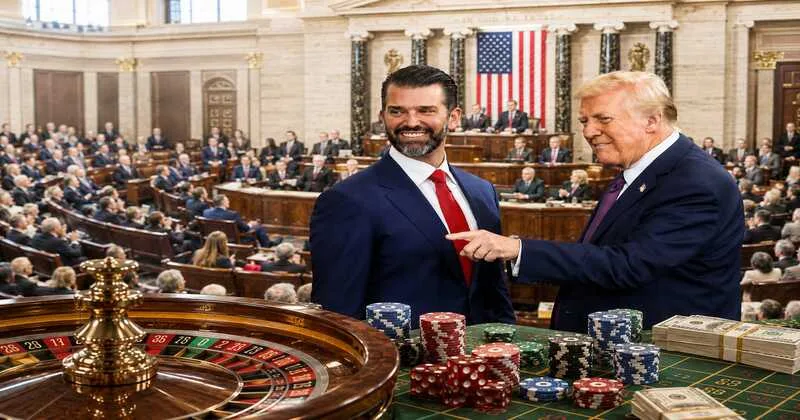
The rapid expansion of political prediction markets in the United States has opened a disturbing new frontier where state power, military operations, and executive decisions are increasingly transformed into speculative financial assets. What began as a niche form of online wagering has now evolved into a multi-million-dollar ecosystem operating in the shadows of American constitutional institutions, raising profound questions about conflicts of interest, insider access, and the collapse of ethical safeguards within the U.S. political system.
In recent months, traders on prediction market platforms such as ‘Polymarket’ and ‘Kalshi’ generated massive profits by betting on highly sensitive geopolitical and political events involving the United States government, including military operations and regime-change developments abroad. The sequence and timing of these trades have intensified scrutiny over insider access, regulatory collapse, and the widening gap between constitutional governance and financialized political influence.
One trader reportedly earned more than $436,000 after placing bets on whether Venezuelan President Nicolas Maduro would lose power before the end of January 2026. The timing of those trades immediately drew attention because most of the bets were placed only hours before President Donald Trump publicly announced a raid in Venezuela that resulted in Maduro and his wife being captured. A second set of trades intensified concerns further. At least six newly created accounts reportedly made nearly $1 million collectively by correctly predicting that the United States would launch military strikes against Iran before the end of February. Several of those trades were placed just hours before the attacks began. One account alone reportedly generated more than half a million dollars by wagering on the death of Iran’s Supreme Leader Ayatollah Ali Khamenei.
These incidents exposed a troubling overlap between financial speculation and state action, where confidential information tied to military or executive decisions appears capable of generating enormous private profit.
Markets built on political catastrophe
Prediction markets operate through “event contracts,” where users buy shares tied to the likelihood of a future event occurring. Contracts are generally priced between one cent and one dollar, with the value fluctuating according to perceived probability. If the predicted event occurs, the contract pays out.
Unlike conventional gambling or sports betting, which largely fall under state-level oversight, these platforms are regulated federally through the Commodity Futures Trading Commission (CFTC). Platforms such as Polymarket and Kalshi frame themselves not as gambling enterprises but as financial forecasting systems.
However, the distinction has become increasingly blurred as contracts now involve wars, assassinations, regime change, deportations, military operations, and executive decisions. In effect, national security events have become tradeable commodities.
The structure of these markets creates a system where privileged information can be monetised almost instantly. Unlike stock markets, where insider trading laws are comparatively developed and aggressively enforced, prediction markets occupy a poorly defined regulatory space. Existing U.S. laws addressing conflicts of interest and financial misconduct among federal officials were not designed to govern speculative event trading tied directly to state action.
The ethical vacuum becomes more severe because the U.S. president and vice president are exempt from key federal conflict-of-interest statutes under 18 U.S.C. §§203-209. Those provisions prohibit most government employees from participating in matters in which they possess direct or indirect financial interests. Yet the highest offices in the executive branch remain outside those restrictions. This legal asymmetry creates a system where ordinary federal employees face tighter ethical limitations than the president and vice president themselves.
Executive power and the collapse of ethical boundaries
The absence of uniform ethics enforcement across the US government has long been a structural weakness within the American constitutional system. Different branches of government maintain separate ethical codes, while enforcement mechanisms often rely heavily on voluntary compliance rather than binding restrictions. Prediction markets have now exposed how fragile that arrangement has become.
The current framework leaves enormous discretion in the hands of political appointees, regulators, and private platforms. Existing laws prohibit certain forms of bribery, compensation from outside interests, and direct conflicts involving federal employees, but they do not clearly address the trading of contracts tied to military action, executive decisions, or foreign policy operations.
The problem is compounded by the way these platforms are regulated. Under the Commodity Exchange Act, prediction market operators possess broad authority to self-certify contracts before they go live. In practice, platforms themselves determine whether contracts comply with federal regulations, often allowing controversial markets to begin trading before regulators complete meaningful review. This effectively outsources oversight from the state to private corporations with direct financial interests in maximising trading volume.
The result is a regulatory architecture where enforcement becomes reactive instead of preventative. By the time authorities examine questionable contracts, millions of dollars may already have changed hands.
The legal uncertainty surrounding these platforms has triggered litigation in at least eight American states, where authorities argue that prediction markets are functioning as unlicensed gambling systems while bypassing state betting laws through federal regulatory loopholes. At the centre of these disputes lies a broader constitutional question that whether federal financial regulators possess authority over contracts that directly intersect with state gambling laws, political processes, and national security concerns.
The rise of extra-constitutional influence networks
The political entanglements surrounding prediction market platforms have intensified concerns about the growing influence of unelected actors operating adjacent to state power. Donald Trump Jr. currently serves on the advisory board of Polymarket while also acting as a strategic adviser to Kalshi, two companies deeply involved in ongoing legal and regulatory battles. His simultaneous association with major prediction market firms and proximity to the White House creates extraordinary ethical complications. As the son of the sitting president, Trump Jr. occupies a position uniquely close to political strategy, executive decision-making, and potentially sensitive nonpublic information. Yet current federal statutes and regulatory frameworks do not explicitly prohibit such relationships.
The situation illustrates how influence networks surrounding political families increasingly operate in spaces beyond formal constitutional accountability. Private advisers, corporate actors, financial platforms, and politically connected intermediaries now occupy positions where state decisions can carry direct market consequences.
Prediction markets amplify this convergence by transforming geopolitical crises into speculative assets traded for profit. The deeper constitutional concern is not merely the possibility of insider trading. It is the gradual erosion of distinctions between public office, private wealth generation, and state authority. When military operations, regime-change actions, and foreign policy decisions become instruments for speculative gain, democratic governance itself risks being subordinated to financial incentives.
The institutional weakness lies in the inability of existing American legal frameworks to respond to rapidly evolving financial technologies intertwined with political power.
A constitutional vacuum in the digital age
The CFTC recently announced that it is seeking public comments before introducing future regulations governing event contracts. Yet the current regulatory landscape remains fragmented and uncertain.
No comprehensive federal framework clearly governs how political insiders, executive relatives, advisers, or connected financial actors may participate in prediction markets linked to state actions. Existing ethics laws were drafted for an earlier era, before digital financial platforms enabled anonymous, high-speed speculation on military strikes, assassinations, or geopolitical crises. The expansion of these markets reveals a deeper transformation inside the American political order that institutions once presented as pillars of constitutional restraint are increasingly vulnerable to commercialisation and financial exploitation. The issue extends beyond individual trades or isolated profits. Prediction markets expose how executive power, military secrecy, and political influence can now intersect with speculative finance in ways that existing democratic safeguards appear unable to control.